
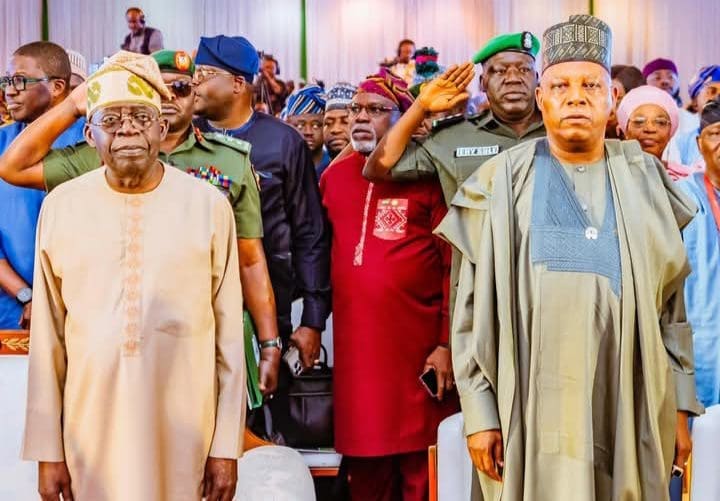
Imagine 288 million Americans losing faith in the White House—that is how much public trust has collapsed in Nigeria. A recent Africa Polling Institute (API) survey shows 83 percent of Nigerians no longer believe in President Bola Tinubu’s leadership.
Elected in 2023 on a “Renewed Hope” promise to fix the economy and tackle insecurity, more than half of the Nigerian population say life has only gotten harder since he took office.
“The only thing renewed is our suffering,” said Muhammed Abdulhamid, a security officer at a public college in Kaduna State. “The little hope we had before this government came has disappeared. Now, we have hunger.”
Nigeria’s Terror Belt
Beyond economic pain, there is something more terrifying: fear for life. To Americans used to hearing the phrase “terror zones” on the news, Nigeria today is that reality.
The country is battling multiple insurgent groups. Boko Haram and the Islamic State in West Africa Province (ISWAP) terrorize the Northeast. In the Northwest, militant groups with Al-Qaeda ties continue their reign of terror. In the Middle Belt, Fulani militias from Chad, Mali, and Cameroon attack Christian communities unchecked.
In April, Fulani militia killed at least 40 people in an attack on a Christian farming community in Plateau State, North-central Nigeria. Families were locked in their homes and burned alive. Samuel Jugo, spokesperson of the Irigwe Development Association, an ethnic organization, said the assault was “very provocative, vexing and undeserving.”
Weeks later in Benue, another Northcentral state 143 miles (straight line) from Plateau, more than 200 were killed, with entire villages razed and thousands displaced. Locals told TruthNigeria that soldiers and the police stood by, outnumbered and outgunned to fight the heavily armed militia. In Imo State, Southeastern Nigeria, gunmen killed at least 30 travelers and torched more than 20 vehicles in a single attack.
Nigeria’s weak borders with Niger and Cameroon have turned it into a safe haven for foreign fighters. Armed groups cross in and out with ease, linking up with local militias and fueling the violence already plaguing the Northeast, Northwest, and Middle Belt.
Government’s Response Falls Flat
President Tinubu plans to recruit 130,000 forest guards to support the military’s 230,000 troops—the largest in sub-Saharan Africa—in counterinsurgency operations.
According to the Presidency, the forest guards will “flush out terrorists and criminal gangs hiding inside the forests for criminal activities.” Local reports say each state will recruit between 2,000 and 5,000 guards.
But security experts told TruthNigeria the move falls short.
“If you must defeat all the insurgents across the country, Nigeria needs more than a million soldiers. They will be used to hold territories recaptured from the enemies after using overwhelming force,” Friday Agbo, head of Alterconsult, a northern think-tank, said.
Analysts also warn that equipping thousands of local guards – especially if they are better armed than state forces – could lead to more violence. It could also force communities to negotiate ceasefires and semi-permanent peace deals in the absence of effective federal- and state control.
Economic Collapse
When Tinubu took office on May 29, 2023, his first move was to scrap Nigeria’s long-standing gas subsidy without a proper mitigation plan. He claimed it would “free up budgetary resources for critical investments in infrastructure and social services.”
Instead, it triggered runaway inflation. The naira now trades at ₦1,500 to $1, up from ₦1,000 when Tinubu took over. Inflation is nearing 30 percent. Food, housing, transport, and healthcare costs have skyrocketed. Major companies are shutting down or leaving the country.
Today, over 106 million Nigerians live in extreme poverty, surviving on less than $2.15 a day. In rural areas, poverty has passed 75 percent. Despite its oil wealth, the average Nigerian remains trapped in poverty. According to World Bank data, Nigeria’s GDP per capita is just $807 – slightly above Niger’s $723, far below Cameroon’s $1,762, and nowhere near Ghana’s $2,406.
In July 2024, Tinubu raised the national minimum monthly wage from ₦30,000 ($19.60) to ₦70,000 ($45.80). A big achievement for the leaders, but unfair and disheartening economically to the citizens.
“The inflation level has made nonsense of the new wage. I have a family of four and my salary is four times less than my monthly expenses. It’s like pouring water into a leaking bucket,” Abdulhamid said.
Since the All-Progressive Congress (APC) came to power in 2015, the economy has declined sharply. But under Tinubu, the hardship has deepened. Over the years, Nigerians have simply learned to endure the repressive economic hardship and austerity inflicted upon them.
For many Nigerians, therefore, the promise of “Renewed Hope” has turned into renewed despair. Insecurity rages on. Hunger bites harder. Yet, Nigerians remain resilient—dodging bullets to stay alive and stretching every naira just to make ends meet.
Ezinwanne Onwuka writes human interest and feature stories for TruthNigeria from Abuja.