
Investigators Probe Possibility of Multiple Mass-Hostage Camps in Many States
By Segun Onibiyo
Kaiama county, Kwara state, Nigeria – In the forests straddling Kwara and Kogi, where Fulani Ethnic Militia terrorists have waged a relentless campaign of killings and abductions, the Nigerian Army scored a rare victory, a joint assault that crushed a militia base and freed 21 captives, some held for over four months.
On October 17, 2025, troops of the Nigerian Army stormed three terrorist camps hidden deep in the Kaiama forests. According to military insiders, these camps, controlled by the Fulani Lakurawa faction, were notorious strongholds where dozens of victims had been kept in inhuman conditions. The kidnappers, described as hostile, aggressive, and alien in behavior, operated with the same ruthless pattern as the mass kidnapping syndicates entrenched in Rijana forest in Kaduna State, which for years has served as a hub for abductions along the Abuja–Kaduna highway.
TruthNigeria reporters are compiling evidence of Rijana-style, mass hostage-holding camps in Kwara, Benue and Nasarawa States.
Describing the camp, a kidnapped victim Aboderin Isaac told TruthNigeria, “the camp itself was a grim scene. There were rows of makeshift shacks covered with torn tarpaulin, fenced with thorny branches, and dotted with pits used as holding cells. We were chained in twos, some forced to sleep on bare earth, some others inside crude wooden cages.”
“Charred cooking pots, empty cartridges, and rotting food littered the ground – were evidence of a group hardened by years of violent survival,” said a soldier who was part of the rescue operation to TruthNigeria.
“It was like stepping into another world. They had built a shadow society of cruelty in the forest,” he added.
A community guard who breached the camp described the kidnappers as unusually erratic under pressure.
“They shouted orders in Fulani (Fulfulde) and screamed curses as they scrambled to escape,” said the community guard who led one of the blocking units.
“They left their weapons (AK-47s) half-buried in the sand, their cooking fires still burning. It was panic. These Fulani Ethnic Militia terrorists (suspected to be Lakurawa) are always aggressive when attacking villages, but when cornered, they become desperate and reckless,” said another soldier to TruthNigeria.
“Their hostility is not just violence, it is alien, like they are detached from the communities they terrorize,” he went on to say.
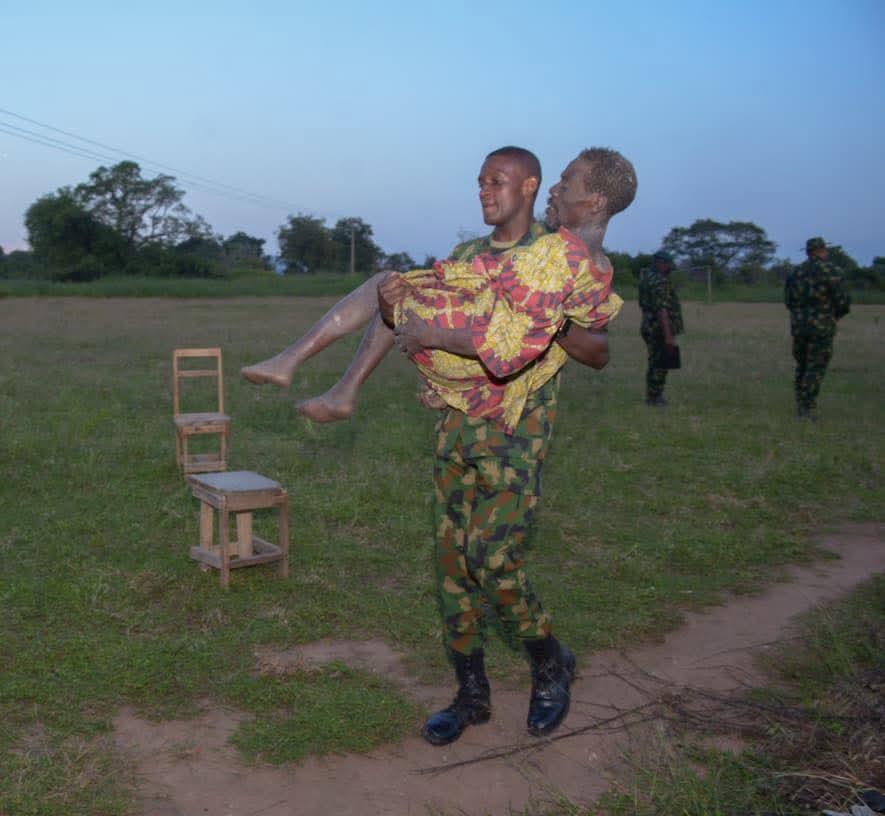
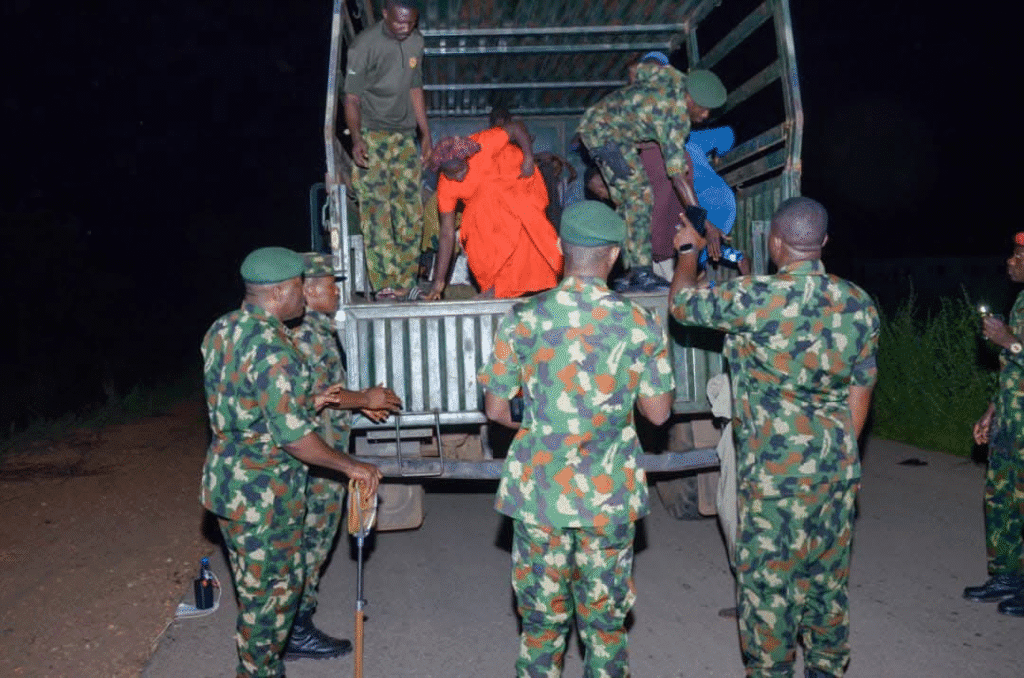
The captives freed in Kwara state included 14 males, 5 females, an infant, and four Chinese nationals. They had been snatched from farms, highways, and construction sites, with some trapped in captivity for more than four months.
The coordinated push involved soldiers from 12 Brigade Lokoja, Kogi state, and 22 Armoured Brigade Ilorin, Kwara state, supported by air assets.
Also, among the rescued was Pastor Obafemi of the Christ Apostolic Church (CAC), Okoloke, Yagba West County, Kogi State, his wife, and grandchild.
“Facing encirclement, the kidnappers fled, abandoning their captives in the process. The victims were evacuated to a military medical facility, where doctors treated injuries from beatings, malnutrition, and exhaustion,” according to a military source.
Military insiders say the mission succeeded because of layered tactics. Troops sealed escape routes with blocking forces, while air surveillance tracked movements from above. At dawn on Friday, soldiers advanced silently before blasting warnings over loudspeakers. Surrounded, the Lakurawa fighters fled rather than risk a firefight.
“You don’t always need bullets,” said Col. (retired James Okoro, a military strategist based in Abuja, to TruthNigeria.
“Sometimes you need to squeeze until the enemy suffocates. That’s what happened here.”
The raid is the Army’s latest response to months of terror inflicted by Fulani Ethnic Militia terrorists across Kwara and Kogi states, North-Central Nigeria. Residents say these attacks have destroyed farms, emptied villages, and worsened food insecurity in the region.
In September, Fulani militias stormed Egbe, a border town in Kogi, slashing a farmer in a brutal night raid.
TruthNigeria captured these attacks.
That same month, six villagers were killed when armed Fulani militias descended on Kogi border communities, torching homes and forcing survivors to flee into the bush.
In August, a swarming attack by Fulani militias in Kwara State forced entire communities to flee en masse. Eyewitnesses described the invasion as a “wave of fire and bullets” that left dozens displaced.
Security experts argue that the Army’s success in rescuing the 21 victims is significant, but not a final victory.
“This is a win, no doubt,” said Dr. Musa Ibrahim, a criminologist at the University of Ilorin. “But the militias will regroup. What’s needed is a sustained campaign, not just a dramatic rescue.”
Another analyst, Lagos-based security consultant Aisha Lawal, emphasized the importance of collaboration.
“The Army didn’t do this alone,” she said. “Air support, intelligence, and coordination with community guards were key. If that synergy collapses, the terrorists will find breathing space again.”
Major General C.R. Nnebeife, General Officer Commanding 2 Division, said there will be no let-up.
“There will be no hiding place for bandits,” he told national media. “We are committed to sustaining this onslaught until peace is restored.”
He praised the Nigerian Air Force for air cover and other security agencies for their synergy. He also directed his brigades to maintain the tempo.
For survivors, the nightmare is not over yet. Many remain traumatized. A mother freed with her infant whispered, “We thought we would die in the forest. Today, we see light again.”
But villagers warn that one victory does not erase years of terror. In many parts of Kwara and Kogi, survivors recall past raids where security forces responded late or not at all.
“We thank the Army for rescuing these people,” said Samuel Adeyemi, a community leader in Kaiama, Kwara State. “But we have seen operations before that ended quickly, and then the terrorists returned stronger. If this effort is not sustained, we will be back to square one.”
For now, the Army’s daring strike offers a glimmer of hope in a region haunted by fear. Yet, in Kwara and Kogi, where Fulani Ethnic Militia terrorists, particularly the Lakurawa have left scars on families and fields alike, hope is fragile.
“We are grateful for this rescue,” said Reverend Joseph Adebayo, a cleric in Kogi State. “But peace must not be temporary. Our people need to know they can farm, worship, and sleep without fear. Our leaders are denying the truth about Christian genocide, but we feel and know the truth. We pray the world, particularly the Trump administration, will come to our rescue.’
Onibiyo Segun reports on terrorism and conflicts for TruthNigeria.