

By Mike Odeh James
(Wukari, Taraba State ) Routine denials from top Nigerian officials of a Christian genocide hasn’t stopped a young Catholic priest and missionary Judd Saul from delivering bags of rice to famished displaced citizens in Taraba State.
Since U.S. President Donald Trump started to pressure the government of Nigeria on Oct, 31 waves of violence continue to tear through the rural heartlands of Benue and Taraba States. But one Catholic priest is racing between shattered villages and scattered survivors, determined to keep the flame of hope alive amid devastating loss and paralyzing fear. He has been backed up by film maker and missionary Judd Saul, founder of Equipping the Persecuted.
The Nigerian government confirmed that the nation has more than 6.7 million displaced persons, according to The Sun Nigeria. Yet, the number increases steadily every month in the shell-shocked Middle Belt States. A preview of the forthcoming 6-year review of lives lost by The Observatory for Religious Freedom in Africa (ORFA) shows that most of the 7,000 annual victims of the nation’s internal conflict lose their live are Christians, leading many observers to cite a genocide against Christians.
Driving his sturdy Toyota through dense trees and tall grasses, Reverend Father Titus Shimaniyan of St. Paul’s Catholic Church navigates deep, bone-rattling potholes as he speeds toward the volatile Benue–Taraba border. His parish — the main one serving the Aye-Twar/Agu Centre community in Katsina-Ala County in Benue State has been brought to its knees.
“I want you to see for yourself how the Church is holding on against the onslaught of armed Fulani militia in Benue and Taraba,” he told this TruthNigeria correspondent during the tense journey.
Attack on St. Paul’s
Aye-Twar was overrun by a Fulani ethnic militia during a brutal three-day night assault from August 11–13, 2025. Homes were burned, residents fled blindly into the darkness, and the community’s spiritual anchor — St. Paul’s Catholic Church — was vandalized and desecrated. The rectory was ransacked.
The entire community was displaced. Some survivors fled toward Chanchengi, Peva and Amadu in Taraba State, while others ran to Tor-Donga, Zaki-Biam, and Katsina-Ala in Benue.
Fr. Shimaniyan counts the cost with quiet anguish. “I have over 3,000 persons from my parish and its outstations who are now Internally Displaced Persons in Taraba and other parts of Benue,” he told TruthNigeria. “My mission is simple: I must attend to them all, no matter where they are staying.”
The drive from Katsina-Ala through the brooding forest into Wukari felt endless — a punishing two-hour trip on a narrow road notorious for ambushes. Each time the priest swerved around a pothole or slowed before a blind bend, his usually calm face tightened.
The tension peaked at a military checkpoint. He braked sharply as a young soldier stepped forward.
“Your identity card, please. And why are you going to Wukari?” the officer demanded.
Fr. Shimaniyan lifted his worn ID. “I am a Catholic priest. I am going to Wukari to tend to my flock — my people who were scattered by the attacks.”
The soldier’s stern expression briefly softened, and he waved them through.
A Mass in Exile, Under the Open Sky
By the time the priest reached Amadu village in Wukari, word of his arrival had spread. He hurriedly sent messages across scattered pockets of survivors — families hiding in borrowed rooms, school compounds, church halls, and abandoned buildings.
“Come. Gather. We will celebrate Mass. Help has come.”
On Saturday morning, displaced Christians arrived in waves. What began as a trickle grew into hundreds, then more than 1,000 to 1,500 people — men, women, widows, orphans, the elderly, and infants tied to their mothers’ backs. Many had fled barefoot as flames swallowed Aye-Twar.
Some wore the only clothes they owned, washed and rewashed in streams. Others had not eaten a proper meal in days.
Yet they came — not to their desecrated church back in Benue, but to an improvised altar under the vast Wukari sky. Their voices, thick with sorrow and stubborn faith, rose in quiet song.
Fr. Shimaniyan stood before them, his vestments fluttering in the Harmattan breeze that brings dust and microbes every November.
“Do not despair,” he pleaded in an emotional homily. “God has not abandoned you. If you suffer, you suffer as Christians. There is honor in that. And I assure you — God is in control.”
A raw cry broke through the crowd. Some sang hymns, others wept silently. Many fell to their knees.
A Lifeline from Across the Atlantic

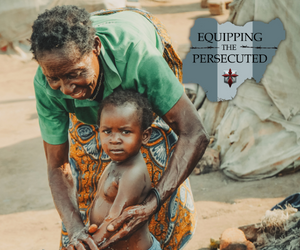
Then, a rare moment of relief arrived. Equipping The Persecuted (ETP) — the American missionary organization founded by Iowa filmmaker Judd Saul — had delivered vital aid to this forgotten forest belt.
The assistance included:
· 20 large bags of rice
· Cash assistance for urgent medical care
· Essential relief supplies donated by compassionate supporters abroad
When the rice bags were opened, children surged forward before being gently held back. Mothers sobbed in relief — many had fed their children only soaked garri (a grain soup) for three days.
Mary Terson, 31, carrying an infant with sunken eyes, whispered:
“If Father had not come today… I don’t know if this child would survive another night.”
For hours, the priest moved among the crowd — blessing, praying, comforting, and lifting the spirits of survivors who had lost everything.
While thanking ETP, Fr. Shimaniyan told TruthNigeria: “We thank you Judd Saul, founder of Equipping the Persecuted, for sending these materials to us.
Pray that God blesses you. We thank the American people for remembering us.
Tell Judd and American Christians that we are grateful, but we need more aid — blankets, mosquito nets, and malaria drugs.”
Chanchengi Mass and Relief in Southern Taraba
The next day, he drove with TruthNigeria to Chanchengi, another settlement hosting thousands of displaced persons from Benue. There, he celebrated another Mass and offered encouragement.
“God has not forgotten you,” he assured them. “You will return to your ancestral homes. We know that Christian leaders across the world are putting pressure on the Nigerian government. Your return will come.”
In this battered corner of Nigeria, where violence has shattered countless lives, the image of a lone priest and a shipment of aid from across the Atlantic stands as a reminder that even in the darkest hour, faith and solidarity can bring light.
Mike Odeh James is a conflict reporter, and he writes for TruthNigeria.