
Labor unions and churches take to the streets as killings contradict Abuja’s disclaimers.
By M. Kiara
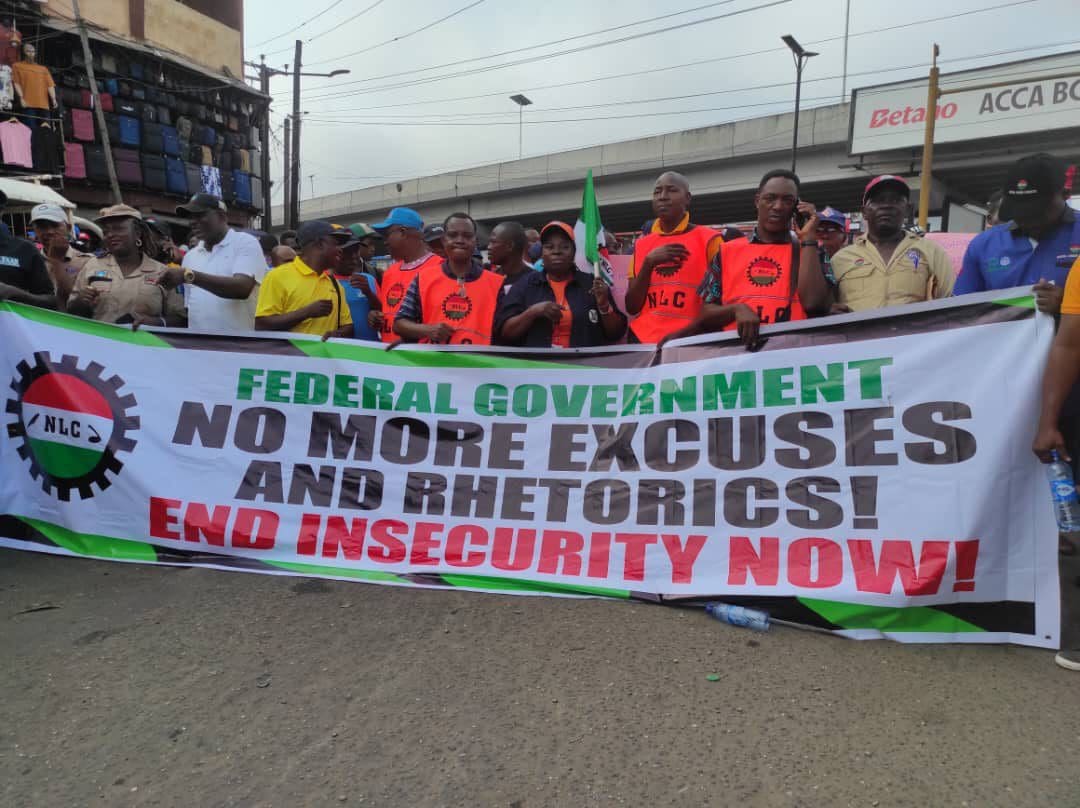
For the second time in two weeks, Nigerians poured into the streets nationwide; protesting relentless terror attacks that continue even as the government denies targeted violence and insists security is improving.
The demonstrations, led by the Nigeria Labor Congress (NLC), unfolded across Abuja, Lagos, Borno, Port Harcourt, Minna, and other major cities, reflecting nationwide anger over mass killings, kidnappings, and the steady erosion of public safety in Africa’s most populous country.
This was not a protest over fuel prices or wages. It was a public rejection of official assurances.
A Rare National Outcry
Labor unions in Nigeria seldom organize mass protests over security. Churches rarely do. That both have now spoken out, within days of each other, underscores how deeply violence has penetrated daily life.
In Abuja, the capital, protesters gathered under heavy police presence, demanding an end to kidnappings that have forced teachers, students, and entire communities to flee their homes.
In Lagos, Nigeria’s commercial hub, demonstrators marched toward the state government complex, warning that insecurity is crippling livelihoods and driving citizens into displacement camps.
“What we are saying is that the damage is enormous, and it has to stop,” said Ismaila Bello, deputy general secretary of the NLC. “Children should return to school. People should live in their communities. This is what the constitution guarantees.”
Schools, Churches, and Farms under Siege
Across northern and central Nigeria, repeated attacks have forced schools to shut down after mass abductions of students, while farming communities, many of them Christian have been abandoned following deadly raids.
In Borno State, near Nigeria’s northeastern border with Chad, journalists and residents told TruthNigeria that fear now defines daily life.
“Farmers cannot go to their farms, and education is under assault,” said Abdulkarim Haruna, chairman of the Nigeria Union of Journalists in Borno. “Children are being abducted for ransom. This is not normal life.”
One protester, Magdalene Eneche, described a population living on constant alert.
“Nobody sleeps with both eyes closed anymore,” she said. “No matter who you are, everyone is afraid.”
The Numbers the Government Cannot Explain Away
According to the Nigeria Labour Congress, the human toll is staggering.
Since 2009, more than 2,295 teachers have been killed by insurgents and bandits. Over 19,000 teachers have been displaced across Borno, Yobe, and Adamawa states. At least 910 schools have been destroyed, forcing roughly 1,500 learning centers to shut down or be converted into displacement camps.
In the health sector, the NLC says 35 percent of facilities in Nigeria’s northeast have been destroyed by terrorism, while half are no longer accessible.
These figures stand in sharp contrast to repeated government claims that security is stabilizing.
Churches Break their Silence
The protests followed a rare and striking demonstration inside one of Nigeria’s largest megachurches.
Earlier this month, worshippers at Family Worship Centre in Abuja arrived dressed in black to mourn Christians killed in recent attacks across Nigeria’s Middle Belt, a region roughly 150 miles east of the capital where Christian farming villages have been repeatedly targeted.
Lead pastor Sarah Omakwu delivered a direct rebuke of Nigerian authorities.
“We condemn in the strongest terms the terrorism and kidnappings that have become daily life in this country,” she said. “What kind of leadership negotiates with bandits? God forbid such leadership.”
Her remarks captured the central dispute now dividing Nigeria’s public narrative: whether the violence is random criminality, as officials insist, or a sustained pattern of attacks that disproportionately devastate Christian communities.
Denial meets Accountability Demands
President Bola Tinubu’s administration has repeatedly rejected claims of religious targeting, framing Nigeria’s crisis as generalized insecurity.
Yet survivor testimonies, independent monitors and international observers continue to document attacks on churches, Christian villages, and clergy, often with little accountability.
Human rights lawyer Femi Falana, addressing protesters in Lagos, pointed to the government’s failure to prosecute known terror financiers.
“We are demanding the immediate prosecution of more than 400 terrorism financiers arrested in 2021,” Falana said. “Failure to punish perpetrators is what emboldens this crisis.”
Why the World is Watching
The protest comes as international scrutiny of Nigeria quietly intensifies.
U.S. lawmakers have held hearings on religious freedom abuses. Congressional delegations have conducted fact-finding visits. Washington has cited terrorism and weak security vetting in recent policy actions affecting Nigeria’s global standing.
Yet much of Nigeria’s political and media establishment continues to frame the crisis as exaggerated or misunderstood, a posture that increasingly distances Abuja from its allies.
For Western governments, the concern is no longer abstract. Mass displacement, unchecked extremist violence, and state denial in Africa’s most populous nation carry consequences far beyond Nigeria’s borders.
A Crisis That Will Not Stay Contained
The convergence of labor unions, churches, journalists, and ordinary citizens marks a critical moment.
These are not opposition rallies. They are distress signals.
As one banner carried by protesters put it plainly: “Nigeria is bleeding.”
M. Kiara reports on conflict for TruthNigeria.