

Denial of Religious Dimension of Crime Evades Triggering International Scrutiny
Official dismissals, echoed by mainstream media, buy time for kidnappers while Christians absorb the losses
By Mary Kiara
(Lagos) – Nigeria’s terror economy is not sustained by firepower or numbers but by a culture of Official Denial, experts tell TruthNigeria.
Security specialists, media analysts, and religious freedom researchers argue that routine repudiation of demonstrable facts — echoed by Nigeria’s mainstream press – has enabled daily kidnappings, mass killings, and ransom extractions.
“This is not a failure of information,” said Seun Ambrose, a global affairs analyst. “It is the strategic use of uncertainty. Denial, then delay, reaction followed by delay is what makes this system profitable.”
Who Absorbs the Losses?
Faith-based monitoring groups say Christian communities absorb a disproportionate share of that cost.
Nigeria accounted for 3,490 of the 4,849 Christians killed worldwide for their faith in 2025; roughly 72 percent of the global total. No other country recorded comparable figures.
Henrietta Blyth, chief executive of Open Doors UK, said the figures are often misunderstood or deliberately reframed.
“When governments describe this as generic criminality, they erase what victims themselves report,” Blyth said. “Survivors consistently report attackers telling them, ‘We will destroy all Christians.’”
But denial has secondary effects, she added.
“When the religious dimension is denied, international mechanisms that depend on classification and thresholds are never triggered,” she said.
Media as a Force Multiplier
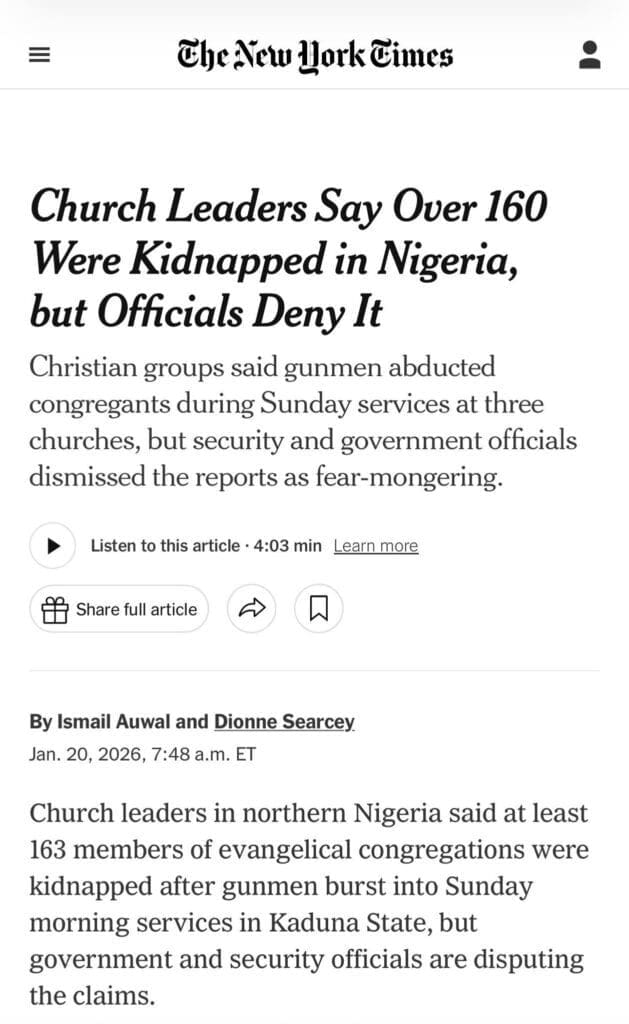
Several media researchers told TruthNigeria that denial gains power when it is amplified before verification.
“In Nigeria, official statements are frequently treated as conclusions rather than claims,” said a Lagos-based journalist who requested anonymity. “Once denial is published, it becomes the frame. Everything else is treated as rumor.”
That pattern was visible when early official denials of a mass church kidnapping in southern Kaduna dominated headlines, even as eyewitnesses searched for missing relatives.
“The story was framed as ‘nothing happened,’” the journalist said. “By the time facts caught up, the urgency was gone.” Even the New York Times got caught up in it.
Denial as Economic Infrastructure
Data collected by SBM Intelligence shows that between July 2024 and June 2025, armed groups in Nigeria secured at least $1.8 million in confirmed ransom payments, while demanding more than $33 million from families, churches, and local communities.
But analysts caution that the figures only tell part of the story.
“Ransom is just the visible revenue stream,” Segun Sunday, a security analyst told TruthNigeria. “The real currency is time, the hours and days gained when authorities deny attacks and media outlets repeat those denials. That window allows captors to relocate, negotiate, and erase trails.”
SBM Intelligence has described Nigeria’s kidnapping landscape as a “repeatable business model”, marked by predictable targeting, standardized negotiations, and minimal risk of arrest.
Why Ambiguity is Effective
Experts say ambiguity functions as a shield, not only domestically, but internationally.
“When foreign partners are unsure whether violence is systemic or exaggerated, they default to caution. That hesitation is the oxygen this system needs,” Ambrose told TruthNigeria.
Several analysts compared the dynamic to historical cases of narrative suppression.
Ambrose said the parallel is not academic.
“When a government spends millions on international lobbying while dismissing local testimony, the objective is not persuasion,” he said. “It is confusion. Confusion postpones action.”
Public disclosures show Nigeria entered a $9 million lobbying agreement in Washington to counter what officials call “misrepresentation” of its security situation.
“You don’t pay that much to change facts,” Ambrose said. “You pay to slow consequences.”
Pressure Abroad, Promises at Home
International concern has sharpened in recent months, particularly after U.S. airstrikes targeted jihadist positions in northwest Nigeria, and President Donald Trump warned of further action if attacks against Christians continued.
Yet analysts say pressure abroad has not translated into structural change at home.
“Deterrence requires arrests, prosecutions, and visible disruption of networks,” said Polycarp Enedu, a Nigerian security analyst. “What we see instead are statements, redeployments, and silence after massacres.”
Residents in affected areas describe a cycle of appeals and abandonment.
“People are selling land, paying ransoms, and burying loved ones,” terror attack survivor Joan Emmanuel told TruthNigeria. “This has gone on for too long.”
The System Endures
For analysts who study conflict economies, the conclusion is blunt.
“Nigeria’s terror economy is not sustained by ignorance,” Ambrose said. “It is sustained by managed doubt by the repeated postponement of truth until it no longer demands action.”
Until that changes, he added, “violence will remain profitable, denial will remain useful, and civilians will continue to pay the price.”
Mary Kiara reports on Terrorism for TruthNigeria.