
But What Spokesmen Refuse to Reveal Raises Questions
By Onibiyo Segun
(Kogi) Nigerian forces have killed notorious bandit kingpin Kachalla Kabiru in coordinated air and ground strikes across forest hideouts in Kogi State, according to Blueprint.ng, citing unnamed “reliable sources.”
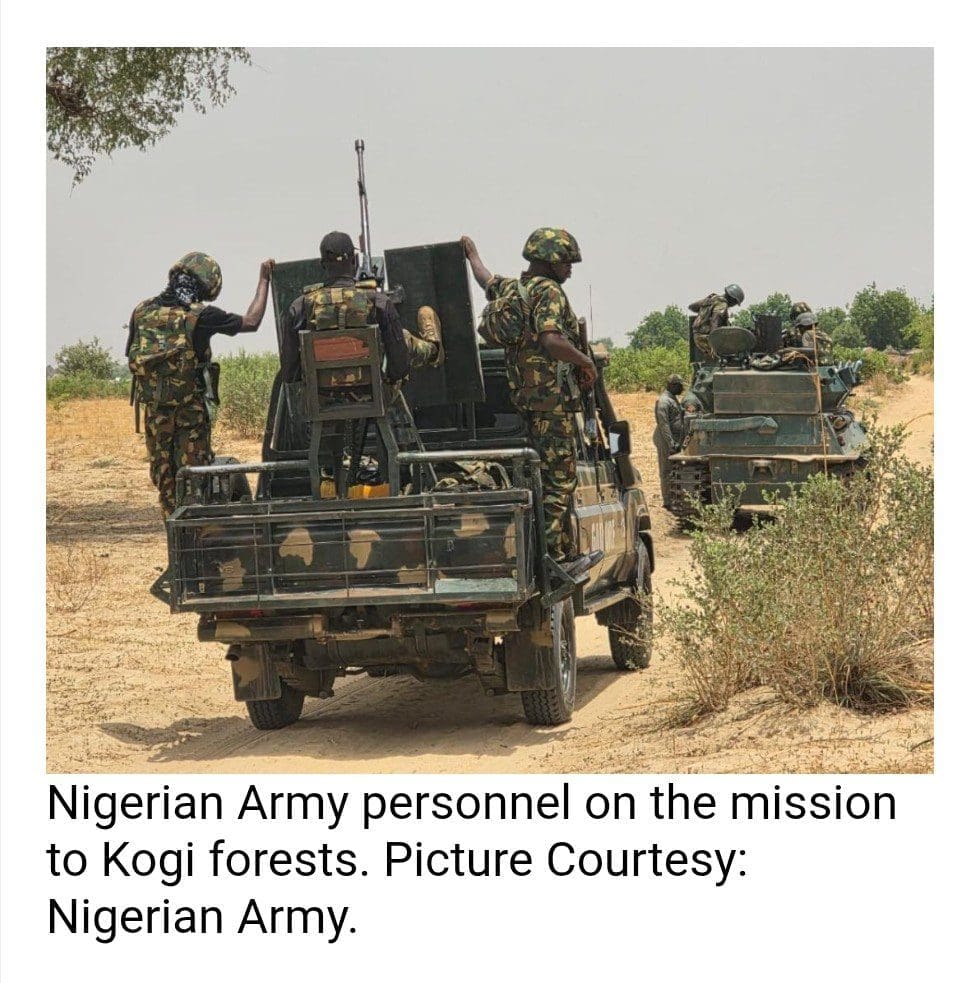
The operation on February 13, 2026, combined fighter jet bombardment, surveillance drone tracking, and ground assaults led by operatives of the Office of the National Security Adviser (ONSA), working with the Department of State Services (DSS), Nigerian Army units from 2 Division and 12 Brigade, the Nigerian Air Force, Navy, Police, and local vigilance groups, according to
Major General Edward Buba, Director of Defence Media Operations to the media in Abuja.
“The operation followed weeks of intelligence surveillance and successfully neutralized a high-value target while dismantling terrorist infrastructure,” Buba told media.
Security sources used aerial reconnaissance to confirm Kabiru’s presence at a forest enclave spanning the Lokoja–Yagba–Ijumu corridor before jets struck fortified shelters and troops advanced under rifle and machine-gun cover, according to Punch.
Officials said three entrenched camps were destroyed. Several senior lieutenants were killed. The officials claimed that an unspecified number of kidnapped civilians were rescued, but did not reveal any names, explaining that the victims would be treated at a hospital and then transferred to IDP camps.
The action essentially makes verification of government claims of rescue unverifiable during a period in which partially hidden kidnap camps in Kaduna and Benue State have become sensational stories.
Analysts are studying the kidnapping for ransom industry in Kogi through the lens of the sprawling hostage crisis in Kaduna State, where hundreds are believed to be held currently in southern Kaduna’s Rijana forest, according to investigative reporting by TruthNigeria.
A Kidnapping Kingpin Who Moved Hostages
“Kachalla Kabiru was among the earliest commanders to entrench armed kidnapping cells inside Kogi’s forest belt,” Retired Brigadier General Bayo Omotosho in Abuja told TruthNigeria.
“Kabiru allegedly coordinated logistics, shifting fighters, ammunition, and abducted victims between camps to avoid rescue attempts,” Bayo added.
National media report says his network operated across Kogi, Kwara, Benue in the North-Central, Enugu in the Southeast, Edo in the South-South as well as in Ekiti and Ondo in the Southwest of Nigeria.
Exploiting bush paths and rural highways to move captives and weapons, according to intelligence briefings from security officials.
What Spokesmen Have Not Revealed
Officials have not released biometric proof, photographs, or forensic confirmation of Kabiru’s death. Nor have they published a detailed inventory of rifles, rocket-propelled grenades, or communication devices recovered at the sites.
Experts have raised questions in chats with TruthNigeria.
“You must show what was destroyed and what was seized,” Colonel Julian Eze (Rtd), counterterrorism expert and former infantry commander, told TruthNigeria.
Authorities have yet to disclose a total of fighter deaths or names of arrested collaborators.
Security trackers say the terrain connects northward toward Niger and Kaduna forests and southward into Edo and Ondo, forming corridors used by kidnapping gangs to move captives.
Authorities have not publicly stated the religious identities of victims rescued in the Kogi strike. In previous North-Central kidnapping cases, victims have included Christians and Muslims targeted primarily for ransom.
Survivor’s Account
“They tied our hands and marched us at night. When we heard the jets, the guards began to run”, a rescued trader Elizabeth Achi, abducted along the Kabba-Lokoja road, Kogi State, told TruthNigeria.
“That was when soldiers reached us,” Achi added.
Medical teams treated freed captives for dehydration, gunshot wounds, and trauma before stabilization and transfer, according to state emergency officials, Lokoja.
Terrorist Den Raid – Why Now?
TruthNigeria reported that markets, schools, places of worship and motor parks across seven counties (local government areas) in Kogi West were closed days before the strike to cut food and fuel supplies to forest camps.
“When agencies confirm a target’s location and patterns, they strike fast. But removing a commander does not automatically dismantle his financiers or recruiters,” said Colonel Julian Eze (Rtd), counterterrorism expert and former infantry commander, Lagos.
According to the SBM Intelligence report Economics of Nigeria’s Kidnap Industry, at least 4,722 people were abducted nationwide between July 2024 and June 2025; Kogi State was among the affected states, with 158 victims reported during that period.
“Kogi recorded repeated highway kidnappings along the Okene–Lokoja–Kabba axis through 2024 and 2025,” according to Dr. Ahmed Luggar, a public analyst, monitoring North Central violence.
“There is no publicly released evidence the strike was timed to blunt legislative oversight,” Luggar added.
“However, visible battlefield results often follow heightened public alarm over ransom demands,” Luggar said.
“Past campaigns in Kogi and surrounding states have seen armed cells disperse and later regroup in new forest pockets,” Mrs. Omoniyi Margaret, a regional security researcher based in Ondo said.
IDP Transfer Debate
“Rescued victims may briefly pass through internally displaced persons facilities for medical screening before reunification with families,” according to Funsho Fanwola, Kogi State government spokesman, Lokoja.
“Survivors need treatment and family reconnection. Extended camp stays can deepen trauma,” said Prof. Halima Mohammed, rehabilitation and reintegration specialist based in Obubra, Cross River state.
“Some IDP facilities in parts of northern Nigeria have previously faced perimeter security concerns, underscoring the need for strict monitoring, said Audu Jafar, humanitarian observer based in Abuja.
“When someone survives captivity, the first expectation is home,” said Folusho Akintona, a resident of Ejiba, Yagba West local government area, Kogi State.
Tactical Win, Strategic Test
Bombing camps and killing a logistics coordinator disrupts ransom pipelines, but the ability to hold ground is key.
“If you do not hold cleared ground and track the money behind the rifles, fighters return,” said Dr. Musa Gidado, defense strategist and security consultant based in Abuja.
Whether Kachalla Kabiru’s death marks a turning point will be measured in fewer ambushes, fewer ransom calls, and verified reductions in highway kidnappings in the months ahead.
Onibiyo Segun reports on terrorism and conflict for TruthNigeria.