
Taraba Pogrom: Fulani Militia Attacks Force 90,000 Catholics to Flee
100 killed, 200 Villages Destroyed as Diocese Appeals for Intervention
By Mike Odeh James and Elisha Ayes
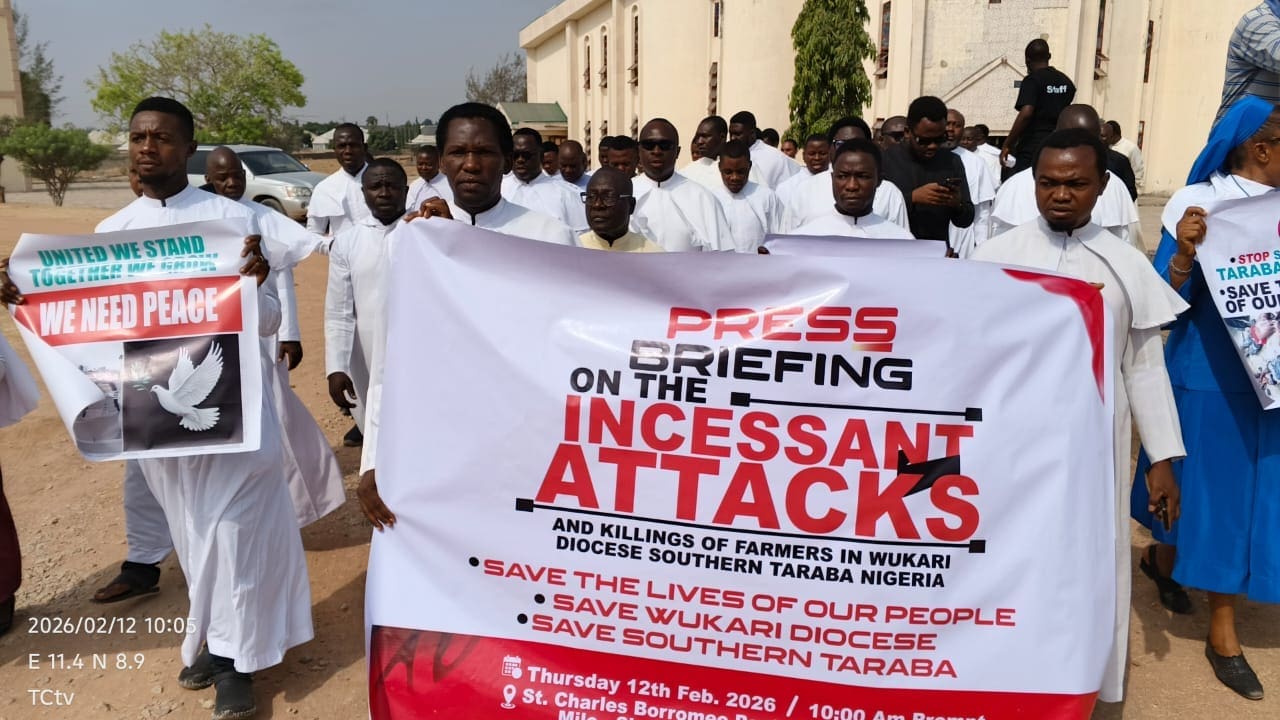
(Jalingo) 50 Catholic clergy marched through the streets of Jalingo, Thursday, February 12, 2026, to protest of what they call “systematic extermination of Christians” in Nigeria’s Taraba State.
Priests, nuns, and religious leaders from Catholic communities across the state converged on the capital to demand action from a government they accuse of criminal indifference to mass killings that have escalated since September 2025.
The solidarity march culminated in a press briefing on February 12 at the Catholic Secretariat, where church leaders detailed a campaign of terror that has killed more than 100 people and displaced more than 90,000 Catholics — a crisis unfolding in Nigeria’s volatile Middle Belt, where Africa’s largest economy is fracturing along religious and ethnic fault lines.
Broader Pattern of Violence
The Taraba crisis represents the latest flashpoint in Nigeria’s Middle Belt, a religiously mixed region where the predominantly Muslim north meets the largely Christian South. While Western attention has focused on Boko Haram’s insurgency in northeastern Nigeria, a deadlier but less publicized conflict has consumed the Middle Belt, where thousands have died in attacks attributed to armed Fulani herdsmen over the past decade.
Nigeria, Africa’s most populous nation with 230 million people, is roughly split between Muslims and Christians. International Crisis Group estimates that Middle Belt violence killed more people than Boko Haram between 2016 and 2020.
Land Seizure, Not Herder-Farmer Clashes
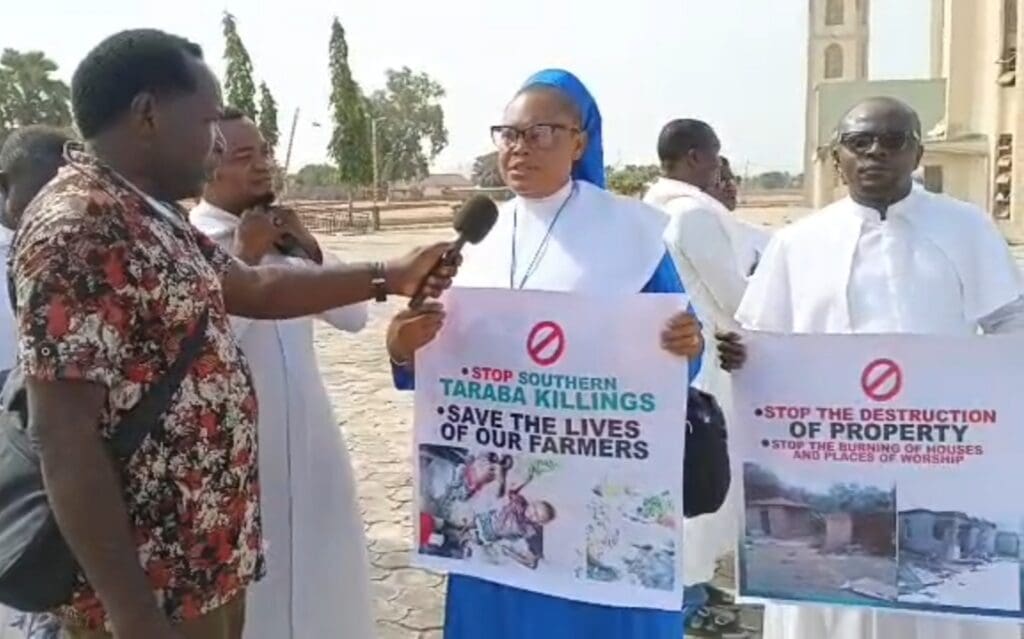
The violence in Southern Taraba follows a disturbing pattern that church leaders say is not spontaneous “herder-farmer clashes,” as Nigerian authorities routinely call it, but systematic ethnic cleansing and land appropriation.
Fulani terrorists strike villages in the predawn hours, killing residents in their sleep and torching homes, churches, and harvests. The most recent assault was launched on February 10 in Mchia village, where attackers killed 10 people at 5:30 a.m. More than 200 communities and church buildings have been destroyed across Chanchanji Ward in Takum County (Local Government Area), and parts of Ussa and Donga districts.
“Between February 1st and 11, 2026, over 80 Christians have been killed. This is not even the actual figure because we are still pulling out dead bodies from the bush,” Fr. George Dogo of Holy Ghost Cathedral, Takum, told TruthNigeria at the protest venue.
The Fulani militia have seized entire farmlands, attacking anyone who attempts to harvest crops. Women have been raped while trying to gather food for their families. Armed men block roads to ambush farmers. Most recently, militants have been harvesting seized farms and feeding the produce to their cattle.
“These Fulanis are not indigenous to Southern Taraba, they cannot speak our language, and we have not seen them before. They started coming here recently,” Sr. Thelma Otuonye, a nun with the Catholic Diocese of Wukari, explained. “This is not herder-farmer clashes.”
“Every day, we witness the killings of Christians in Southern Taraba — one killed, two killed, even ten killed. Those killing Christians are Muslim Fulanis,” Fr. Moses Angean of Wukari Diocese stated. “They rape, chase the indigenous people from their lands and occupy the lands. This is genocide to me.”
Church Issues Ultimatum
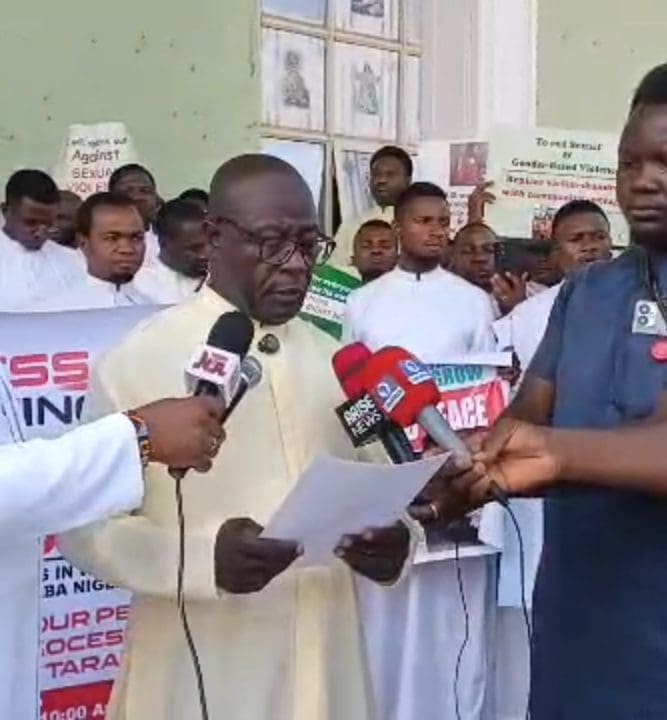
Speaking shortly after the protest, Fr. James Yaro cited over 80 farmers killed in Takum, Donga and Ussa within 90 days, more than 200 churches and communities destroyed, and 90,000 Catholics displaced since September 2025. He warned that if the state fails to guarantee security, the Church may seek international intervention.
Yaro announced four demands: immediate deployment of security forces to affected areas, prosecution of perpetrators regardless of ethnic or religious affiliation, humanitarian relief for displaced persons, and dialogue among traditional rulers, religious leaders, and political figures.
The displaced urgently need food, bedding, toiletries, medical care, and temporary shelter to prevent a major humanitarian catastrophe, according to Yaro.
The diocese warned that if Nigerian authorities cannot guarantee security, they will seek international intervention — a significant escalation that could invite foreign scrutiny of President Bola Tinubu’s administration.
A Christian Governor’s Silence
Compounding the crisis is Governor Kefas Agbu — himself a Christian — who has neither visited Southern Taraba nor issued any statement condemning the attacks.
“The state governor is fully aware of the situation but has not done anything at all,” Fr. Dogo said. “Once, he was confronted about the killings in the southern part of his state, his response was one of indifference.”
The Christian Association of Nigeria (CAN), Taraba State chapter, and the Mdzough U Tiv (MUT), a Tiv cultural organization, have criticized Governor Agbu, accusing his administration of inadequate response and failure to protect vulnerable communities.
Southern Taraba is home to indigenous Christian farming communities — including the Tiv, Jukun, and Kuteb peoples — who have cultivated these lands for generations. Christians comprise more than 97 percent of the population in districts like Wukari, Takum, and Donga.
Despite the terror, church officials remain defiant.
“The bishop, priests, religious, and the laity are not discouraged, but convinced that with God on their side and sustained prayers, lasting peace can be achieved,” according to their statement.
International Fallout
The crisis has implications beyond Nigeria’s borders. Religious persecution in the Middle Belt has raised concerns among US policymakers and international religious freedom advocates.
The failure to protect Christian farming communities could accelerate regional instability in West Africa’s Sahel region, where jihadist groups have exploited ethnic and religious grievances to expand their influence from Mali and Burkina Faso toward Nigeria’s Middle Belt, according to US-based think tanks.
Mike Odeh James and Elisha Ayes are conflict reporters for TruthNigeria.