
Christian Protesters Charge Deliberate Denial of Law Enforcement in Taraba State
Complex Clashes Driven Both by Ethnicity and Religion: Experts
By Mike Odeh James and Izighe Bitrus Adamu
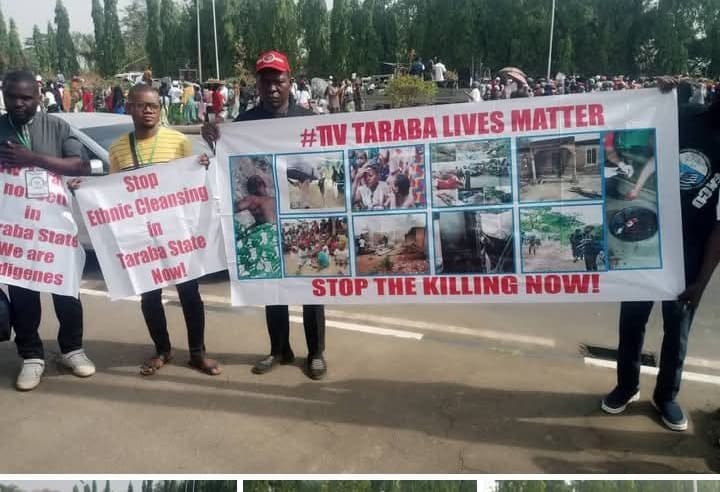
(Abuja) Hundreds of Christian youths last Tuesday stormed Nigeria’s National Assembly, accusing authorities of abandoning Tiv-tribe communities to Fulani-tribe terrorists seizing land and driving out Christian land-holders.
Dressed in black and clutching placards, the demonstrators converged Tuesday, February 17, 2026, at the entrance of the National Assembly in Abuja — Nigeria’s highest federal lawmaking body — demanding justice for what they described as an unfolding genocide against Tiv Christians in southern Taraba State.
Another protest erupted the same week in Taraba State, where many Catholic clergymen marched through the state capital of Jalingo, issuing a joint statement demanding urgent intervention. Together, the twin demonstrations marked a sharp escalation in public pressure after months of sustained attacks.
Another protest in Takum County by Tiv Christians ensued after the killings of their kinsmen by Fulani ethnic militia.
Mr. Ephraim Kumaga, chairman of the Taraba Tiv Youths Association, told journalists: “Fulani terrorists have been given a deadline of three months to finish — to wipe out — the Tiv people in Taraba State.”
Fulani Terrorist Campaign in Taraba
The victims are overwhelmingly Tiv Christians — farmers rooted in ancestral lands across Takum, Donga, and Ussa Counties (Local Government Areas) in Taraba State, a Middle Belt State bordering the nation of Cameroon.
Security analyst David Onyilokwu Idah, Director of the International Human Rights Commission (IHRC) in Abuja, told TruthNigeria that the pattern in Taraba mirrors Fulani Ethnic Militia operations documented across Nigeria’s Middle Belt.
“This is not a farmer-herder clash,” Idah said. “It is a coordinated campaign by armed Fulani terrorists aimed at territorial occupation and demographic displacement.”
According to the Observatory for Religious Freedom in Africa, Fulani militants were responsible for 55 percent of recorded Christian deaths in Nigeria between 2019 and 2023. Between 2019 and 2024, they accounted for 47 percent of all civilian killings nationwide.
Villages in Chanchanji Ward of Takum LGA have been repeatedly attacked at night. Survivors report that Fulani Ethnic Militia fighters enter while families are asleep, kill residents indiscriminately, burn homes and churches, destroy crops, and return days later to consolidate occupation of seized farmland.
Church leaders and residents describe the campaign as ethnic cleansing.
Why Taraba Violence Has Escalated
Idah explicitly links the surge in Taraba attacks to two converging factors.
First, he alleges a lack of decisive will by Taraba State authorities to curb Fulani terrorist operations.
“Despite intelligence warnings, there was no preventive deployment capable of stopping the attacks,” Idah said. “The governor has not demonstrated the urgency required to dismantle militia cells operating in southern Taraba.”
Second, Idah argues that intensified federal onslaughts against terrorists in Benue, Plateau, and Kaduna States have displaced armed Fulani groups, pushing them into what he describes as a softer security environment in Taraba.
“As security pressure increased in Benue, Plateau and parts of Kaduna, militia elements migrated toward less resistant corridors,” Idah told TruthNigeria. “Taraba became an expansion zone.”
In his assessment, the violence in Taraba is not spontaneous but strategic relocation.
“These are strategic occupations aimed at seizing indigenous Tiv land,” he said. “The goal is permanent territorial control.”
Death Toll and Displacement
Between January 2 and February 3, 2026 — just 33 days — at least 102 Tiv Christians were killed and over 31 injured in no fewer than ten coordinated Fulani terrorist attacks on Chanchanji district, according to the Northern Christians Religious Leaders Assembly (NOCRELA).
Since September 2025, over 80 people have been killed, more than 200 churches and communities destroyed, and approximately 90,000 Catholics displaced across Takum, Donga and Ussa, the Catholic Diocese of Wukari confirmed in a formal press briefing.
Aid to the Church in Need places the death toll above 100 since September 2025.
Victims include farming families caught in their homes, elderly residents unable to flee, and children killed during pre-dawn raids. Survivors describe returning to villages only to find farmlands occupied and harvests destroyed.
In some communities, Tiv residents reportedly pool personal funds to fuel police patrol vehicles — a measure critics cite as evidence of state abandonment.
Political Vacuum and Ethnic Sensitivities
Taraba’s internal ethnic tensions compound the crisis. Governor Agbu Kefas is from the Jukun tribe, and Tivs and Jukun tribes have a long history of tribal warfare even though both are predominantly Christian.
Idah accuses the state government of downplaying the severity of the Fulani terrorist campaign.
“The government’s inaction allowed the terrorists to gain strength, subdue local populations, and entrench themselves,” he said.
He warned that failure to confront the Fulani Ethnic Militia decisively risks emboldening cross-border actors. Foreign Fulani elements from Niger, Chad, and Cameroon have participated in attacks, suggesting a transnational dimension, according to Idah.
A November 2025 peace agreement between Tiv farmers and Fulani leaders collapsed within 24 hours when killings resumed.
Implications for Washington
Nigeria ranks 6th on the 2025 Global Terrorism Index. Analysts warn that minimizing Fulani Ethnic Militia violence as a pastoral dispute risks strategic miscalculation.
Idah cautioned that Washington, D.C., should not ignore the threat.
“Labeling them as bandits understates their capacity,” he said. “These armed Fulani groups have demonstrated organized mass violence, territorial seizure, and cross-border mobility.”
He warned that if militia encampments consolidate in Taraba’s forests, they could serve as operational corridors into Cameroon and reinforce the wider Sahelian insurgent arc stretching toward Mali and Burkina Faso.
“A movement capable of coordinated killings and land occupation can evolve into a structure that threatens regional stability and Western interests,” Idah said.
For Tiv Christian communities burying their dead, the protests in Abuja were not symbolic. They were a demand that Fulani terrorists be named, confronted, and stopped — before Taraba becomes another entrenched front in Nigeria’s widening insurgent crisis.
Mike Odeh James and I Izighe Bitrus Adamu are conflict reporters for TruthNigeria.