


Young Nigerians traveling to mandatory service camps face rising abductions on northern highways as forest‑based gangs expand their reach.
By Onibiyo Segun
(Abuja) – Armed kidnappers are increasingly targeting Nigerian graduates traveling for national service, exposing young professionals to ambushes on northern highways and raising concerns about government protection.
For more than five decades, Nigeria’s National Youth Service Corps (NYSC) has been a cornerstone of the country’s post-civil war nation-building effort.
Established in 1973 after the Nigerian Civil War, the program requires university graduates under 30 to spend a year serving outside their home states.
The policy was designed to rebuild trust between regions divided by the war and to expose young Nigerians to different cultures.
Each year hundreds of thousands of graduates travel long distances to report to orientation camps before beginning work in schools, hospitals, and government offices.
But many of those journeys now pass through highways where kidnappers routinely stop vehicles and drag passengers into nearby forests.
Graduate Abduction Raises Alarm
One recent case illustrates the danger.
Musa Usman Abba, a 23-year-old graduate of Federal University Gusau in Zamfara State, was kidnapped on January 9, 2026, while traveling to Sokoto State to begin his NYSC service year.
Gunmen intercepted the vehicle he was traveling in and forced passengers into the bush.
His captors later demanded a ₦10 million ($7,215 USD) ransom, which relatives reportedly paid.
Despite the payment, the kidnappers allegedly failed to release him and demanded three motorcycles, raising fears that he had been killed.
Security analysts say buses carrying students, traders, and young professionals have become frequent targets along northern highways.
Forest Corridor Enables Kidnapping Networks
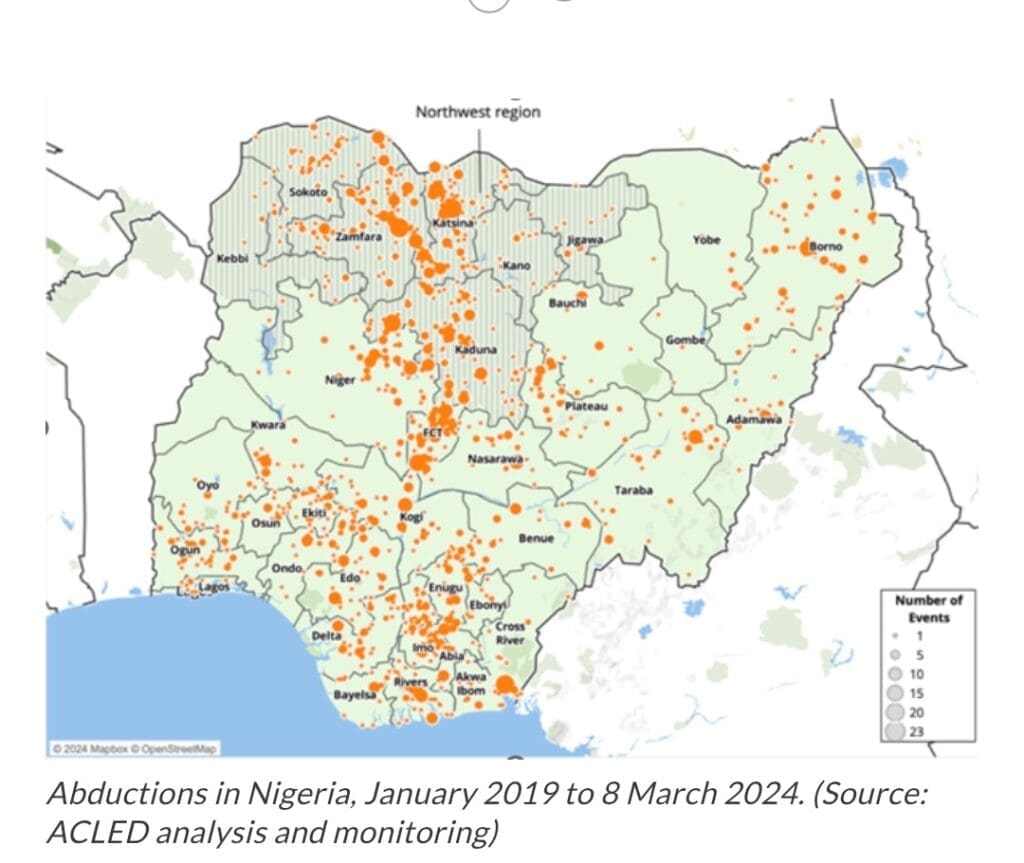
“Many kidnapping gangs operate from forest belts stretching across northwestern and north-central Nigeria,” said Colonel Benjamin Ibrahim of a Nigerian Army tactical unit to TruthNigeria.
Ibrahim pointed to Rijana Forest in Kaduna State, long identified by security officials as a major base where gangs hold hostages during ransom negotiations.
From forest camps such as Rijana, armed groups strike highways linking Kaduna, Niger, Zamfara, and Katsina states.
Security researchers say the corridor extends farther south toward parts of Niger and Kogi states, creating a loose network of forest routes that allows kidnappers to move victims quickly across state borders.
These corridors have become notorious among travelers. Vehicles are ambushed, passengers forced into nearby forests, and relatives contacted for ransom payments.
For NYSC members reporting to camps or primary assignments, these routes are often unavoidable.
Unlike government officials or military personnel, most corps members travel on commercial buses without armed escort.
Data Shows Persistent Attacks
Conflict monitoring data underscores the scale of the problem.
The Nigeria Terror Tracker, which documents violent incidents across the country, has recorded hundreds of kidnappings across northern Nigeria over the past decade.
Many of the attacks occur along highways connecting Kaduna, Sokoto, Zamfara, Niger, and Katsina states – routes frequently used by newly deployed corps members traveling to orientation camps.
A BBC investigation in 2024 reported that the true number of kidnappings is likely higher because families often negotiate privately with abductors rather than reporting incidents to authorities.
Former Corps Members Describe Ordeals
Several former corps members who spoke with TruthNigeria described how quickly routine travel can turn violent.
Fatima Bello, who served in Katsina State in 2025, said gunmen blocked the road near Zamfara and opened fire before forcing passengers into the forest.
“They took our phones and called our families,” Bello told TruthNigeria in a chat.
“We were released after 14 days only when ₦5 million ($3,600 USD) ransom was paid.” Fatima said.
In August 2023, seven NYSC members traveling to Sokoto for orientation were abducted in Zamfara on an AKTC bus; all were later released in batches almost a year after.
Security analysts say kidnapping has evolved into a major criminal enterprise across parts of northern Nigeria.
Dr. Ibrahim Suleiman of the Nigerian Institute of Policy and Strategic Studies in Kuru told TruthNigeria that poorly secured highways have become hunting grounds for armed gangs.
“These attackers stop buses, separate passengers, and move them quickly into nearby forests,” Suleiman told TruthNigeria.
“Young graduates traveling alone are especially vulnerable.” Sulieman added.
Security researcher Bulama Bukarti of the Tony Blair Institute for Global Change has also warned that kidnapping gangs increasingly operate as organized criminal networks.
Bukarti noted that “forest hideouts and weak rural policing allow armed groups to move victims across multiple states, complicating rescue operations.”
NYSC Policy Debate
Questions about corps member safety have intensified in recent years.
A safety pamphlet circulating online once suggested that kidnapped corps members might consider paying ransom to secure their release.
NYSC officials later rejected the document, saying it did not represent official policy.
Ndubuisi Umeh, an NYSC spokesman in Abuja, told TruthNigeria the agency “coordinates with security services and provides guidance to corps members posted to high-risk areas.”
Critics say warnings alone are insufficient.
Human Capital at Risk
Nigeria invests heavily in higher education and professional training.
Chidi Eze, a Lagos-based human capital analyst, said kidnapping incidents represent a serious economic loss.
“Every abducted graduate represents years of national investment,” Eze told TruthNigeria.
“When insecurity disrupts national service, the country risks losing valuable talent.” Eze noted.
Maryam Abubakar, a security researcher in Abuja, warned that continued attacks could weaken public confidence in the program.
“If graduates cannot travel safely to serve their country, the credibility of the program suffers,” Abubakar told TruthNigeria.
Calls for Reform
Security experts interviewed by TruthNigeria proposed several reforms.
These include armed escorts for corps members traveling through high-risk areas, safer deployment policies, and government-funded insurance covering kidnapping, injury, or death during service.
Dr. Bernard Okebukola of the University of Ibadan said stronger protections are overdue.
“Families currently carry most of the financial burden,” Okebukola told TruthNigeria.
“The state must take greater responsibility for protecting these young Nigerians.” Okebukola added.
Onibiyo Segun reports on terrorism and conflict for TruthNigeria.