
ANALYSIS: Government silence and fragmented media reports obscure the scale of coordinated attacks across Nigeria
Editor’s Note: This analysis examines conflicting accounts, unclear casualty figures, and gaps in official communication following the Palm Sunday attack in Jos. It is published as analysis to help readers understand not only what is known, but why key facts remain unsettled.
By Mary Kiara
JOS, Nigeria — Nigeria, by all accounts, is accustomed to confusion in times of crisis. But after a deadly Palm Sunday attack in Jos, even the basic facts; attackers and death toll – proved difficult to pin down.
Within hours, casualty figures diverged, officials withheld specifics, and media reports offered sharply different accounts, leaving facts unsettled.
A Massacre Without a Confirmed Toll
Terrorists stormed communities in Angwa Rukuba and surrounding areas on Sunday evening, killing an undetermined number of Christians in one of central Nigeria’s largest cities.
What followed was a cascade of conflicting figures.
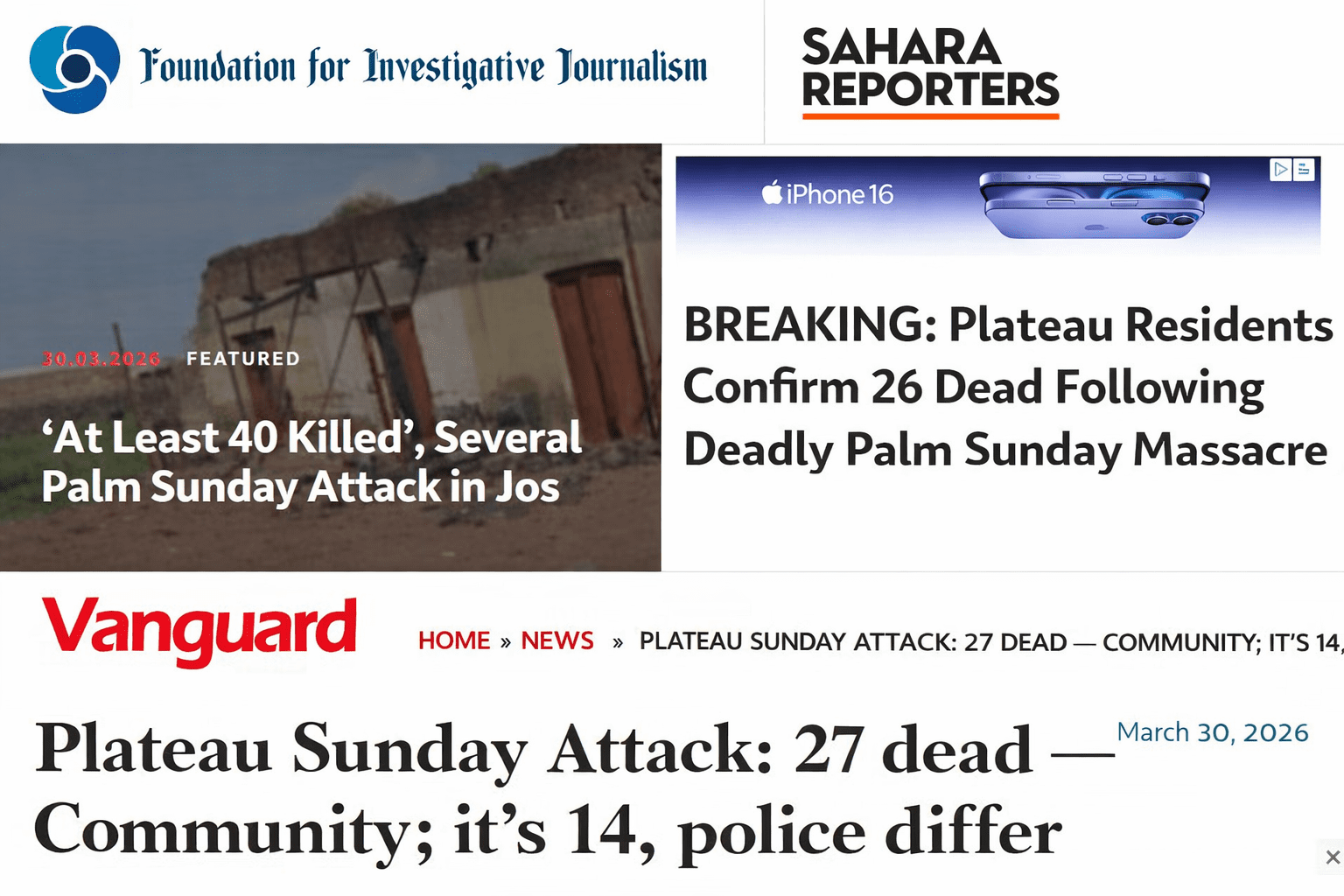
Some local sources cited about 10 deaths, other outlets, including the Foundation for Investigative Journalism, reported figures exceeding 40. Police offered a lower estimate.
“Twelve persons, 10 men and two women, were killed when gunmen opened fire,” said SP Alfred Alabo, the Plateau State Police Public Relations Officer.
State officials declined to provide a confirmed toll.
“Loss of lives” had occurred, Joyce Ramnap, Plateau State commissioner for information, said in a statement announcing a 48-hour curfew.
Who Carried Out the Attack?
That question remains unanswered.
“They are Boko Haram, not Fulani,” one resident told TruthNigeria.
Other local sources described the attackers as Fulani militants who arrived on motorcycles and retreated toward nearby hills.
No official statement has clarified the identity of the attackers.
Beyond Jos: More Reports, Same Uncertainty
As reports from Jos continued to shift, additional attacks were reported elsewhere.
In Kagarko County, Kaduna State, at least 13 people were killed during an assault on a community gathering, according to local accounts obtained by TruthNigeria.
Other attacks were reported in Borno State, where an improvised explosive device attack in Ngoshe killed Christians, Zamfara State, and parts of Kogi state, where displacement followed fresh attacks.
Whether these events are connected remains unclear.
What is consistent is the pattern of fragmented reporting: multiple incidents, emerging quickly, described differently, and verified unevenly.
Government Response: Present, but Limited
The Plateau State government imposed a curfew within hours of the Jos attack, and Governor Caleb Mutfwang visited affected communities the following day.
“I did not sleep in Jos,” Mutfwang said while addressing residents during the visit.
While filled with promises of “getting justice for the lost souls”, the governor’s address was void of key details, including confirmed casualty figures and attacker identity, these remain undisclosed.
Media: Fast, But Not Aligned
Nigerian media outlets reported the Jos attack rapidly, but accounts diverged on critical facts.
Death tolls varied widely. Descriptions of the attackers ranged from “bandits,” to “militants,” while some reports offered no clear identification.
Similar inconsistencies appeared in reports from Kaduna, Borno, and Zamfara.
“When reporting is inconsistent, it becomes harder to identify patterns,” Anuhe Aba, a retired journalist told TruthNigeria.
Leaders Speak – But Facts Remain Fluid
Political and religious leaders responded quickly.
“This heinous assault is a damning indictment of the near-total collapse of security,” Atiku Abubakar, former Vice President said in a statement posted on X.
“The continued slaughter of innocent citizens cannot become our new normal,” he added.
“Protecting lives must remain a top priority,” Rt. Rev. Sunday Adewole, chairman of the Christian Association of Nigeria in Kwara State, told TruthNigeria.
Yet these statements rely on facts that remain unsettled.
Why This Matters
Nigeria remains designated by the United States as a Country of Particular Concern for religious freedom violations.
Accurate, timely reporting is central to how such designations are assessed and acted upon.
“When information is fragmented, policy responses can also become fragmented,” Aba told TruthNigeria.
“If the scale and pattern of violence are unclear, response becomes less effective.”
A Familiar Pattern
Government officials have often framed attacks as isolated incidents.
But when multiple attacks occur in quick succession and are reported with conflicting details, even determining what is isolated and what is part of a broader pattern becomes difficult.
In that sense, the “fog of war” is not only about violence. It is also about information.
Mary Kiara reports on terrorism and religious-freedom policy for TruthNigeria.