

By Onibiyo Segun
Abuja, Nigeria — Armed kidnapping gangs across Nigeria are generating millions of naira annually through ransom payments, turning abductions of farmers, travelers, and clergy into a lucrative criminal economy.
“Kidnapping in Nigeria has increasingly become a structured criminal enterprise where ransom payments fund further attacks, weapons purchases, and the expansion of armed networks,” said Kabiru Adamu, founder and chief executive officer of Beacon Security and Intelligence Services, Abuja.
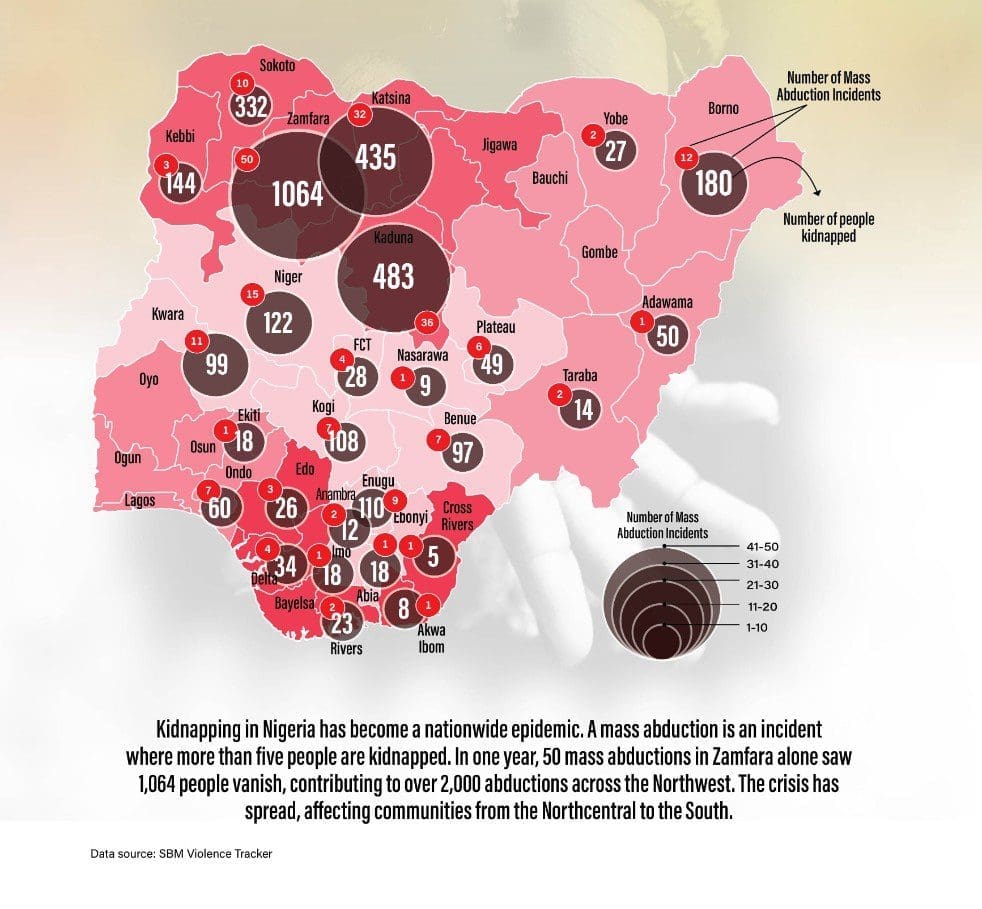
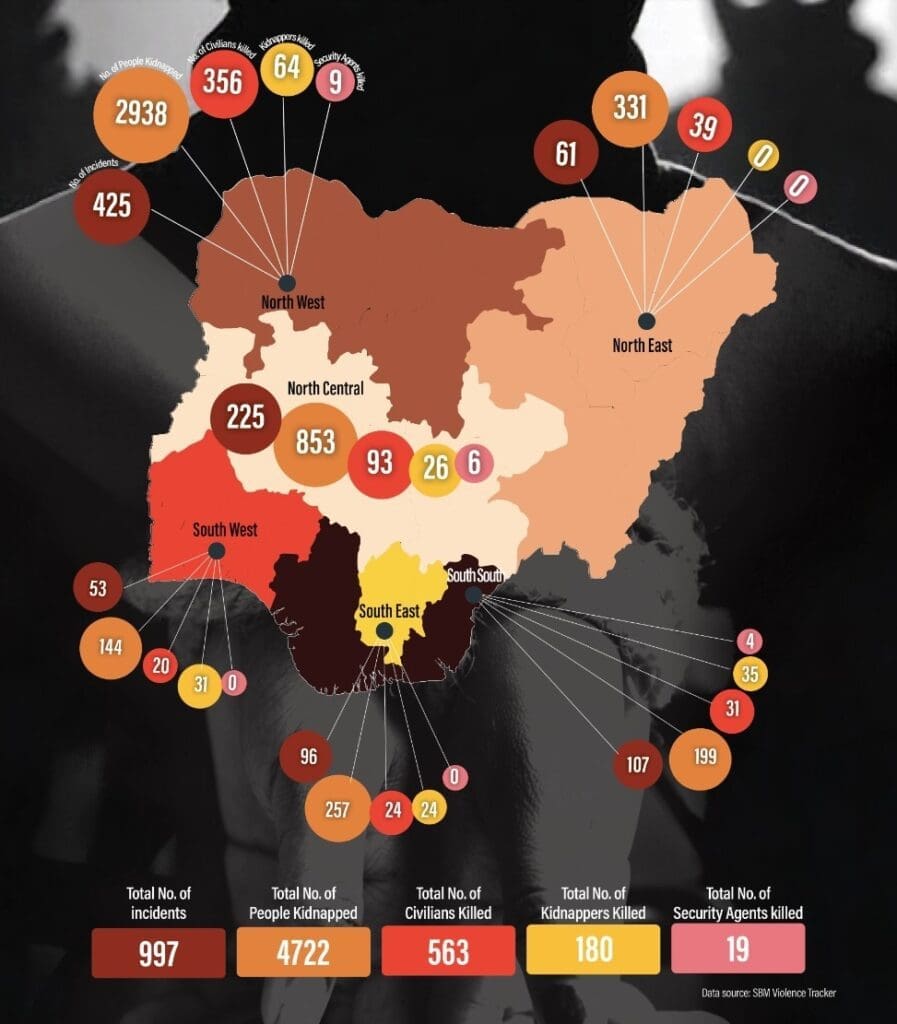
Between July 2024 and June 2025, at least 4,722 people were abducted in 997 incidents across Nigeria, according to a detailed report by geopolitical research firm SBM Intelligence, which said kidnappers received at least ₦2.57 billion (about $1.85 million) in ransom payments during that period (Vanguard).
Data from the Nigeria Terror Tracker (NTT) also corroborates these figures, showing widespread abduction clusters in the Middle Belt, North Central, and Federal Capital Territory zones over the same period (NTT Map).
Kidnappings Spread Across Central and Northern States
Incident data from volunteer groups, open‑source reporting, and the NTT show that between March 3 and March 7, 2026, at least 41 civilians were abducted across multiple states and the FCT, with many assaults attributed to armed criminal gangs.
These incidents were concentrated in Kaduna, the FCT, Kogi, Kwara, Oyo, and Enugu states (Zagazola).
In one recent security operation in the FCT’s Bwari area, Nigerian troops and police rescued 19 kidnapped persons and neutralized at least one suspect (Zagazola).
“Kidnappers are increasingly operating from forested corridors connecting the FCT with neighbouring states, making rural and peri‑urban communities along key highways especially vulnerable,” said Dr. Chukwu Emeka, security analyst based in Lagos.
He highlighted the strategic advantage of forest hideouts that allow gangs to strike and withdraw rapidly.
Calculating the Ransom Revenue
Criminologists say the average ransom payment in rural Nigerian kidnappings is around ₦2.77 million (about $2,000) per victim.
“Though amounts vary depending on perceived wealth, community influence, and negotiating leverage,” said Prof. Banji Adefowope, criminologist and security expert based in Lagos.
Using that estimate, the 41 kidnappings recorded in early March could generate roughly ₦113.6 million (about $82,000) if families secure releases through negotiated payments.
Typical ransom demand ranges include:
- ₦414,000 (about $900) — for low‑income farmers or rural families
- ₦2 million–₦7 million (about $1,400–$5,000) — for middle‑income professionals or traders
- ₦23 million (about $16,000) — for high‑profile individuals or clergy
If similar levels of activity continued across 25 weeks, the estimated ransom income for a single kidnapping network could reach approximately ₦2.84 billion (about $2.05 million).
Security economists, such as Dr. Aisha Suleiman, financial risk analyst in Abuja, say this level of revenue explains why kidnapping remains resilient.
“Ransom cash is often recycled into weapons, mobility, and logistics, expanding criminal operations despite occasional rescue successes,” Dr. Suleiman explained to TruthNigeria in a chat.
How Ransom Funds Flow Through a Criminal Economy
Kidnapping experts emphasize that ransom money rarely stays with the captors alone.
Instead, cash circulates through a wider informal network that may include:
- weapons suppliers
- local intermediaries and negotiators
- transport and logistics providers
- informants who identify targets
- corrupt officials offering protection or intelligence
According to Retired Col. Samuel Obiora, security analyst based in Lagos, “Kidnapping networks use ransom funds to sustain multiple facets of their operations, from informants who identify profitable targets to those who shield them from law enforcement.”
Analysts estimate that 10–20 percent of ransom revenue may flow upward through bribery or protection payments, allowing criminal groups to cultivate local influence and evade pressure.
If a network generates ₦2.84 billion (about $2.05 million) over 25 weeks, this estimate implies roughly ₦415 million–₦568 million (about $300,000–$400,000) might be diverted into patronage networks that include politically connected brokers, local power holders, or security personnel. Payments are often disguised as gifts, community contributions, campaign support, or protection fees, making them difficult to trace or prosecute.
Human and Economic Costs
“Beyond the financial figures, Nigeria’s kidnapping crisis has deep human impacts,” said retired Air Commodore Darlington Abdullahi, disarmament consultant.
“Families often sell farmland, livestock, or businesses to pay ransoms, pushing households into long‑term debt,” he explained.
Economic activity in affected regions declines as farmers abandon fields and transporters avoid high‑risk corridors.
The SBM Intelligence report underlines this toll: along with the 4,722 abductions recorded over the year, at least 762 people were killed in abduction‑related violence (Vanguard).
Experts like Dr. Halima Usman, social policy specialist based in Kano, told TruthNigeria that “the compounded effect of ransom payments and violence deepens distrust in governance and exacerbates community trauma.”
Link to Terrorist Financing and Broader Insecurity
Although many kidnappings are financially driven by criminal gangs, analysts warn that ransom flows can indirectly strengthen militant networks, including jihadist groups in northeastern Nigeria.
“Groups like Boko Haram and Islamic State West Africa Province benefit from shared criminal markets, weapons trafficking routes, and informal protection arrangements that overlap with general ransom economies,” said retired Major Ahmed Luggar.
Dr. Amina Habib, terrorism finance expert in Abuja, told TruthNigeria that “Ransom flows provide capital that can indirectly support insurgent logistics and bolster groups that exploit the same criminal ecosystems for recruitment and supply.”
Professor Shoun Abeke, financial analyst and security consultant in Abuja, said addressing the kidnapping crisis requires a multi‑layered strategy targeting both the profit motive and the enabling security structures.
“Money flows are the artery of this crime,” Abeke told TruthNigeria.
Abeke noted that “Unless you cut off the financial lifelines and dismantle protection networks, rescue operations alone will not stop the cycle.”
Policy Implications for Nigeria and the West
Dr. Halima Usman told TruthNigeria that “effective policy must combine security operations with financial disruption and governance reform.”
Key approaches include:
- Enhanced financial tracing and anti‑money‑laundering enforcement
- Stronger anti‑corruption prosecution to deter collusion
- Expanded community protection along known gang corridors
- Economic programs targeting unemployment, poverty, and rural marginalization
Criminologists like Prof. Banji Adefowope argue that “Understanding the naira scale of the kidnapping economy and its dollar equivalent for international audiences is crucial for designing responses that address both the financial incentives of crime and the institutional weaknesses that allow it to flourish.”
This underscores a stark reality — Nigeria’s kidnapping crisis is not just a law enforcement problem but a complex financial and institutional challenge.
Without tackling the cash flows, patronage networks, and governance gaps that sustain it, rescue operations remain temporary fixes.
Effective intervention requires coordinated security, financial disruption, anti‑corruption enforcement, and community‑focused economic programs.
Mapping the flow of criminal money alongside human consequences allows Nigeria and international partners to design interventions that are both strategic and sustainable, aiming to sever the lifeline of a multi‑billion‑naira illicit economy that preys on citizens and destabilizes regions.
Onibiyo Segun reports on terrorism and conflicts for TruthNigeria.