
By Luka Binniyat
(Kaduna) – Demonstrations have erupted in several Northern Nigerian cities after Iran’s Supreme Leader, Ayatollah Ali Khamenei, was killed in a joint United States–Israeli military strike Saturday, spiking global oil prices, according to several news sources.
Global oil prices have jumped roughly 8–13 percent, with Brent crude near $80+ per barrel amid Iran conflict and Strait of Hormuz disruption, and analysts warn prices could spike to above $100 if supply routes remain blocked, according to the Guardian.
The development has heightened security- and economic anxiety in Africa’s most populous country whose economy largely hinges on oil and is also the most dangerous country to be a Christian, according to a 2025 report of Christian Solidarity Worldwide (CSW).
Shiitte Protest
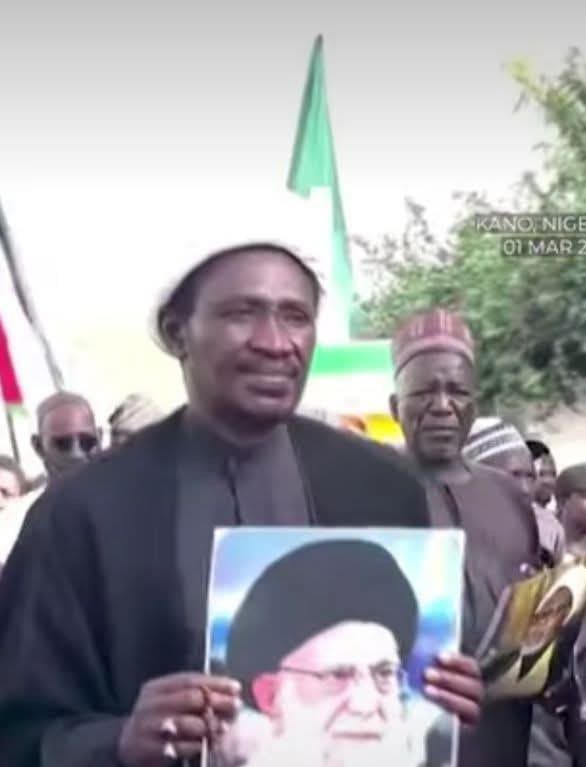
Hundreds of members of the Islamic Movement in Nigeria (IMN) – a Shiitte sect – marched in Kano (Kano State), Sokoto (Sokoto State), Gombe (Gombe State), Niger (Niger State) and Kaduna (Kaduna State), condemning the killing and expressing solidarity with Iran, according to Daily Trust.
In Kano protesters were waving Iranian flags and chanting anti-U.S. and anti-Israel slogans. The protests were largely peaceful but emotionally charged, the report added.
Who Are the IMN?
The Islamic Movement in Nigeria (IMN) is a Shiite religious organisation founded by Sheikh Ibrahim Zakzaky in the late 1970s, inspired by Iran’s 1979 Islamic Revolution. Analysts estimate Shiites constitute roughly 5 percent of Nigeria’s estimated 100 million Muslim population.
The IMN has experienced repeated clashes with Nigerian authorities, most notably the 2015 Zaria confrontation between members and the Nigerian Army, in which at least 347 were massacred by government troops, according to Premium Times.
In 2019, Nigeria banned the IMN after prolonged violent confrontations with Nigerian security forces and alleged flagrant disobedience to civil order.
While IMN members demonstrated publicly, other Muslim groups across Nigeria expressed anger over the killing but avoided open street protests, TruthNigeria findings show.
Among Nigerian Christians, reaction has largely played out on social media, where relief, and in some cases quiet satisfaction, was expressed over the weakening of Iran’s leadership.
Major Christian bodies have refrained from public celebration, instead urging calm.
“This is more of a political issue than religious,” said Rev. Peter Adeyemi, National Spokesman of the Christian Association of Nigeria (CAN) to TruthNigeria Nigeria from Abuja, Monday.
“As followers of Christ, we do not encourage war or assassination of anyone, but we preach global peace, justice, and human fraternity through our Almighty creator,” he said.
Iran, Arms Smuggling and Linkage to Boko Haram
Nigeria’s past security encounters with Iran add another layer of complexity. In October 2010, Nigerian authorities intercepted 13 containers of weapons originating from Iran at Apapa Port in Lagos. The cache included 107mm rockets, artillery shells, grenades and ammunition concealed as building materials as well documented in several news reports
The shipment was allegedly linked to Iran’s Revolutionary Guard networks.
At the time, Boko Haram’s insurgency was escalating in northeastern Nigeria, prompting speculation about possible external supply lines.
However, no publicly confirmed operational link was established between that arms cache and Boko Haram.
The United States maintains active security cooperation with Nigeria, including military advisers, intelligence sharing, counter-terrorism training and joint operations against extremist groups such as Boko Haram and ISWAP.
With heightened tensions between Iran and the U.S., security experts warn that American personnel and assets in Nigeria — including embassy facilities, advisers, and contractors — could face elevated symbolic risk from Islamists sympathetic to Iran.
Dr. Michael Onuoha, a geopolitical analyst in Abuja, told TruthNigeria, Monday:
“Even if there is no direct operational link, heightened anti-American sentiment among Iranian sympathizers can increase the vulnerability of U.S. advisers or diplomatic facilities,” he said.
“Nigeria must tighten intelligence surveillance,” he said.
“There is currently no confirmed threat, but it must be cautioned that global proxy dynamics often ripple into regional theatres,” he added.
Security Implications for Nigeria
“Nigeria is already battling insurgency in the northeast, banditry in the northwest, and communal tensions in the north-central region,” said Prof. Emmanuel Musa, of the Department of Criminology, Niger State University, Lapai, to TruthNigeria from Minna, Monday.
“Nigerian government has to be up and doing, because we have severe domestic unrest triggered by foreign geopolitical tensions,” he said.
“This could overstretch already burdened security agencies,” he added.
Iran is a significant oil producer just like Nigeria.
“Escalation in the Middle East often pushes global oil prices upward, especially if the Strait of Hormuz through which roughly 20 percent of global oil shipments pass is threatened,” said Okolo Adams, Energy Editor with Business Day to TruthNigeria.
“Higher oil prices could mean increased export revenue for Nigeria,” he said, “However, Nigeria imports much of its refined petroleum. Rising global crude prices often translate into higher domestic fuel costs and inflation,” he warned.
Luka Binniyat writes for TruthNigeria on Politics and Conflict from Kaduna.