
Christian Community in Kachia County Denies Claims of Army Rescue
Inside the Easter Sunday Raid That Left Dozens Abducted in Southern Kaduna
By Mike Odeh James and Luka Binniyat
(KADUNA Exclusive to TruthNigeria)–A community leader in Ariko, Kachia Local Government Area of Kaduna State, has provided a chilling, first-hand account of how heavily armed assailants executed a coordinated Easter Sunday attack that left at least five people dead and 36 abducted within minutes.
Despite published claims (including by TruthNigeria) that 31 persons were rescued from abduction on Easter Sunday, the claim is false, TruthNigeria has learned. In fact, 36 people remain in captivity.
The community leaders who spoke to TruthNigeria disputed claims of military intervention.
“The military did not rescue anyone,” he said. “They came after the attackers had already left.”
“They even left without deploying a single soldier to assist us,” he added.
Such allegations mirror longstanding concerns raised by civil society groups regarding delayed or inadequate security responses in rural conflict zones:
The 36 abducted persons reportedly are in kidnapper dens currently.
“They contacted us this morning and said they had arrived safely,” the leader said. “But they have not yet made any demands.”
Kidnapping for ransom remains a persistent tactic across northern Nigeria, with humanitarian monitors documenting rising incidents in rural communities:
Disputed Security Response
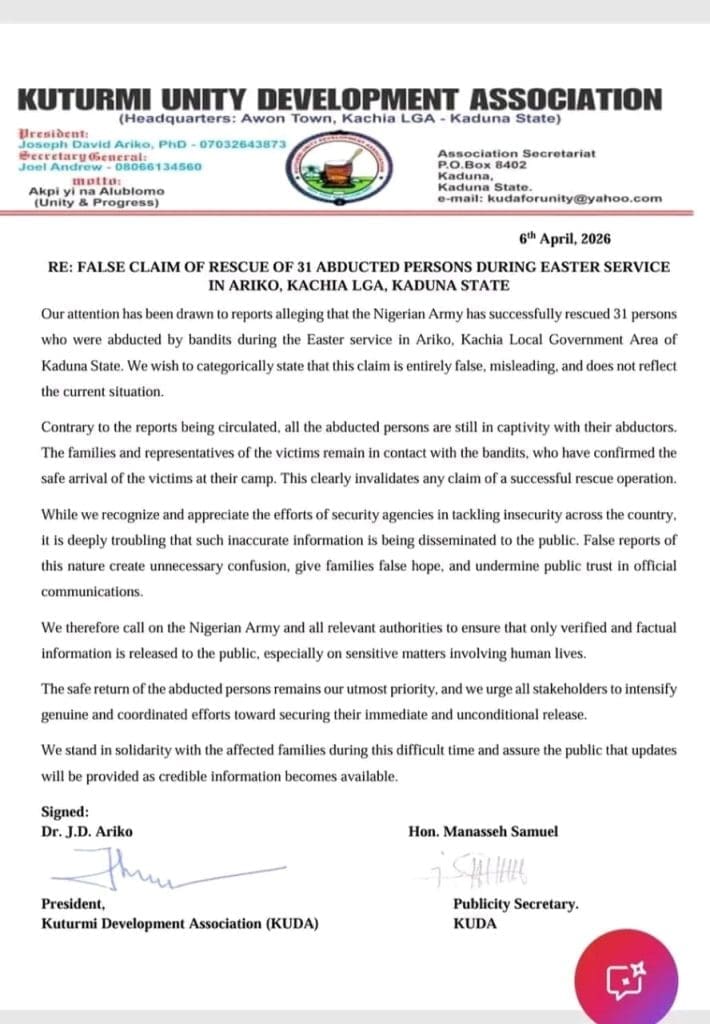
TruthNigeria had earlier written on how the terrorists attacked the community, killed many and abducted others.
Speaking to TruthNigeria on condition of anonymity due to security concerns on Monday, April 6, 2026, the local leader described a community under sustained assault, warning that Ariko is now one of the last inhabited settlements in a region increasingly hollowed out by armed groups.
“Ariko is the main community standing now within a radius of about five miles,” he said. “All the surrounding villages have been abandoned. Some are now occupied as bandit camps, and the government knows it.”
Pattern of Repeated Attacks
According to anonymous the source, the Easter assault followed at least five previous attempts by the militants to invade the town. In each case, local hunters and volunteer guards had repelled the attacks, though not without casualties.
This pattern aligns with broader violent trends documented across Kaduna State and Nigeria’s northwest:
This time, however, the attackers changed strategy.
“The terrorists usually use a known path to attack, and that route has been closely monitored,” the leader said. “But this time, they came through a very narrow bush path that is hardly used anymore.”
Timing the Attack
The assault was carefully timed.
“Most of the village guards had gone to church,” he said. “Only a few remained watching the usual route.”
The attackers avoided that route entirely.
“They came through that bush path and went straight to the ECWA Church just as the service had ended and people were dispersing.”
“The church cashier was the first to be shot while counting the offering,” he added. “People began running, only to run into attackers positioned in ambush.”
Targeting Women and Children
The attackers appeared to focus on abductions rather than indiscriminate killing.
“They were mostly interested in kidnapping women and children, not adult men,” the witness said. “That’s how I escaped.”
“In less than 20 minutes, they gathered over 70 women and children and began moving them into the bush.”
A mass holding camp for abducted hostages is approximately 35 miles west of Ariko, according to 17 TruthNigeria investigations. The ransoms that kidnappers will aim to recoup will be in the range of at least $72,000 according to TruthNigeria sources.
Resistance and Partial Rescue
Local guards regrouped and pursued the attackers.
“It was during that engagement that 31 women and children were freed,” he said. “But three of our guards were killed, and seven were wounded.”
This account corresponds with emerging field reports indicating that some captives were recovered during a gun battle, though details remain contested across sources.
A Region Emptying Out
Ariko’s situation reflects a wider humanitarian and security crisis.
Across Southern Kaduna, repeated attacks have forced mass displacement, leaving villages deserted and farmlands abandoned. Some of these areas are reportedly being repurposed as operational bases by armed groups.
Local defense units—hunters and volunteers—remain the primary line of resistance but face increasing pressure from better-armed attackers.
Human rights watchdogs such as Open Doors have argued for years that the steady removal of indigenous populations of farmers in southern Kaduna’s remote regions is part of a deliberate strategy of displacing the Christian majority populations for which Southern Kaduna is well known.
Frans Veerman, Managing Director of World Watch Research, has told Open Doors: “The Southern Kaduna Peoples Union (SOKAPU) lists a whole range of Local Government Areas, Wards and village communities affected by unprovoked attacks by Fulani militia.”
Veerman went on to say: “The native population of predominantly Christian background is being deliberately displaced. At least 50,000 have been forced to relocate to the squalor of various IDP camps in the region or to family relations because their villages are either too unsafe to return to or have been taken over by Fulani militia. The consequences for food security are immense. In addition, thousands of children have been out of school, some for over three years, with the authorities making no remedial effort to assist them.”
According to former SOKAPU president Jonathan Asake, the Kaduna State Government has colluded with Fulani ethnic militias to dispossess them of ancestral lands.
A Community on Edge
For residents, the priority remains the safe return of the abducted.
“We are exposed,” the community leader said. “If nothing changes, they will come again.”
As Ariko braces for possible ransom demands, it stands as a stark example of a deepening crisis—where communities are left to defend themselves amid evolving threats and uncertain state protection.
Mike Odeh James and Luka Binniyat are conflict reporters for TruthNigeria