
Stranded Christian Displaced Persons in Borno State Face Roadside Bombs
By Suleman Ayuba
(Gwoza) Thousands of displaced citizens who fled Boko Haram attacks in Borno State in early March are facing roadside bomb attacks by the same terrorists a month later, TruthNigeria has learned.
Approximately 12,402 individuals (2,067 households) fled the Christian stronghold of Gwoza March 3 and sought temporary shelter in the more secure town of Pulka, according to the UN’s Relief Web.
Most of these displaced persons attempted to return to Ngoshe during the last week of March. Yet, when thousands of displaced people attempted to return home along the Ngoshe-Pulka Road, fresh tragedy unfolded. Boko Haram exploited the movement by planting improvised explosive devices (IEDs) and launching ambushes, turning the route into a deadly trap that killed 4 people and injured 24.
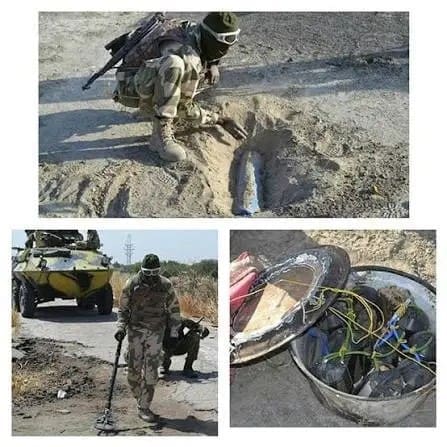
Nigerian troops have been detecting and neutralizing Improvised explosive devices (IEDs) along Ngoshe–Pulka road in Borno in the last days of March, according to Zagazola Makama media.
There have been several IED incidents. One device was discovered and neutralized on March 31, 2026, during a routine clearance at the Bokko area along the main supply route. Earlier detections occurred on March 22 at two locations, according to survivor Musa John who spoke to Truth Nigeria.
Bitrus Haruna, a survivor who spoke to TruthNigeria, recounted the horror: “scenes of bodies scattered on the road, some hacked as they tried to reach safety.” The Pulka-Ngoshe area, long notorious for buried mines and ambushes, has become a corridor where terrorists deliberately target civilians attempting to resettle.
This pattern fits Boko Haram’s tactic of disrupting returnees to regain access to areas once considered secure. Military sources and local accounts (who spoke anonymously to TruthNigeria) note frequent IED discoveries by troops as well as the group’s ability to quickly replant devices that were dug up. Clearance operations continue, but the thick brush and porous borders allow rapid regrouping.
Parallel to Chibok’s Enduring Trauma
The Ngoshe massacres of March 3-4, 2026, are echoes of the long ordeal of nearby Chibok, another community in the Borno axis repeatedly hit by targeted violence. Chibok, home to many Christians, was thrust into the global spotlight when Boko Haram abducted 276 schoolgirls (mostly Christians) from Government Secondary School on April 14, 2014. Many faced forced conversion to Islam, marriage to fighters, other abuses. More than 190 eventually escaped, but around 82 girls remain missing more than a decade later.
Boko Haram has repeatedly overrun villages in the Chibok area, killing dozens in house-to-house raids, burning churches, and abducting hundreds of women and children overall. Recent incidents include the abduction of mothers and children from subdivisions such as Shikarkir. In one November 2025 attack on Shikarkir, twelve people, including two daughters of a local pastor and an infant—were abducted though some later escaped.
These assaults have displaced thousands, shattered livelihoods, and left families in perpetual fear. Dr. Bitrus Pogu, President of the Middle Belt Forum and a Chibok native, told TruthNigeria in late March 2026 about a Holy Week attack on the nearby Christian community of Kautikari on March 30, 2026, where ISWAP killed 12 Christians: “I am very shocked that you people have not heard that Kautikari Christian community just outside my Chibok town was attacked and 12 people killed on Monday.”
The suffering in Ngoshe and Chibok reveals a sustained campaign that preys on returning communities. In Ngoshe, victims included refugees lured back by promises of safety, only to face renewed terror. Chibok families endure the trauma of mass abductions alongside daily threats of raids that claim lives and force fresh displacement.
Military Response and Recent Rescues
Nigerian troops under Operation Hadin Kai have pushed back hard. In late March 2026, soldiers foiled a major Boko Haram abduction attempt in the Borno area. On March 30, 2026, troops escorting civilians along the Buratai–Kamuya axis came under attack near Dutse Kura. A quick response force repelled the insurgents, pursued them toward Mangari, and rescued more than 150 civilians targeted for abduction. The rescued individuals were safely reunited with families. Troops also handled IED threats during operations, though some personnel sustained injuries.
Earlier clashes on the Ngoshe-Pulka Road saw terrorists and Civilian Joint Task Force (CJTF) paramilitary volunteers exchange fire, resulting in deaths of terrorists. Air support and ground operations have neutralized fighters and disrupted camps. Yet the persistent IED threat shows terrorists adapt quickly, using rugged terrain and border areas to regroup and replant devices.
A Cycle of Violence and the Path Forward
The violence along Pulka-Ngoshe and in Chibok underscores deeper challenges: fragile resettlement programs, inadequate road security and the terrorists’ resilience after years of counterinsurgency. Boko Haram and splinter groups such as the Islamic State of West Africa (ISWAP) exploit ungoverned spaces, targeting civilians in Christian-majority towns such as Ngoshe and Chibok, and spread fear.
Both communities share burdens of displacement, loss, and interrupted lives. Survivors call for stronger protection, faster humanitarian aid, and a sustained military footprint so returns feel genuinely safe rather than suicidal.
Suleman Ayuba, a native of Gwoza in Borno, is a contributor to TruthNigeria.