
By Luka Binniyat and Mike Odeh James
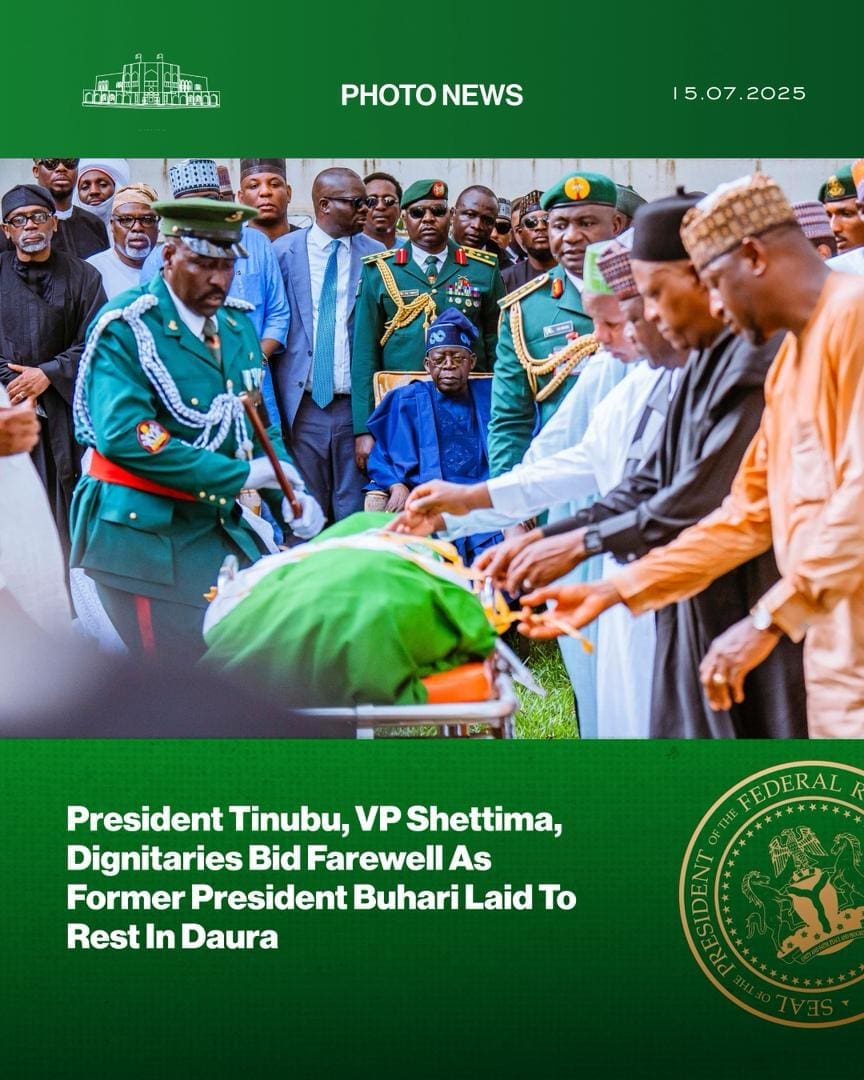
(Abuja) – The body of former Nigerian President, Gen. Muhammadu Buhari (rtd), was laid to rest in his hometown of Daura, Katsina State, North-West Nigeria, on Monday, 15th July, 2025. His passing has drawn sharp criticism from Christian leaders who accuse him of enabling genocide against communities in Nigeria’s Christian-majority Middle Belt.
Buhari, who ruled as an elected President from 2015 to 2023, died in a London hospital on 13th July, 2025, after a prolonged illness, according to his spokesman, Garba Shehu.
The Federal Government declared Monday (15th July, 2025) a work-free day and announced a seven-day national mourning period in honour of the late former military ruler who had seized power in a 1983 coup that toppled the democratically elected government of Alhaji Shehu Shagari.
Despite receiving a state burial attended by President Bola Ahmed Tinubu, top government officials, National Assembly leaders, service chiefs, and other dignitaries, Buhari’s death has reignited painful memories and strong condemnation from several Christian commentators across Nigeria.
“He Created the Darkest Moments for Christians”
The Southern Kaduna Christian Leaders Forum, in a statement issued on Monday (15th July, 2025) accused Buhari of presiding over what they described as one of the darkest chapters for Christians in Nigeria.
The statement, signed by Apostle Dr. Emmanuel Nuhu Kure, Chairman of the Forum, reads in part:
“As a body that speaks on behalf of deeply wounded people, we must express the truth without pretense or political correctness.
President Buhari’s second term in office stands out in our memory as one of the darkest and toughest eras for the Southern Kaduna people,” he said.
“Under his watch, our communities were subjected to unchecked violence, persecution, and marginalisation, while the federal government remained either indifferent or complicit through silence.”
Southern Kaduna is a Christian-majority region located in the Middle Belt—commonly referred to as the Christian Belt of Northern Nigeria.
“Mass Graves and Ethnic Cleansing Were His Legacy”
Former President of the Southern Kaduna Peoples Union (SOKAPU), Hon. Jonathan Asake, was also unsparing in his remarks.
Speaking exclusively to TruthNigeria, Asake said:
“Not even during the Othman Danfodio jihad did our people suffer the cruelty that we experienced under Buhari’s rule,” he said.
“Southern Kaduna is dotted with scores of mass graves as a result of the ethnic cleansing carried out by Fulani bandits in which, at the time I was SOKAPU President (2019–2023), no less than 245 villages were wiped out or displaced.”
According to Asake, Buhari remained silent and took no visible action to stop the violence.
“An Exit of a Tragedy, Not the Tragedy of an Exit”
Washington-based international human rights lawyer, Emmanuel Ogebe, a long-time critic of Buhari’s administration, released a scathing statement Monday, describing Buhari’s passing as:
“The exit of a tragedy, not the tragedy of an exit.”
Ogebe continued: “Buhari’s legacy is soaked in blood. According to Amnesty International, over 6,800 civilians were killed in Fulani militia attacks in Benue State alone between 2023 and 2025—exceeding the entire number of terrorists killed nationwide by the military in the same period.
The war isn’t going well,” he said grimly.
“During the Yelewata massacre, 200 villagers and two policemen were killed, while only one attacker died. It’s a lopsided slaughter—99.9% Nigerian lives lost to 0.1% terrorist casualties.”
Comparing Nigeria’s bloodshed to the recent Iran-Israel conflict, he added:
“In one week of war, Israel lost 24 citizens; Iran lost 224. In just one night, Benue lost more people than Israel did in a week-long war.”
Ogebe also revealed that Buhari’s government targeted him for his international advocacy:
“Documents unearthed in a U.S. defamation case showed that Nigeria’s embassy in Washington, D.C. sought to revoke my passport and silence me for speaking before the U.S. Congress.
They accused me of ‘trash-talking Nigeria’ in Congress and called for punitive action.
It was a gross violation of international law and U.S. statutes.”
He noted that prominent human rights lawyer Femi Falana (SAN) had to sue the Nigerian government to prevent the illegal withdrawal of his citizenship.
“Putin recruits foreigners to fight external enemies. Buhari imported foreign Fulani militia to terrorize his own people,” Ogebe declared.
He described Buhari as “the most treasonous leader in Nigerian history.”
Ogebe also recalled the 2011 post-election violence carried out by Buhari supporters after he lost the presidential election to Dr Ebele Jonathan:
“700 churches were burnt and over 1,000 Christians were killed in just 48 hours. It was the deadliest attack on Christendom in contemporary world history.”
“Legacy of Terror and Nepotism”
Dr. Pogu Bitrus, President of the Middle Belt Forum (MBF), representing over 400 predominantly Christian ethnic nationalities, echoed the condemnation.
Speaking to TruthNigeria in Abuja, Dr. Bitrus said:
“Under the leadership of Gen. Buhari, terror added a new dimension in Nigeria as armed Fulani herders became law unto themselves and unleashed unprecedented terror on Christian communities of the Middle Belt with no consequences to the terrorists.
The man left a legacy of terror, impunity and nepotism never seen on this scale in Nigeria’s history.”
Born on December 17, 1942, in Daura, Katsina State, Muhammadu Buhari was a retired Major General in the Nigerian Army. He became Nigeria’s military Head of State after overthrowing President Shehu Shagari in a 1983 coup. Known for his anti-corruption stance at that time, his regime was also criticized for human rights violations. After several failed attempts after leaving the military, he was elected civilian president in 2015 under the All Progressives Congress (APC) and re-elected in 2019. Buhari’s presidency was marked by economic challenges, rising insecurity, and deep ethnic and religious divisions.
Luka Binniyat and Mike Odeh James report conflict for TruthNigeria.