
TruthNigeria’s Reporting Cited by Security Expert
By Mike Odeh James
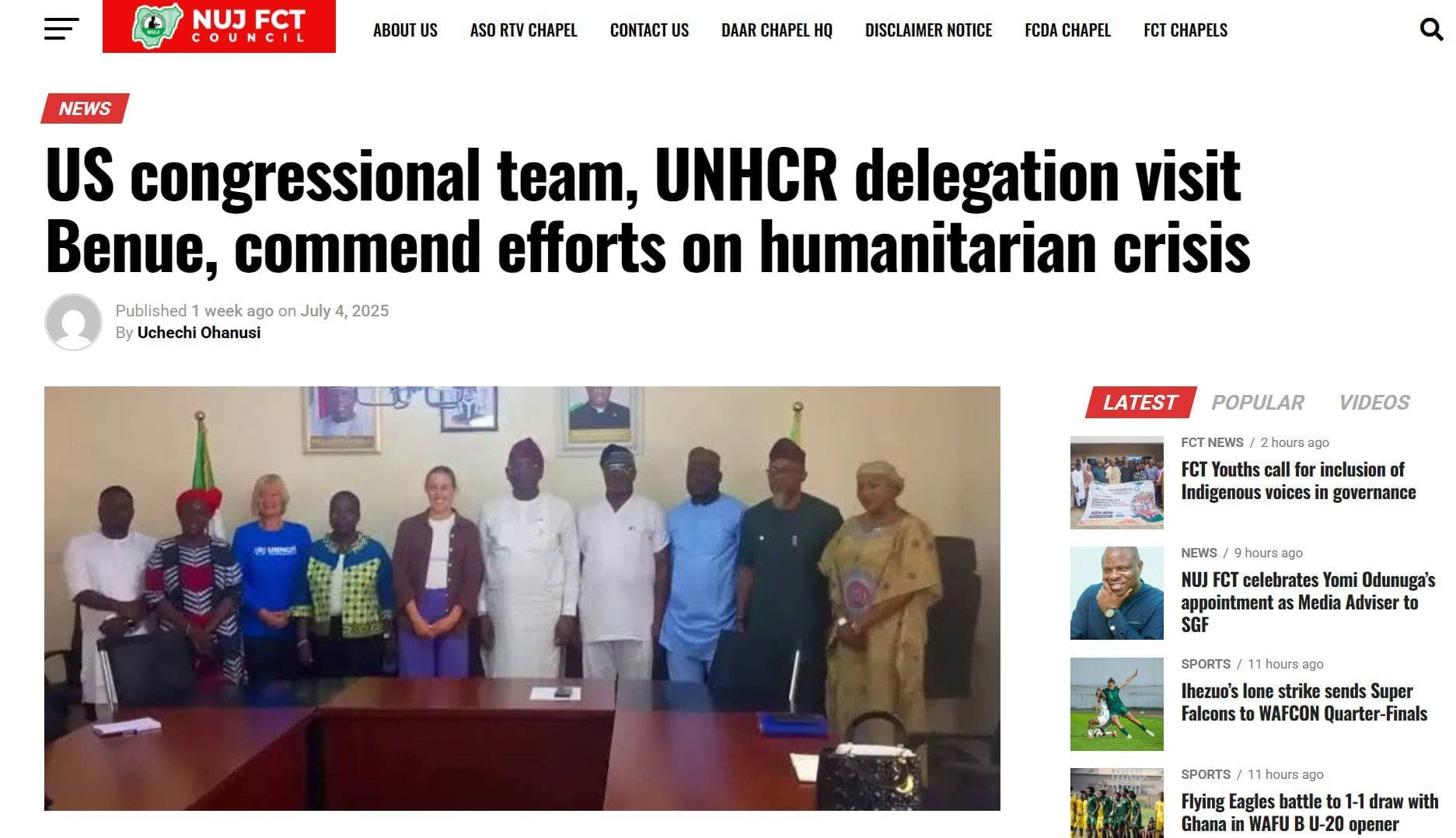
(Abuja) A surprise visit by a large United States delegation to Nigeria’s Benue State has drawn renewed international attention to the escalating violence gripping the country’s Middle Belt—especially in Yelwata, a community recently devastated by a triple digit mass killing.
Carried out during the U.S. Embassy’s summer recess, when diplomatic activity is usually minimal, the visit is being seen as a rare and urgent signal of growing concern from Washington over Nigeria’s human rights situation and rising insecurity.
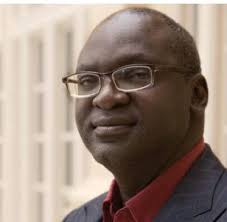
Respected U.S.-based international human rights lawyer Emmanuel Ogebe welcomed the move, calling it a breakthrough in long-standing global advocacy for persecuted communities in Nigeria.
“That a U.S. delegation would travel at this time, despite the Embassy running a skeletal crew, speaks volumes,” Ogebe told TruthNigeria in an exclusive interview from Washington, D.C. “It means the United States is no longer watching the carnage in Benue and Plateau from the sidelines.”
Ogebe, a native of Benue State himself, revealed that the visit reflects broader U.S. concern over disturbing developments in Nigeria. These include, he said, “the abduction and forced conversion of Christian children in a Kano state orphanage, and the death sentence passed on Sunday Jackson, a farmer who killed a Fulani attacker in self-defense.”
He emphasized that the visit was not coincidental, but rather the result of sustained advocacy by faith leaders and human rights defenders.
“This was not a coincidence,” Ogebe said. “It is the fruit of unrelenting work by courageous figures like Bishop Wilfred Anagbe who testified before the U.S. Congress earlier this year despite direct threats.”
In March 2025, the Benue Bishop appeared before the House Foreign Affairs Subcommittee on Africa, chaired by Congressman Chris Smith, New Jersey Republican. Following the testimonies, he reportedly received threats from Nigerian security personnel—prompting Rep. Smith to issue a strong public rebuke. Smith also cited past threats made against Ogebe by the Buhari regime.
Ogebe further revealed that years ago, he urged the Ambassador for International Religious Freedom to go on a fact-finding mission to Benue, but the visit to Benue state was denied by the embassy which cited the dangerous environment.
“We’ve been asking for this kind of international engagement for years,” he said. “That it’s finally happening—even under reduced diplomatic capacity—is a long-overdue acknowledgment,” Ogebe told TruthNigeria.
Benue State Government Accused of Restricting Access to Yelwata Victims
Despite the diplomatic attention, Ogebe expressed concerns over the Benue State Government’s alleged effort to block media and aid workers from accessing victims of the Yelwata massacre.
“It is deeply disturbing that those who wish to tell the truth or offer humanitarian assistance are being locked out,” he said. “Gov. Ortom, did not agree to hide the suffering of his people, despite tremendous pressure on him from the presidency.”
“When governments muzzle media and aid agencies, they are not protecting victims—they are revictimizing them,” Ogebe added.
Ogebe also exhorted the Nigerian President, Bola Tinubu, to take decisive steps to stop the killings in Benue, Plateau, and the rest of Nigeria.
“Under the former President, Muhammadu Buhari, a Fulani, Fulani terrorists escalated their massacres and land grabbing while he ‘Fulanized’ the federal government as even the Congress noted then. However, we have a new president who is not a Fulani. He must do all it takes to stop the killings and the land grabbing by the terrorists.
“This US Congressional Foreign Affairs Delegation visit must lead to measurable outcomes—international accountability and real protection for the most vulnerable,” Ogebe went on to say.
Visit Carries Symbolic and Political Weight: Expert
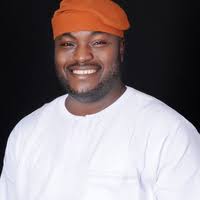
The visit is rich in symbolic meaning, according to Professor Gbemisola Animasawun of the Centre for Peace and Strategic Studies, University of Ilorin.
“First, it is communicative in many ways because it conveys the collective sympathy of the delegation and what they represent,” he explained. “It is a testament to the fact that we now live in a global village where distance no longer constrains or limits the expression of empathy. The visit can be described as consoling and assuring the community that they are not alone in their grief.”
Animasawun urged caution in interpreting the U.S. government’s understanding of the conflict.
“Except we have a report where the U.S. government has expressed its own interpretation of the conflict in Benue, we cannot assess their understanding,” he said. “Violence in Benue is not caused by any single factor. There is a need to unpack the conflict morass carefully to avoid prescribing the wrong therapy based on a wrong diagnosis.”
He described the situation in Benue as involving multiple layers of violence—from land disputes and traditional leadership struggles to farmer-herder clashes and outright occupation of communities by militias.
TruthNigeria Cited as Consequential Voice
He also pointed to the influence of international media such as TruthNigeria in shaping the delegation’s itinerary.
“It is plausible the visit was influenced by persistent reporting from media outlets such as TruthNigeria, given their reach and the trust of their audience,” he said.
Catholic Church’s Role and a Call for Grounded Policy
Prof. Animasawun also acknowledged the Catholic Church’s crucial role in drawing global attention.
“This is another possibility, because the Catholic Church has consistently led from the front and walked the talk in humanitarian activities globally,” he added.
He cautioned international actors to avoid simplistic narratives.
“My appeal is to avoid defining the problem without grounded knowledge based on the lived experiences of those affected,” he said. “Interpretation of the violence will shape policy and program responses, which could miss the mark if not properly understood. Responses should be based on dispassionate investigation and evidence—not positions of power. Only then can we design tailored solutions that address the true drivers and perpetrators of violence.”