
But divisions in the regional bloc and questions over funding cloud the Nigeria-led effort even as Washington signals approval for arms sale
By Onwuka Ezinwanne
West Africa is spiraling into its deadliest security crisis in decades and Nigeria is at the center of it. Terrorist groups are multiplying, violence is deepening, and borders no longer matter to militants who strike in one country and retreat to another.
ECOWAS Mulls a Regional Military Force
At the African Chiefs of Defense Staff summit in Abuja on Tuesday, August 26, 2025, ECOWAS President Omar Alieu Touray announced plans to deploy 260,000 troops to battle jihadist networks spreading across the Sahel and coastal West Africa.
“There is no denying that West Africa, in particular the Sahel sub-region, has emerged as the epicenter of global terrorism,” Touray said. “The Sahel accounted for 51 percent of global terrorism deaths in 2024 alone.”
ECOWAS, founded in 1975 and West Africa’s most influential political and economic bloc, is appealing to the African Union, the U.N. Security Council, and international partners to raise $2.5 billion annually to support frontline states such as Nigeria.
“The activation of this rapid deployment force has become a necessity given the asymmetric security dynamics in the region,” Touray added.
Violence Spreads from the Sahel to Nigeria
The call for the military force comes at a time the Sahel is gripped with violence. In 2024, the region recorded more than 25,000 conflict-related deaths, including nearly 4,800 caused by terrorist attacks.
Nigeria has also suffered heavily. It ranked sixth globally in the 2025 Global Terrorism Index, with 565 terrorism-related deaths last year.
Al-Qaeda’s affiliate JNIM now fields up to 6,000 fighters, controlling territory in Mali and Burkina Faso and pushing into Benin—becoming the best-armed militant group in the Sahel.
Another group, IS–Sahel, has extended its reach into Nigeria. The group carried out at least 16 attacks in Nigeria last year.
Washington Responds to Nigeria’s Call for Military Support
With violence spilling over from the Sahel and deepening Nigeria’s security crisis, Abuja has turned to Washington for support.
The Nigerian government has requested $346 million worth of defense equipment, including programmable fuzes, bomb components, rocket systems, and logistics support.
The U.S. State Department has already signaled approval.
“The proposed sale will improve Nigeria’s capability to meet current and future threats,” the Defense Security Cooperation Agency said.
Tinubu Pushes For A Continental Defense
Amidst these growing threats, Nigeria’s President Bola Tinubu, represented at the summit by Vice-President Kashim Shettima, urged a broader defense strategy.
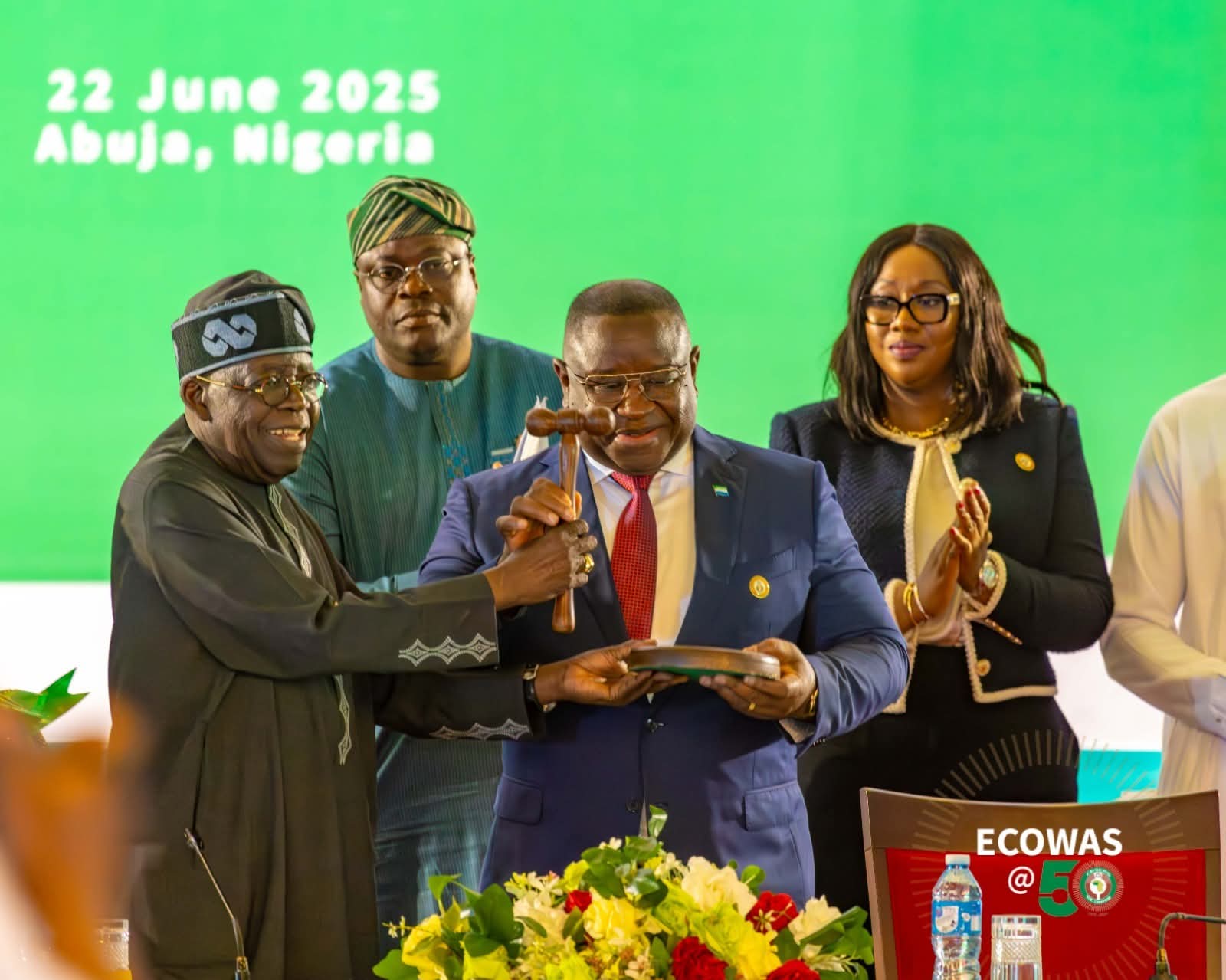
Tinubu, who led the ECOWAS Authority of Heads of State and Government until June 2025, called for a permanent African Chiefs of Defence Staff Forum. The forum would serve as a standing body for intelligence sharing, strategic planning, and operational coordination across the continent.
“In this family, defense is the first expression of love each member can promise the other,” he said.
Division in ECOWAS Weakens the Fight
The plan, however, comes as ECOWAS itself is divided.
Mali, Burkina Faso, and Niger quit the bloc on January 29, 2025, after recent coups. Their leaders have repeatedly blamed ousted civilian governments for failing to fight insurgents effectively.
They also created a confederation called the Alliance of Sahel States and strengthened alliances with Russia, Turkey, and Iran to address internal security threats such as jihadists and armed gangs.
Their withdrawal poses a challenge. While ECOWAS calls for unity, three of the hardest-hit Sahelian states are no longer at the table.
Analysts warn that this weakens both the credibility and the effectiveness of the proposed standby force.
“The absence of these frontline states undermines the very logic of a “regional” anti-terror coalition — how effective can ECOWAS be when its most exposed territories are no longer part of its framework?” David Onyilokwu Idah, Director, Special Representative and Envoy at the Africa Region Headquarters of the International Human Rights Commission, Nairobi, told TruthNigeria.
“International donors and partners will likely be hesitant to pour large sums into a security framework that does not include the very states where terrorism is most entrenched.”
Financial Shortfall Threatens West Africa’s Military Force
On Friday, 29 August, Defense and Finance Ministers from ECOWAS remaining 12 member states met in Abuja to discuss how to fund the new force. They admitted that current resources fall short of the region’s security demands.
Idah warned that the bloc’s $2.5 billion goal will be difficult to reach. “To be honest, raising $2.5 billion every year will be very tough,” he told TruthNigeria.
“The world is currently facing many crises at the same time — wars in Ukraine and Gaza, humanitarian disasters in Sudan, the Sahel, and elsewhere. Many of the international donors who usually help Africa are now stretched thin. This is what we call donor fatigue.”
The other challenge is ensuring money reaches frontline states rather than being wasted. Idah recommended earmarking funds for specific uses, working with partners such as the African Development Bank or United Nations Development Program to manage disbursements, conducting yearly audits, and tying funding to results.
“For Nigeria specifically, this means frontline units in Borno, Zamfara, Sokoto, and border zones should get direct support in equipment, logistics, and welfare,” he said. “The funds could also help set up regional supply hubs in Nigeria so the military doesn’t waste precious time waiting for materials. This approach would also ensure that Nigeria doesn’t carry an unfair share of the burden as it has done in the past.”
Ezinwanne writes human interest stories and features for TruthNigeria.