
After years of stalled prosecutions, Nigeria is finally putting on trial suspects accused of two of the country’s deadliest massacres targeting Christians
By M. Kiará
Lagos—Nigeria has begun trying terrorists linked to two of the country’s most brutal anti-Christian massacres- the 2022 Pentecost Sunday Church attack in Owo, Ondo state, and the June 2025 slaughter of villagers in Yelewata, Benue state.
The cases unfolding simultaneously in Abuja are being described by human rights advocates as “a defining test” for Africa’s most populous nation, where jihadist violence has long gone unpunished.
Owo: The Church Massacre That Shook a Nation
On June 5, 2022, Islamic militants opened fire on worshippers at St. Francis Catholic Church in the quiet Southwestern town of Owo, 200 miles east of Lagos. 41 people were killed and more than 60 wounded, including children, in what became one of Nigeria’s most shocking terror attacks.
For nearly two years, there were no convictions, and no closure. Then, in August 2025, Nigeria’s Department of State Services (DSS) charged five suspects on a nine-count terrorism charge under the Terrorism Prevention and Prohibition Act, accusing them of links to Al-Shabaab, the East African jihadist group.
According to the DSS, the defendants; Idris Abdulmalik Omeiza, Al Qasim Idris, Jamiu Abdulmalik, Abdulhaleem Idris, and Momoh Otuho Abubakar allegedly operated a terror cell in Kogi State and coordinated the Owo assault “in furtherance of their religious ideology.”
Justice Emeka Nwite denied them bail, citing “overwhelming evidence and the capital nature of the charges.”
“This case marks a turning point,” said Alloy Atah, a human rights advocate monitoring the proceedings.
“For once, a massacre of Christians is being prosecuted as terrorism, not brushed off as random banditry. If convictions happen, it will restore hope. If it fails, impunity becomes policy.”
Yelewata: A Village Erased
Three years later, another massacre followed. On June 13, 2025, armed Fulani Jihadists stormed the Christian farming village of Yelewata, seven kilometers north of Makurdi, the state capital, killing more than 200 residents overnight.
Nigeria’s police chief, Kayode Egbetokun, later confirmed the arrest of 26 suspects, while the DSS said several ringleaders were captured in coordinated raids across Benue and Nasarawa States. Their arraignment began in October before Justice Mobolaji Olajuwon at the Federal High Court in Abuja.
“The various arrests and trials of terrorism suspects show that security agencies are being diligent,” DSS Director General Tosin Ajayi told the press. “The men we are prosecuting are separate from hundreds still under military custody. We will make every suspect accountable under the law.”
International Pressure and Domestic Doubt
The prosecutions come as Nigeria faces renewed scrutiny over its human rights record, following its recent redesignation as a Country of Particular Concern for religiously motivated killings.
Analysts say the trials could help Nigeria signal cooperation to Western allies, but warn that public confidence is dangerously low.
“This is more than justice for victims,” said Phil Esan, a security analyst. “It’s about proving that the Nigerian state can still enforce the rule of law. The U.S. and U.K. are watching to see if this is genuine accountability or political theatre.”
A System on Trial
Still, skepticism runs deep. In a country where mass killings often fade from headlines without consequence, these trials test whether justice in Nigeria exists only on paper.
A senior judicial source told TruthNigeria on condition of anonymity that the system is “overstretched and underfunded.”
“Hundreds of terror suspects have never seen a lawyer. Victims can’t afford transport to hearings. Progress looks good on paper, but it’s fragile. The question is whether verdicts will ever come.”
Voices from the Ground
In Owo, families who lost loved ones say justice still feels distant.
“We hear there’s a trial in Abuja, but for how long?,” said one survivor who asked not to be named. “Justice in Nigeria moves slower than grief.”
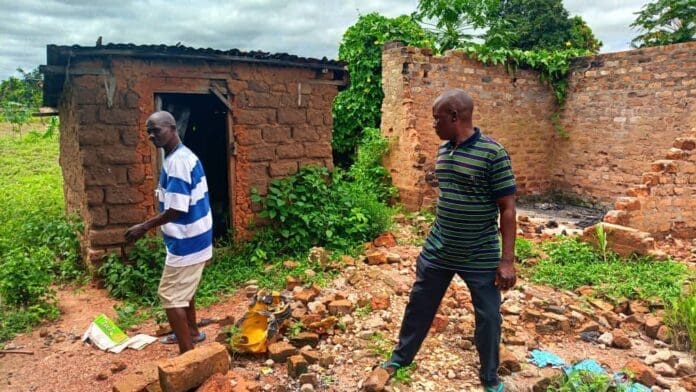
In Yelewata, village chief Julius Joor Kwumaga who earlier spoke to TruthNigeriaestimated that more than 400 homes were destroyed, none of which have been rebuilt.
“Since Yelewata was attacked, state and federal officials have come here and promised to rebuild our houses,” the chief told TruthNigeria. “But it was all words. Nothing has happened.”
Local Nigerian Pastor BabaTunde Wole who spoke to TruthNigeria said, “The prosecutions bring a glimmer of hope,” but warned against complacency.
“Justice must not stop at show trials,” he said. “The people who bury their children need to see real accountability.”
Wider Crackdown on Terror Networks
The Department of State Services says the Owo and Yelewata trials are part of a broader offensive against jihadist networks operating inside Nigeria.
Among those facing prosecution are Mahmud Muhammad Usman (aka Abu Bara’a) and Abubakar Abba, alleged leaders of Ansaru, an Al-Qaeda affiliate. They were arrested in July after a months-long manhunt and face 32 counts of terrorism, including arms trafficking and kidnapping for ransom.
Also back in court is Khalid Al-Barnawi, mastermind of the 2011 United Nations bombing in Abuja that killed 23 people. His case, stalled for nearly a decade resumed in October after an order for an accelerated hearing.
Human rights experts say the overlapping cases may finally push Nigeria toward treating terrorism as a national threat, not just a local problem.
The Road Ahead
Both the Owo and Yelewata trials have been adjourned to early 2026. Prosecutors say more arrests are expected across Kogi and Nasarawa States.
But in Owo’s rebuilt church and Yelewata’s burned-out farmlands, survivors say the clock on justice has already run out.
Whether these trials deliver justice or repeat old failures will reveal if Nigeria’s fight against terrorism has truly begun.