Survivor of Rijana Hostage Hell Saw 2,000 Terrorists Operating a Terror Hub
By Steven Kefas
(Kaduna) A Nigerian government policemen who spent months in terrorist captivity tells TruthNigeria that rogue military- and police officers are arming the very terrorists they are meant to combat.
A Military Officer’s Five Months in Hell
Mr. John Ali, a retired military intelligence officer with the Nigerian Army, never imagined his expertise in security operations would one day be used to observe the inner workings of terrorist camps from the perspective of a captive.
Abducted in Kachia Local Government Area of Kaduna State in July 2025, Ali spent five harrowing months in the custody of what he unequivocally calls “Fulani terrorists.”
What Ali witnessed during his captivity reads like a devastating indictment of Nigeria’s counterterrorism efforts. Speaking exclusively to TruthNigeria, the former intelligence officer painted a picture of a well-oiled criminal enterprise where ransom payments are immediately converted into military-grade weapons through a network that includes compromised security personnel.
“I spent five months with these terrorists the government calls bandits, and I can tell you that there is no end in sight,” Ali said.
“Have you ever wondered what they use the large sums they get from ransom payments to do? The very day any ransom is going to be paid, arms dealers—including bad eggs in the police and the military, will come to the camp with supplies and exchange the arms they brought for cash.”
The Mechanics of a Deadly Trade

Ali’s testimony provides rare insight into the operational dynamics of terrorist financing in Nigeria. According to his account, the exchange of ransom money for weapons follows a predictable pattern, suggesting a sophisticated and organized supply chain.
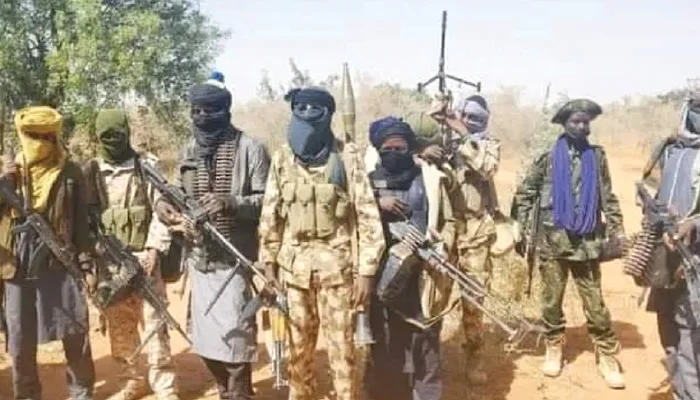
The retired officer’s ordeal was endured in Rijana forest, a notorious terrorist stronghold located approximately 33 miles south of Kaduna city. Ali described the location as housing a massive operation with more than 2,000 well-armed terrorists, supported by several smaller cells scattered throughout the vast forest. [TruthNigeria recently reported that hundreds of hostages also are warehoused in two large outdoor camps in Kachia County on the border with the Federal Capital Territory.]
“I spent most of my time in captivity in Rijana. I would hear the terrorists speak on phone telling their callers that they should come to Rijana,” Ali said. “It is a massive camp with more than 2,000 well-armed terrorists.”
Beyond Ransom: A Catalog of Horrors
The arms-for-ransom pipeline is only one dimension of the humanitarian catastrophe in Nigeria’s terrorist hostage camps reported by TruthNigeria for more than 12 months. Ali’s testimony also documented systematic sexual violence, torture, and murder, crimes that he witnessed firsthand during his captivity.
“The things those terrorists do to people can only be imagined. I witnessed them rape women and girls, I witnessed torture, some tortured to death,” he said, his words offering a glimpse into the suffering endured by thousands of Nigerians currently held in similar camps across the country.
Political Calculations and Perverse Incentives
The persistence of Nigeria’s kidnapping crisis cannot be understood without examining the political dimensions of ransom payments.
“Kidnapping is a for-profit enterprise in Nigeria, in some cases abetted by state governors,” according to Scott Morgan, an Africa security expert interviewed by TruthNigeria.
He says ransom payments serve dual purposes for politicians: they provide immediate relief that can be publicized as successful intervention, while avoiding the political risk of failed prosecutions.
Zariyi Yusuf, former National Coordinator of the Middle Belt Patriots, was even more direct in his assessment: “Focus must beam on the government of Nigeria, especially state governors who prioritize paying ransoms, striking peace accords and staging state-sponsored ceremonies of welcoming ‘repentant terrorists,'” he stated.
Yusuf pointed to the case of Ado Aleru, one of the most notorious bandit-militia leaders. “At the end of the interview when the BBC reporter asked him what he does with monies he gets from government and individuals (ransoms) he simply stated, ‘we acquire more arms,'” Yusuf said. “The huge sums that have gone into ransom payments or monies paid by government to appease terrorists, in billions, is clearly seen in the corresponding increase in the sophistication of the weaponry of the Islamist fighters.”
His conclusion was stark: “What we call ransom or ‘compensation’ or ‘appeasement’, especially from the Nigerian government (state governments), is a clever guise of empowering the Islamists with resources by their sympathizers in places of power.”
International Cooperation and New Hope
But there are signs of renewed international commitment to addressing Nigeria’s security challenges. On Friday, January 23, 2026, the United States and Nigeria convened a high-level working group meeting in Abuja focused on security cooperation and counterterrorism efforts.
The meeting brought together senior officials from both nations and addressed critical areas including intelligence sharing, capacity building for Nigerian security forces, and strategies to disrupt terrorist financing networks, according to sources familiar with the face-face exchanges. These sources noted that conversations about cutting off terrorist funding homed in on the ransom-to-arms pipeline.
The timing of this bilateral engagement is significant. It comes as Nigeria grapples with an increasingly sophisticated terrorist threat. For the working group’s initiatives to succeed, they must address the systemic corruption that enables arms trafficking, strengthen vetting and oversight of security personnel, and develop alternative strategies for hostage recovery.
The Road Ahead
John Ali’s testimony offers a roadmap of the challenges Nigeria must overcome to break the cycle of kidnapping and terrorism. His five months in captivity revealed an enemy that is well-funded, well-armed, and confident in the protection provided by corrupt officials and political calculations.
The question now is whether Nigeria’s leadership, supported by international partners, can muster the political will to confront not just the terrorists in the forests but also the enablers in positions of authority.
The testimony of one retired intelligence officer has illuminated the dark mechanics of Nigeria’s kidnapping economy. The question is: Will those in power have the courage to act on what has been revealed?
Steven Kefas is a conflict reporter for TruthNigeria.