


Jihadist Enclave in Kainji Lake Morphing into Next Sambisa Forest?
By Onibiyo Segun
Suspected members of Jama’atu Ahlis Sunna Lidda’awati wal-Jihad (JAS), a Boko Haram faction, carried out a deadly nighttime raid on Damala village in Borgu County, Niger State, killing at least four residents and burning a church, according to eyewitnesses and local security sources.
National media reports described the assailants only as “bandits,” but residents and analysts say the tactics bear hallmarks of jihadist operations increasingly spreading into Nigeria’s North-Central region.
The attack, which occurred late on January 9, 2026, has renewed fears that extremist violence once concentrated in Nigeria’s northeast is pushing southward and westward, exploiting weak rural security, forest corridors, and delayed official acknowledgment.
According to a prior TruthNigeria investigation into the January 3, 2026 Kasuwan Daji massacre in the same Borgu area, the attacks form part of a deliberate jihadist campaign to create a secure no-settlement perimeter around Boko Haram–controlled gold mining sites deep inside the Kainji Lake National Forest.
The St. Mary’s Catholic secondary school kidnapping and the following massacres in Borgu County (Local Governance Area) may be the same jihadist group. TruthNigeria exclusively reported an unnamed security expert who identified the kidnappers of the St. Mary’s school as JNIM, which identifies itself as Al Qaeda affiliated. Yet, the former commissioner of Niger State Security, the Hon. Emmanuel Umar, told TruthNigeria last week the killings in Borgu have the signature of Boko Haram, which identifies as linked to Islamic State.
Night Raid in Borgu
Musa Abdullahi, a local vigilante (community guard) leader in Damala, said the attackers struck under cover of darkness, firing sporadically, looting foodstuffs and livestock, and setting homes and a place of worship ablaze before withdrawing toward nearby forest routes.
“The gunmen spoke Hausa, accused people of cooperating with security forces, and disappeared into the forest,” Abdullahi told TruthNigeria.
“Their movement and coordination looked exactly like Boko Haram.”
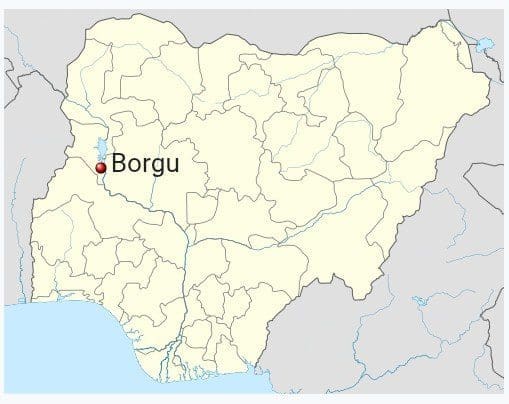
Damala lies about 40 kilometers from New Bussa, Borgu’s administrative headquarters, and roughly 200 kilometers north of Ilorin, the Kwara State capital. Though far from major highways, the village sits close to dense forest reserves increasingly used as transit and hideout zones, security experts say.
Police and national media reports, including Channels Television, confirmed the killings and destruction but did not identify a specific group, referring to the attackers as “bandits.”
Fear, Displacement, and a Burned Church
Damala, a predominantly Kambari farming community, was thrown into panic as residents fled into surrounding bush paths and neighboring villages.
The Kambari are an indigenous ethnic group in north-central Nigeria, concentrated in Borgu, Agwara, and Kontagora areas of Niger State. Many Kambari settlements lie south and east of Kainji Lake, near Kainji National Park – a remote forested zone spanning Niger and Kwara states whose isolation and proximity to cross-border routes have increasingly exposed communities to militant movement.
By morning, survivors returned to find charred homes, stolen livestock, and a church reduced to ashes. Several families have since abandoned the village, joining a growing population of displaced residents across Borgu and neighboring counties.
Villagers said losses of cattle, goats, and poultry wiped out their primary means of livelihood.
A Broader Pattern Emerges
Security experts caution that the violence unfolding in Borgu reflects more than criminal kidnapping or cattle rustling.
Mr. Kabir Adamu, Managing Director of Beacon Consulting in Abuja, said the attacks show early signs of insurgent consolidation.
“This fits a pattern of territorial testing,” he told TruthNigeria. “It’s how armed terrorist groups probe new areas before entrenching.”
Another Abuja-based analyst, Mr. Sadiq Abubakar, said civilian targeting remains consistent.
“Whether they are called bandits or terrorists, attacking villages, schools, and churches is deliberate. The effect on civilians is the same,” he said.
Why Kainji National Park Matters
At the center of growing concern is Kainji National Park, a vast forest reserve near Kainji Lake, formed by the Kainji Dam on the Niger River in North Central Nigeria.
According to regional security analysts and intelligence assessments reviewed by TruthNigeria, jihadist groups, including JAS Boko Haram elements, ISWAP-linked cells, Ansaru splinter factions, and Sahel-based JNIM fighters, exploit forest corridors stretching from the Liptako–Gourma region through Benin Republic into Nigeria’s North-Central zone.
Security analyst Zagazola Makama reported on X on January 10, 2026, that militant movements around Kainji reflect “jihadist operational patterns rather than opportunistic banditry,” warning the area could become a permanent sanctuary without early intervention.
Debate Over Counterterrorism Response
The expanding militant footprint around Kainji has fueled debate over why known forest hideouts have not been decisively neutralized.
Niger State Commissioner for Homeland Security Emmanuel Umar said the government was aware of evolving threats in the Borgu–Kainji axis and that security agencies were adjusting deployments but declined to comment on specific militant identities or operations.
Some analysts have questioned why U.S. drone surveillance and strike capabilities used elsewhere in Africa have not been applied to the Kainji corridor. Mr. Akin Olaniyan, a Lagos-based defense analyst, said such action would require Nigerian authorization.
“Foreign kinetic operations cannot occur without explicit political approval,” he said.
Avoiding Another Sambisa
Counterterrorism experts warn that Kainji shows early warning signs similar to those preceding Boko Haram’s entrenchment in Sambisa Forest: vast ungoverned terrain, delayed political acknowledgment, and fragmented response.
“The danger is not the forest,” said Dr. Abubakar Sidi, a terrorism expert based in Maiduguri.
“It is what happens when warnings are ignored. If left unchecked, the Borgu–Kainji corridor could evolve into a permanent jihadist sanctuary.”
For residents of Damala, the warning is already reality – burned homes, fresh graves, and the fear that violence once seen as distant has arrived.
Onibiyo Segun reports on terrorism and conflict for TruthNigeria.