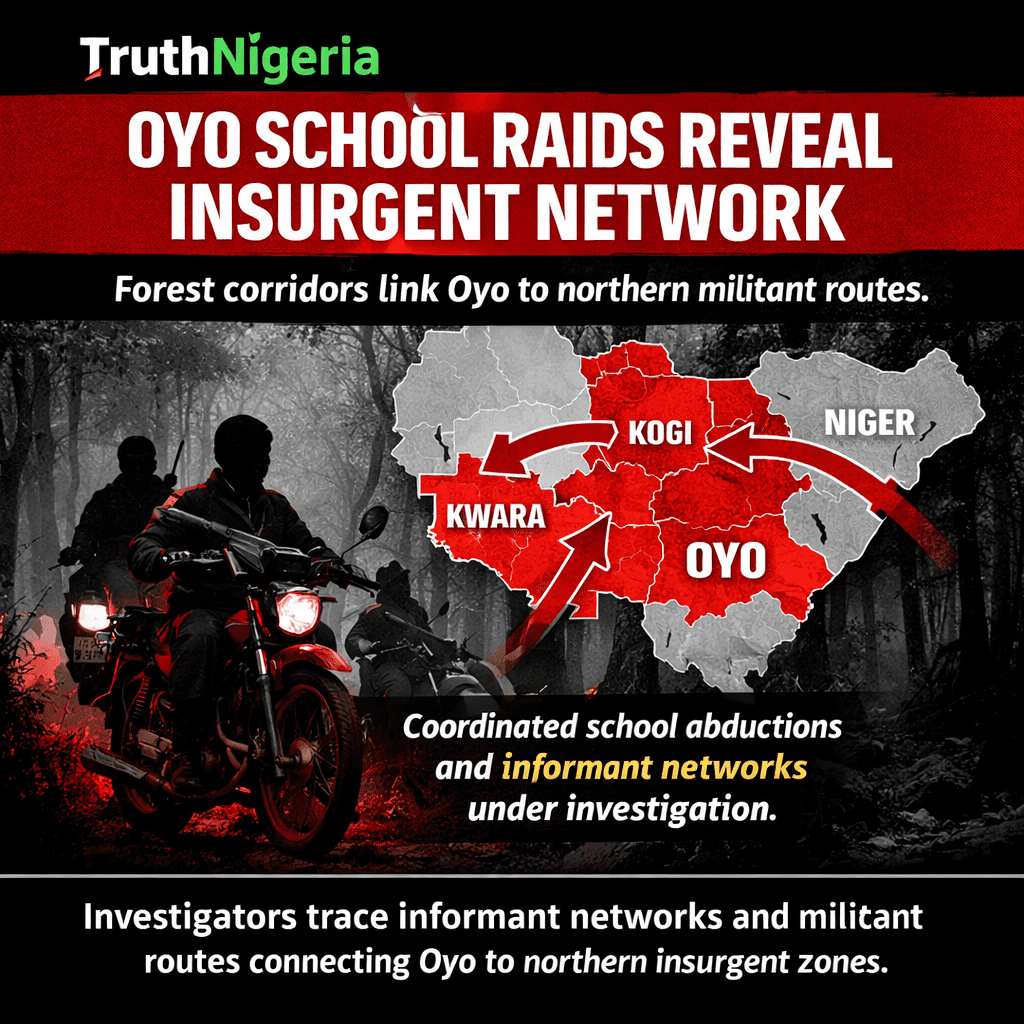
Investigators trace informant networks and militant routes connecting Oyo to northern insurgent zones.
Armed groups show increasing operational alignment with ISWAP and ISIS-linked networks though analysts remain divided on operational verification.
By Onibiyo Segun
IBADAN, Nigeria —Recent attacks in Oyo State expose a dangerous insurgent network using forest corridors to expand across Nigeria’s southwest. Security analysts say the raids mark a turning point, revealing how informant systems, mobility routes, and coordinated abductions now link rural Oyo to broader militant operations spanning Kwara, Kogi, and Niger states.
Teacher Killed in School Raid
On Sunday 17 May 2025, Mr. Michael Oyedokun, mathematics teacher at Community High School Ahoro-Esiele, was killed during attacks affecting multiple schools.
Oyedokun, a Christian member of Living Faith Church, was beheaded during assault triggering panic and school closures across communities.
Residents said violence reinforced fears that insurgent tactics from northern zones now appear in southwest rural communities.
Videos circulated by attackers during incidents were described by analysts as insurgent messaging aimed at amplifying fear, demonstrating reach, and shaping perception rather than incidental documentation to influence communities and security perception on ground.
Coordinated Multi-School Abductions
On Friday 15 May, armed attackers targeted Community Grammar School, Baptist Nursery and Primary School, and Local Authority Primary School in Esiele, Oriire county.
At least two teachers and an Okada rider were killed, while more than 50 pupils and seven teachers were abducted during raids.
Witnesses said attackers arrived in coordinated groups, some on motorcycles, while others moved through bush paths linked to Old Oyo National Park.
The terrain has increasingly been cited as a corridor for cross-county movement between Oyo, Kwara, Kogi and Niger states.
Residents described sustained gunfire as victims fled into vegetation before being forced into forest zones ahead of response teams.
Informant Network and Phone-Trace Investigations
Security investigations reported in national media indicate attackers may have relied on local informants providing intelligence on school schedules, terrain access, and patrol patterns.
Oyo State Police Command spokesperson, deputy superintendent of Police, DSP Oluyinka Ayanlade confirmed phone tracking has led to arrest of six suspects assisting investigators.
“We have six suspects in custody, helping us trace the network behind these crimes,” DSP Ayanlade told Vanguard.
Analysts say informants reflect a key operational feature of insurgent kidnapping systems where collaborators provide logistics intelligence food access and navigation support enabling sustained operations across rural areas.
Hostage System Dynamics and Ransom Uncertainty
Although no ransom demand is confirmed, analysts estimate similar mass abductions could range from ₦5 million to ₦20 million per victim ($3,100 to $12,500), potentially totaling ₦250 million to ₦1 billion depending on numbers reflecting evolving financial and coercive dynamics within kidnapping economies regionally.
Analysts caution ransom extraction is one layer of broader strategy including coercion negotiation leverage and publicity signaling.
Families Await Rescue as Operations Continue
Security officials say rescue operations are ongoing.
In a Channels Television interview, Oyo State Police spokesman, DSP Ayanlade confirmed: “Seven students, 18 pupils, and seven teachers are still missing, and rescue operations are ongoing.”
Families continue to appeal for urgent intervention amid uncertainty over captives.
Professor Wole Alamu, husband of abducted principal Mrs Folawe Alamu, said agencies assured families operations are active but sensitive.
“We are going to grant an interview, but not now. The work is seriously being done underneath”, Mr. Alamu said.
“Anything you say now may jeopardise the rescue operations,” he added.
Oriire county chairman Oriyomi Hamzat said forces are tracking movements through forest corridors used as temporary camps and escape routes.
Intelligence Assessments and Insurgent Alignment Claims
Security analysts interviewed by TruthNigeria say killings abductions and coordinated movement suggest structured planning beyond opportunistic crime.
Colonel Emeka Okafor (ret.) said: “The executions, abductions, and coordination reflect ideological planning.”
He added some rural armed groups show increasing operational alignment with ISWAP and ISIS-linked networks though analysts remain divided on operational verification and attribution certainty.
Dr. Aisha Suleiman said insider collaboration remains central to success, enabling evasion, target selection, and sustained communications.
Analysts also note victim selection requires assessment of ideological, financial, and local conflict drivers.
Security Response And Layered Forces
Joint operations involve Army, Police, Amotekun, Nigerian Security & Civil Defense Corps – NSCDC, Agro-Rangers, Forest Guards, and vigilantes & hunters across forest belts.
Forest Guards are trained state personnel supporting surveillance, while vigilantes are local volunteer groups with terrain knowledge.
Officials say operations have disrupted parts of the network though clearance efforts continue.
Expanding Forest Corridor Threat
Security analysts say attacks reflect shifting violence patterns where forest corridors function as transit and concealment zones for armed groups.
Retired Air Vice Marshal Boniface Monday said rural expansion is underestimated.
“These Oyo attacks show convergence of criminal networks and insurgent influence beyond hotspots,” he said.
Data from the Nigeria Terror Tracker shows rising kidnappings along forest-linked corridors across Kwara, Niger, Kogi, and Oyo states over three years linking remote settlements and enabling rapid movement across state boundaries.
System-Level Implications
Authorities urge vigilance, intelligence sharing, and rapid reporting.
Officials are reviewing school protection frameworks and rural surveillance coordination to address emerging mobility patterns of armed groups operating across state boundaries and strengthening inter-agency coordination across affected rural security zones frameworks.
The Oyo raids underscore how insurgent tactics once confined to Nigeria’s north are now testing the country’s southern security architecture. As forest corridors become contested terrain, the question is no longer whether militants can operate in the southwest — but how far they have already advanced.
Onibiyo Segun reports on terrorism and conflict for TruthNigeria.