
Terrorist Sanctuaries Expand into Ungoverned Forests from Northwest to Southwest
By Segun Onibiyo
Abuja, FCT, Nigeria – A girl with a rusted hoe stands in an empty field in Oke-Ogun, Oyo State, listening for the sound of motorbikes instead of birds. Once a place of yam mounds and cassava ridges, it is now a landscape of silence and dread. Fear of sudden raids has turned fertile land into wasteland across the Southwest, as terror groups and Fulani ethnic militia terrorists expand southward from the war-ravaged Northwest.
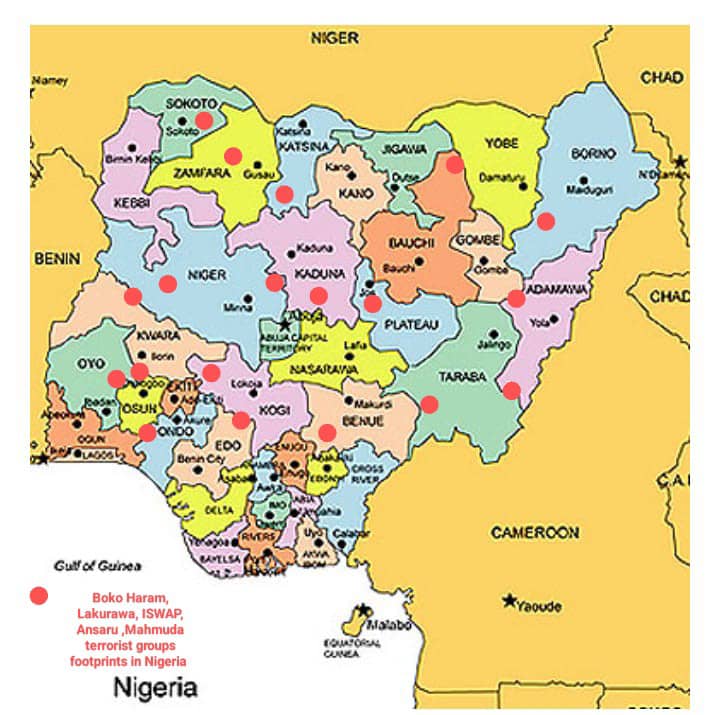
From July to August, Northwest Nigeria witnessed at least 200 civilian deaths and thousands displaced. Villages in Tsafe (Zamfara), Sabon Birni (Sokoto), and Jibia (Katsina) are now trapped in extortion rackets. The Boko Haram-affiliated Mahmud faction in Katsina and the Al-Qaida-linked cells of Lakurawa in Sokoto have extended their reach, echoing Boko Haram’s territorial experiments a decade ago. Analysts describe these zones as “warlord fiefdoms” pockets where Abuja’s authority has collapsed.
Quasi-Overlords and Criminal Governance
The question once raised by TruthNigeria correspondents Mike Odeh and Luka Binniyat in Zamfara in 2024, “Are bandits becoming overlords?” has today been answered. Dr. Murtala Rufa’i, a security historian, who explains to TruthNigeria: “In Zamfara, Niger, and Sokoto, terrorists now dictate farming calendars, settlement rights; the state is absent.” In Shiroro, Niger State, households pay up to ₦50,000 annually for “protection.” In Sabon Birni, farmers secure permits from Bello Turji’s men before planting millet. Kebbi’s Danko-Wasagu region mirrors this “parallel rule,” confirmed by church leaders.
Expansion of Sanctuaries Toward the Southwest
Dr. Ayo Obe, a governance expert speaking to TruthNigeria, calls Abuja’s strategy of granting amnesty to terrorist bandits “state abdication.” She highlights links between bandit cells and jihadist groups such as Boko Haram providing the latter with logistics: “They provide smugglers, safe havens, and recruits.” She warns Washington that these enclaves are becoming hybrid sanctuaries, terrorist incubators with global implications.
The spillover is no longer hypothetical. In Baruten county, Kwara State, terrorists believed to be splinter members of Boko Haram fleeing army raids in the Northwest struck Ganmu-Alheri in Ifelodun County, targeting Christian enclaves in Babanla and Ganmu-Alheri all in Kwara state, North-Central Nigeria. More than 200 fighters overwhelmed a police station, looted markets, abducted villagers, and forced 3,000 to flee.
Who Is Winning?
Government efforts show mixed results. Military raids in Zamfara, Katsina, and Sokoto dismantled some camps, yet terrorists resurfaced in Kwara, Kogi, Ondo, Ekiti, and Oyo forests.
Southwestern states have funded paid local defense units known as Amotekun for five years and officers of the organization tout their successful efforts.

The Amotekun Corps Commander in Ondo state, Southwest Nigeria, Adetunji Adeleye, speaking to TruthNigeria said: “We have pushed terrorists out of forest bases and disrupted kidnapping rings, but need intelligence and logistics to sustain gains.”
“Joint patrols with the army reduced raids in Oke-Ogun, though insurgents keep probing for weak spots,” retired Major Funmi “Ajala” Olatunde in Oyo State told TruthNigeria.
Traditional rulers corroborate the value of Amotekun. The Baálé of Osi, Kwara’s Ifelodun, told TruthNigeria: “Families abandon farms because terrorists on motorbikes cross into our villages at night.” In Kogi’s Yagba East, the Balogun of Isanlu adds: “We hear gunfire weekly, our people need protection, not promises.”
Rafiu Ajakaye, Chief Press Secretary to the Kwara Government told TruthNigeria, “beginning on August 10, the Nigerian Army had taken direct control of Ifelodun county security operations, citing the urgent need to flush out entrenched terrorists’ criminal camps.”
On August 29, TruthNigeria reported a possible terrorist attack in Offa county, in Kwara state.
Yet sources in the Nigerian military offer a caution. “These terrorists retreat when hit, then return in smaller units to test our defenses,” one senior source told TruthNigeria. Experts warn that without federal firepower and rural intelligence, the southward creep will continue.
Governors, Military and Amotekun Respond
Oyo Governor Seyi Makinde warned in July: “Our farmlands are being invaded.” His colleagues in Ogun and Ondo pledged support for Amotekun. Commander Adetunji Adeleye (Ondo Amotekun Corps,) stresses the corps’ strength: “Our local intelligence allows us to track terrorists, cut supply lines, and clear forests.”
Amotekun’s UN ECOSOC recognition has elevated it globally as the first state-owned African security corps with international validation.
Dr. Fatima Adamu, a counterterrorism scholar based in Abuja, warns that bandit-terrorists are copying Boko Haram’s blueprint for raids, taxation, and parallel rule. She warns of possible synergy with ISWAP, creating a full insurgency in the Southwest if unchecked.
The Numbers Behind the Fear
According to the National Human Rights Commission, at least 2,266 people were killed by terrorists in Nigeria during the first half of 2025 – surpassing the total number of such deaths in all of 2024.
Populations in Nigeria’s north-central Plateau and Benue states are facing increased risks amid a sharp rise in inter-communal violence. More than 100 people were killed in April, including over 50 in two districts alone following consecutive massacres. Violence persisted into May and June, with at least 62 additional deaths. In Benue State, between 13 and 14 June 262 people were killed in an overnight assault on Yelewata village by Fulani ethnic militia, TruthNigeria reported.
Implications for the West
Lagos, home to U.S. energy investments, faces risk due to its proximity to Kwara, Oyo and some other North-Central states. Terror disruption could shake oil exports, trigger piracy in the Gulf of Guinea, and create jihadist sanctuaries. Retired Nigerian military officer Spiff Bolanke told TruthNigeria reporter that “America now has a direct stake in the Southwest front. Failing to care may mean harm to its interests”.
Recommended actions mentioned by several security experts interviewed by TruthNigeria include these:
1. Permanent garrisons in hotspots.
2. Fusion intelligence centers.
3. Dismantling of criminal imposed “protection fees.”
4. Extending humanitarian aid to victims of terror, especially Christian communities.
For those living in Ganmu-Alheri and the girl with the hoe in Oke-Ogun, life narrows to two realities: fear and resilience. What some believe began as regional banditry has evolved into a parallel sovereignty that now challenges Abuja’s writ and threatens global stability. Unless Nigeria and its partners escalate from short-term responses to strategic, integrated interventions, the Southwest may soon be carved into outlaw enclaves mirroring Zamfara’s nightmare.
Onibiyo Segun reports on terrorism and conflicts for TruthNigeria.