National Security Advisor Nuhu Ribadu Pushing Bandit Appeasement: El-Rufai
By Luka Binniyat
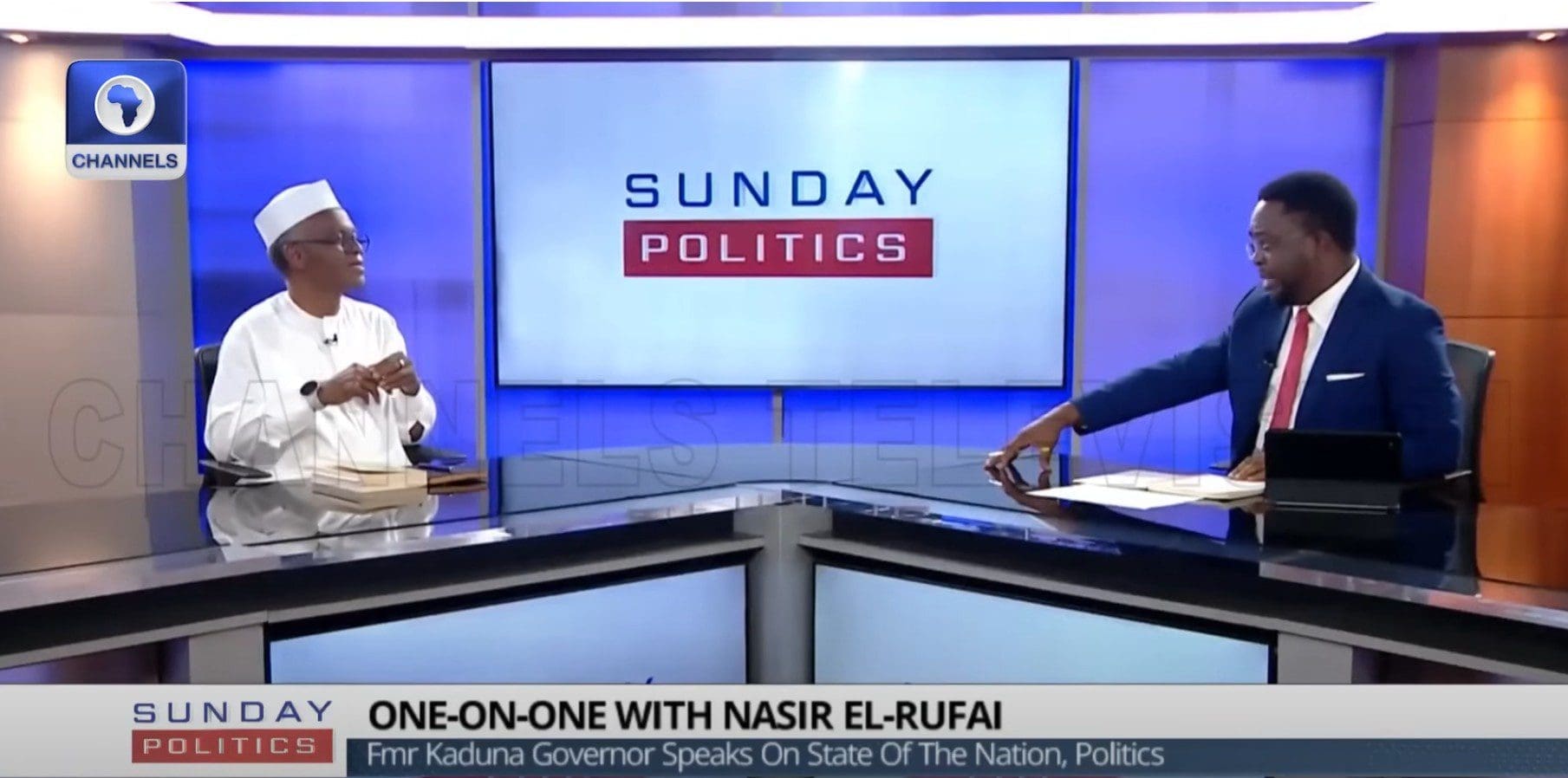
(Kaduna, Nigeria) – Former Kaduna State Governor, Mallam Nasir El-Rufai, has ignited a storm of controversy after alleging that both the Federal Government and the Kaduna State Government are paying armed bandits to secure peace in the Nigeria’s Northwest.
His remarks, made during a live interview on Channels Television’s Sunday Politics program on August 31, have drawn sharp condemnations from both state and federal authorities, who dismissed the claims as “false, reckless, and dangerous.”
El-Rufai, who governed Kaduna from 2015 to 2023, accused the government of adopting what he described as a “national policy of appeasement” that funnels money, food, and allowances to bandits under the guise of non-kinetic security measures.
When asked if Kaduna State was directly involved, El-Rufai said the policy was not initiated at the state level but driven by the Administration of Bola Tinubu, according to allAfrica coverage of the interview.
“It is not the government of Kaduna State, it is a national policy driven by the Office of the National Security Advisor, and Kaduna is part of it. Many states are objecting, but that is the policy now – kiss the bandits. That is the new policy,” El-Rufai alleged. sked if Kaduna State was directly involved, El-Rufai said the policy was no
“What I will not do is to pay bandits; give them monthly allowances or send food to them in the name of non-kinetics. It’s nonsense! You are empowering bandits,” El-Rufai said.
“My position has always been: Kill the bandits. The only repentant bandit is a dead one. Let’s kill them, let’s bomb them. The remaining 5 percent that want to be rehabilitated can be rehabilitated. You don’t pamper your enemy; you don’t give him money to buy more weapons.”
El-Rufai further alleged that ransom payments have already been made in Kaduna State. “The first time they attacked a school, they paid them a billion naira ($700,000). They are paying bandits; they are apologizing to them. Let the governor or anyone come and deny—we have the evidence. At the right time, we will make it available.”
The former governor contrasted his administration with the current one, claiming that school abductions were far less frequent during his tenure. “I was Governor of Kaduna for eight years; only two schools were attacked. This government has been around for two years, and three schools have already been attacked,” he said.
Kaduna State Fires Back
The Kaduna State Government swiftly responded with an unusually hard-hitting statement, accusing El-Rufai of plotting to destabilize the state and drag it back into violent conflict.
In a statement signed by Dr. Suleiman Shuaibu, Commissioner for Internal Security and Home Affairs, the government said El-Rufai’s allegations were part of a calculated attempt to incite unrest after his political allies lost in the August 16 by-elections.
“The Kaduna State Government is compelled to issue this unequivocal and final warning to a former Governor of the State, Mallam Nasir El-Rufai, who, through overt provocation and covert manipulation, is plotting to unleash mayhem across Kaduna State,” the statement read.
“Mallam Nasir El-Rufai cannot stomach the progress Kaduna is making under Governor Uba Sani. Instead of supporting this journey of recovery, he has chosen to obstruct it by peddling dangerous lies designed to incite violence and discord.”
The government accused El-Rufai of convening “an illegal and chaotic meeting” of his political coalition on August 30, which allegedly descended into violence, including gunfire. The statement claimed his television interview was a continuation of this destabilization effort.
“His reckless allegation that both the Federal and Kaduna State Governments are bribing bandits is not just false; it is an insult to the sacrifices of our armed forces and security agencies,” Shuaibu said.
The statement credited Governor Uba Sani’s administration with restoring relative calm to once-volatile areas such as Birnin Gwari, Giwa, Kajuru, Kachia, and Igabi. It also highlighted the killing of notorious bandit leaders such as Boderi, Baleri, Sani Yellow, Janburos, Buhari, and Boka, as well as the arrest of leaders of the extremist group Ansaru.
Beyond security, the statement listed achievements in education, healthcare, financial inclusion, and infrastructure, painting El-Rufai as a relic of the past who “thrives in chaos” and “cannot relate to leadership based on dialogue and inclusion.”
“Let there be no doubt: the Kaduna State Government will do whatever it takes, within the law, to preserve peace and stability. No individual, no matter how highly placed, will be allowed to destabilize the state,” the statement warned.
Federal Government Debunks Allegations
The Office of National Security Adviser Nuhu Ribadu also rejected El-Rufai’s claims, describing them as “baseless” and “deeply insulting” to Nigeria’s security forces.
In a rebuttal signed by Zakari Mijinyawa, spokesperson for Office of National Security Advisor, the federal government insisted that no policy of paying or inducing bandits exists.
“At no time has the ONSA, or any arm of government under this administration, engaged in ransom payments or inducements to criminals,” the statement read.
“On the contrary, we have consistently warned Nigerians against paying ransom. El-Rufai’s allegations contradict verifiable facts on the ground.”
ONSA cited military successes in Kaduna and neighboring states, including the elimination of high-profile bandit kingpins and the dismantling of Ansaru’s operational bases.
“These successes came at a cost—some of our brave officers paid the supreme price. For a former governor to deny these sacrifices on national television is unfair and deeply insulting to their memory,” the statement said.
The National Security Adviser’s office urged political actors to avoid dragging national security institutions into partisan conflicts, emphasizing that “the fight against banditry is a collective struggle, not a platform for political point-scoring.”
Irony: El-Rufai’s Reign of Terror for Christian Communities
The revelations of the Channels interview illustrate that both the current governor and El-Rufai himself stand accused of leaving vulnerable Christian residents undefended against sectarian attacks by Fulani ethnic militia.
As governor of Kaduna State for eight years, El-Rufai maintained a hard-on-crime approach to bandit terrorism, although the record shows that Kaduna Christians suffered horrific attacks by Fulani terrorists and kidnappers on his watch.
In early 2020, so-called armed herdsmen, often referred to locally as “bandits,” attacked more than 125 predominantly Christian villages in Chikun and Birnin Gwari Christian counties. They killed scores, abducted hundreds—including infants—burned churches and homes, looted valuables, and destroyed farmlands, leaving victims destitute and displaced in trauma camps without food, clothing, or shelter. These traumas drove many from their ancestral homes, forced them into makeshift camps, and plunged entire communities into poverty and hunger. Police promised to arrest suspects so that they could be tried by courts, but virtually no suspects were arrested.
Statistics from Southern Kaduna indicate that communities have paid hundreds of millions of naira in ransom, deepening their economic fragility. The victims have blamed El-Rufai for turning a blind eye to the Christian genocide unfolding in his state.
The battle of narratives between the Fulani National Security Advisor and the Fulani ex-governor of Kaduna has exposed damning evidence of prejudice against Nigerian Christian residents that pro-Christian media for decades has been hard-pressed to bring into the public eye.
Luka Binniyat is a conflict reporter for TruthNigeria and is based in Kaduna, Nigeria.