![Nuhu Ribadu (r) in a handshake with his immediate predecessor Babagana Monguno on June 26, 2023 [Twitter/@NuhuRibadu]](https://b4243027.assetcdn.net/2.0/4243027/wp-content/uploads/2025/10/Ribado.webp?lossy=2&strip=1&webp=1 "Ribado")
As Washington debates Christian genocide, Nigeria Follows a Dual Strategy
By Steven Kefas
(Abuja, Nigeria) The attackers came in the dead of the night, their war cries of “Allahu Akbar” piercing the morning stillness. For over four hours, Muslim Fulani militants descended upon Yelewata, a community of 10,000 souls in Benue State, wielding military-grade weapons with impunity. When the carnage ended on June 14, 2025, 258 Christian farmers—mostly refugees who had already fled previous attacks—lay dead in pools of blood, or mounds of charred bones.
The most damning detail? Yelewata sits less than 30 minutes’ drive from Lafia, the Nasarawa State capital, and roughly 30 minutes from Makurdi, the Benue State capital. Both cities house military barracks. Yet, for four interminable hours, help never came.
But this is the story of Nigeria’s Middle Belt—a predominantly Christian region where mass killings have become routine, military intervention remains conspicuously absent, and the federal government’s response oscillates between silence and suggestions that victims surrender their ancestral lands to their killers.
A Tale of Two Battlefronts
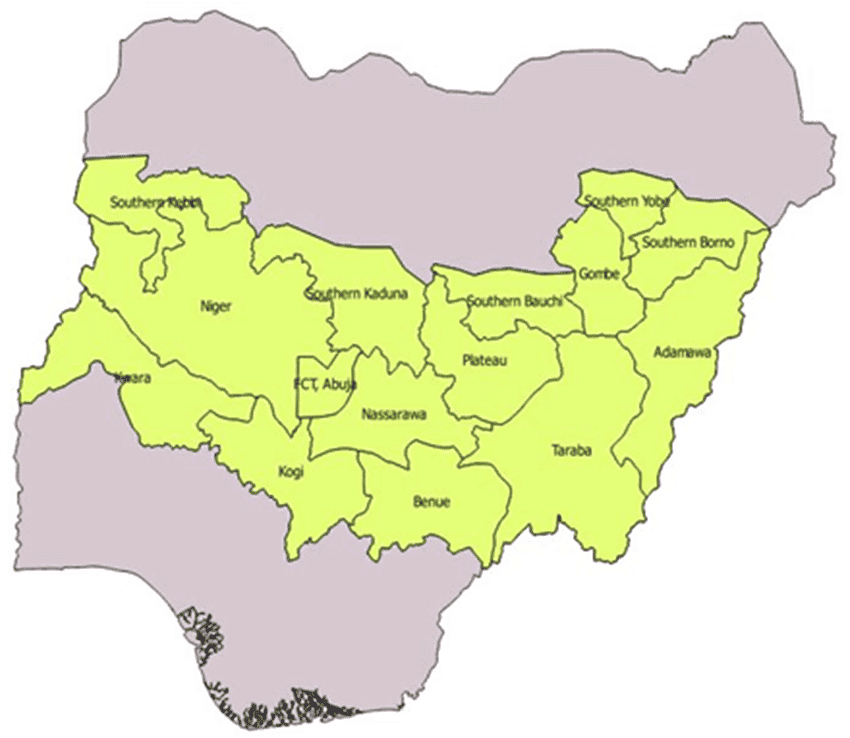
Nigeria’s security landscape is undeniably complex. Boko Haram and ISWAP, (Islamic State of West Africa) a combined threat encompassing 18,000 fighters, terrorize the Northeast. Muslim Fulani militants feast on the Middle Belt. Bandits—a sanitized term for Fulani ethnic militia—plague the Northwest. Lakurawa and Ansaru jihadist fighters operate across the North. Yet, military operations remain heavily concentrated in the Northwest and Northeast according to security experts interviewed by TruthNigeria, leaving the Middle Belt to bleed in the shadows.
The Observatory for Religious Freedom in Africa (ORFA), a non-profit organization, documented this disparity in stark terms. In its four-year report covering October 2019 to September 2023, ORFA observed that despite several local government areas in the Middle Belt ranking among the top ten for casualties, security interventions remained focused elsewhere.
Since President Bola Tinubu assumed office in May 2023, little has changed. Despite appointing security chiefs from diverse regions, military operations are lopsided. True, scores of Fulani bandit commanders have been neutralized in the Northwest since Tinubu’s inauguration, and all have been named and profiled in Nigerian Army press releases. Yet in the Middle Belt? The terrorists continue their reign of terror unabated, taking over scores of villages and never facing military pushback from core army units, nor bombing from Nigerian Air Force.
“The Nigerian military has been known to make claims of neutralizing Islamists, or bandits as they prefer to call them, over the years, but the corresponding effect is that there has only been a proliferation of such Islamist groups and a sophistication in their weaponry in the Middle Belt,” Zariyi Yusuf, immediate past National Coordinator of the Middle Belt Patriots, told TruthNigeria.
The Peace-Deal Charade
Recent footage emerging from Nigeria’s Northwest has exposed what many observers have long suspected: the military’s engagement with these terrorist groups looks less like counterinsurgency and more like capitulation.
Videos show armed Fulani militants, brandishing military-grade weapons, arriving for so-called peace talks in Guga Ward, Bakori Local Government Area of Katsina state. They appear relaxed, confident, surrounded by traditional rulers, and disturbingly, in the presence of military personnel. No arrests. No disarmament. Just negotiations.
“Additionally, the so-called ‘peace deals’ with these terrorists and how they boldly show up with arms in the presence of the military, traditional rulers and the very same victims of their atrocities, does not support such a claim,” Yusuf noted, referencing military assertions of defeating these groups.
“The optics are devastating. Which military force negotiates with terrorists actively killing its soldiers? Which security apparatus allows armed militants to parade weapons at official meetings? The questions answer themselves, painting a portrait of institutional surrender masquerading as strategy,” according to an interview with Dr. Walid Abdullahi, security expert and scholar based in Birnin-Kebbi
“This stands in jarring contrast to the Nigerian military’s celebrated interventions in Sierra Leone and Liberia, where soldiers bravely restored peace to war-torn nations. What changed?” Abdullahi asked.
Questions No One Answers
For residents of the Middle Belt, the military’s posture raises troubling questions that authorities leave unanswered.
“To the best of my knowledge as a Middle Beltan, I have never seen or heard of a deliberate push by the Nigerian Military to either comb our forests and eliminate these Jihadists or even reclaim the communities they have sacked and even occupy in some cases,” Yusuf told TruthNigeria.
“The questions multiply with each attack: How do militants ride in their hundreds “over long distances, engage military forces, inflict casualties, and retreat without Air Force intervention? How do they attack military bases, kill soldiers, seize weapons, and disappear into the night without pursuit?” Yusuf asked.
“After the Yelewata massacre, survivors identified the attackers’ base: Kadarko, in Nasarawa State, less than 8 miles away. Residents say the militants are camped in nearby bushes. Why haven’t these camps been bombarded? Why haven’t arrests been made? “Asked Yusuf.
The same questions apply to other massacre sites: Zike, Bokkos, Mangu, Gwer, Agatu, and Kwande. How many Fulani militants have been arrested? How many face trial? The silence is deafening.
The Man Who Could Change Everything
Mallam Nuhu Ribadu, Nigeria’s National Security Adviser, comes with an impressive pedigree. An ex-police chief renowned for his no-nonsense approach, Ribadu’s appointment inspired hope among Nigerians desperate for competent security leadership.
Publisher Tom Garba, writing in TG News, authored a glowing opinion piece titled “Nigeria’s Silent Guardian: Ribadu’s No-Nonsense Approach Reshaping Security Landscape,” crediting him with transforming Nigeria’s security challenges.
Yet, the reality on the ground tells a different story. Under Ribadu’s watch, armed Fulani militants brazenly display military weapons en route to peace talks. Under his leadership, the Yelewata massacre proceeded for four hours within shouting distance of two state capitals with military installations. Under his stewardship, the Middle Belt remains a no-go zone for substantive military intervention.
For a “no-nonsense” security chief, the tolerance of such nonsense seems remarkable.
Washington Takes Notice
As Nigeria’s federal government downplays the religious dimensions of Middle Belt violence, lawmakers in Washington are paying attention. “The strategy of the Nigerian government is to play a dual role: quashing terrorists and armed gangs in one area but standing down to allow ‘friendly’ terrorists to grab lands in the Northcentral states,” according to TruthNigeria editor Douglas Burton, a State Department staffer in Iraq during the U.S. occupation. “We saw the government of Turkey play a dual role during the multinational campaign to reconquer Mosul from ISIS occupation in 2016. Turkey gave air support to dislodge ISIS forces on the ground, even while allowing ISIS to purchase explosives from Turkish manufacturers,” Burton said.
U.S. Senator Ted Cruz and four other senators are pushing “The Nigeria Religious Freedom Accountability Act” premised upon the certainty that systematic killings of Christians in Nigeria constitute genocide—a legal designation with profound implications.
The disparity in military intervention strengthens their case. When government forces concentrate operations in some regions while leaving predominantly Christian areas defenseless, when authorities label religious militants as mere “bandits,” when peace deals replace prosecution, the pattern becomes difficult to dismiss as coincidence.
“The Middle Belt and its people could be best described as being in a ‘self-preserve mode’, risking total annihilation from the deadliest terrorist organization—the Fulani Islamist militia,” Yusuf told TruthNigeria. “Their genocidal massacres have remained unchecked ever since, and calls by the Federal government, especially under late president Buhari, for the peoples of the Middle Belt to cede their ancestral lands to their killers as a way of appeasement, confirms that the genocidal massacres in the region are indeed the religious expansionism that is currently being denied—an Islamic Jihad.”
Steven Kefas is a veteran conflict reporter for TruthNigeria.