

By Onibiyo Segun
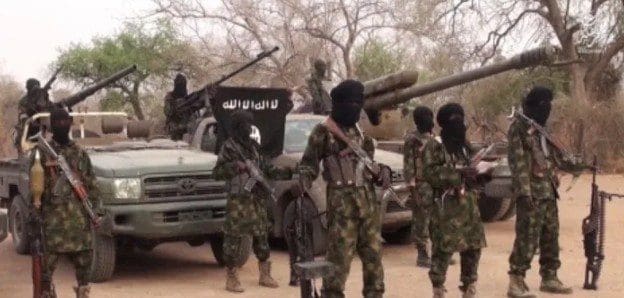
Abuja, Nigeria – “Boko Haram fighters are advancing west from Nigeria’s northeast into the Middle Belt, exploiting security gaps and increasing Abuja’s reliance on U.S. intelligence,” according to Lt. Col. Frank Akpan, a Bayelsa-based defense analyst.
“Insurgents are probing softer corridors beyond Borno,” Lt. Col. Akpan told TruthNigeria.
“When pressure rises in one theater, they disperse and test another.”
Nigeria’s 15-year insurgency, led by Boko Haram, began in Borno in 2009 and spread across Yobe and Adamawa near Lake Chad.
The group has targeted Christians, Muslim clerics, schools, markets, and security forces.
More than 35,000 people have been killed and over two million displaced.
Ransom Payments to Boko Haram?
An AFP investigation reported that Nigeria secretly paid ransom for kidnapped pupils despite official denials.
Kidnapping-for-ransom has become a major funding source for jihadist and armed groups across Africa.
“The AFP report of $9 million bribe claim is a sore thumb the Nigerian government need to clarify. Without official confirmation, such allegations could deepen public mistrust and fuel further speculation,” said Dr. Mohammed Ibrahim, a counterterrorism analyst based in Birnin Kebbi.
“Paying ransoms may save lives immediately. But it strengthens insurgent capacity long term,” Ibrahim added.
“Though unverified, Boko Haram’s abduction-for-ransom tactics align with the Papiri kidnap claims,” said Dr. Kingsley Chukwudi, public affairs analyst in Abuja told TruthNigeria.
“Western governments discourage ransom payments, but democratic states face pressure to secure abducted citizens. Nigeria confronts the same dilemma,” Chukwudi explained.
ISIS lost territory in Iraq and Syria but expanded through regional affiliates.
“ISWAP adopted this decentralized model in West Africa, combining ideological alignment with local recruitment and taxation,” said Prof. Ahmad Busari, disarmament and reintegration expert based in Maiduguri.
“Shrinking foreign deployments and porous borders across the Sahel allow armed groups to move across national lines,” Busari added.
Boko Haram’s westward probes do not yet signal territorial control, but recent attacks – village shootings, motorcycle raids, and abductions – show adaptability.
“To prevent deeper infiltration, Nigeria must pair military pressure with faster intelligence execution and stronger coordination between Abuja and state authorities,” Busari said.
Defense analysts agree that intelligence support from AFRICOM helps but cannot replace domestic reform.
“If militants secure footholds in Nigeria’s central corridor, instability could extend toward coastal West Africa,” retired Brig. Gen. Ola Balogun told TruthNigeria.
Think tank data shows attacks moving toward Niger, Kogi, Kwara, and Benue states, regions historically outside Boko Haram’s main battlefield. Incidents include village raids, roadside ambushes, and kidnappings of civilians.
Insurgent-linked incursions and rural raids are stretching federal forces and exposing weak coordination between Abuja and state authorities, according to TruthNigeria.
The shift follows sustained military pressure in Nigeria’s Northeast. In 2015, Boko Haram, which aligned itself with Islamic State in Iraq and Syria (ISIS) split.
A breakaway faction, also pledging allegiance to ISIS, forming Islamic State West Africa Province (ISWAP).
ISWAP entrenched itself around Lake Chad, attacking military bases and taxing fishing and farming communities.
Rival elements escalated kidnappings and rural assaults.
The Lake Chad Basin – spanning Nigeria, Niger, Chad, and Cameroon – remains the insurgency’s logistical base.
But concentrated troop deployments have pushed fighters to exploit ungoverned spaces less protected by Nigerian military.
North-Central Nigeria has long endured farmer–herder clashes, and security deployments remain lighter there than in Borno.
The International Crisis Group warns that poorly governed rural districts in central Nigeria provide operating space for armed groups.
TruthNigeria reporting shows Boko Haram militants are shifting operations from northeastern Nigeria into the west-central region, taking advantage of ungoverned forests and under-policed rural areas.
On February 14, Boko Haram paraded 176 abducted residents in Woro, Kaiama county (Local Government Area), Kwara State, ridiculing authorities for understating the scale of the abduction.
For Western audiences, the geographic shift carries broader stakes.
Nigeria is Africa’s most populous nation and a major oil producer.
Instability affects the Gulf of Guinea shipping lanes, energy markets, and migration flows toward North Africa and Europe.
The pattern mirrors developments across the Sahel. In Mali, Burkina Faso, and Niger, jihadist groups linked to ISIS and al-Qaeda expanded after being pushed from earlier strongholds.
Fighters disperse under pressure and regroup where state presence is weaker.
Abuja has expanded intelligence cooperation with the United States Africa Command (AFRICOM).
TruthNigeria reported that a U.S. Special Forces team quietly deployed to Nigeria to support counter-terror coordination, surveillance, and reconnaissance.
U.S.- Nigeria cooperation includes intelligence sharing, surveillance support, and counter-improvised explosive device training.
AFRICOM does not conduct combat operations; its role is advisory.
“Intelligence-sharing is often decisive against mobile insurgents,” Lt. Col. Akpan told TruthNigeria.
“But intelligence only works if political and logistical systems can act on it quickly,” he added.
Analysts cite slow interagency communication, uneven coordination with state governments, and limited rapid-response capacity in western states.
Forward operating bases remain concentrated in the northeast. Central states lack the same footprint.
Even accurate intelligence loses value if forces cannot mobilize quickly.
For Africa’s largest democracy and its international partners, the objective is containment before insurgent diffusion accelerates.
Onibiyo Segun reports on terrorism and conflict for TruthNigeria.


well reported