By Mary Kiara
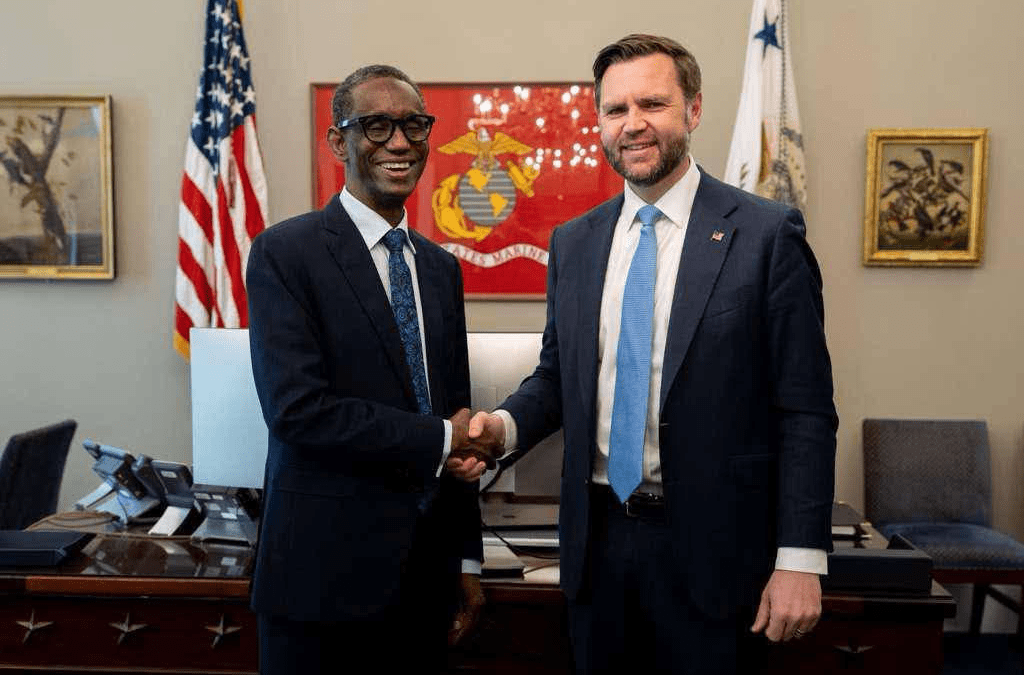
(Abuja) – Nigeria’s National Security Adviser, Nuhu Ribadu, shook hands with U.S. Vice President J.D. Vance in Washington last week, while killings and kidnappings escalated sharply at home.
The timing could hardly have been worse.
Days before Ribadu’s trip, a military airstrike in Borno State killed at least 100 civilians, most of them children. A state commissioner described the dead “terrorist informants.”
Days after Ribadu returned, armed terrorists abducted 39 schoolchildren and seven teachers in Oyo State-Northwest Nigeria, before later releasing a video showing the beheading of teacher Michael Oyedokun.
For years, Nigerian officials have described the violence as “banditry,” “communal conflict,” or “farmer-herder clashes.”
But critics increasingly argue the language itself has become part of the war.
“What we have are sleeping communities invaded by heavily armed militants carrying weapons ordinary herders could never afford,” a Middle Belt civic leader told TruthNigeria anonymously.
“A clash implies two sides fighting. What we have is organized invasion.”
A Handshake Heard in the Middle Belt
Ribadu’s visit, from May 4 to May 6, included meetings with VP Vance, Secretary of State Marco Rubio, and other senior officials. The presidency hailed the trip as deepening “counterterrorism cooperation.”
But many Nigerians saw something else.
“While our people are slaughtered, Abuja’s priority is photo‑ops in Washington,” Aba Anuhe, retired Journalist, told TruthNigeria.
The numbers back the claim.
Nigeria recorded nearly 12,000 conflict-related deaths in 2025, according to the Armed Conflict Location & Event Data Project (ACLED), more than several active war zones.
The 2026 Global Terrorism Index, identified Nigeria as having the largest increase in terrorism deaths worldwide. Attacks rose 43 percent, while fatalities increased 46 percent in 2025 alone.
“The crisis has clearly outgrown the environmental explanation,” human-rights lawyer Emmanuel Ogebe told TruthNigeria.
“Rather than confronting the problem, the government dissipates energy denying the problem,” Ogebe said.
The Disarmament Trap
When terrorists strike Nigeria’s Benue or Plateau states, officials describe the attacks as
“farmer‑herder clashes.” When similar violence erupts in Zamfara State, it becomes “banditry.”
Victims say the language masks a more organized campaign.
“The soldiers disarmed our youth volunteers, we thought they would also disarm the Fulani attackers, but that never happened,” Ofu Adu, a resident of Ochumekwu community, told TruthNigeria in an earlier interview.
More than 2.2 million civilians have been internally displaced across Benue, Plateau, and Nasarawa states since 2019, according to SBM Intelligence.
Disarmed and then attacked, original inhabitants are pushed into squalid camps while their farmlands are occupied by armed groups.
The War Moves South
TruthNigeria’s field reports and terror tracking data show Fulani Ethnic Militia networks expanding into Ondo, Ekiti, Osun, Ogun and Oyo states.
Prince Eniola Ojajuni, abducted near a military checkpoint in Ondo State in 2025,
told TruthNigeria after his release: “They (Fulani terrorists) told me they had 26 camps in Ondo alone.”
“These are jihadists, if we don’t act now, they will take the Southwest.”
More than a year later, little changed. Then came the Oyo school kidnapping and the filmed beheading.
Lobbyists Over Soldiers
Even as violence spreads geographically, Abuja continues investing heavily in international image management.
A report by International Christian Concern (ICC), titled “Nigeria’s $10 Million Genocide Cover-Up,” details multi-million dollar contracts with DCI Group and Valcour LLC, lobbying and public-relations firms hired after the United States redesignated Nigeria as a “Country of Particular Concern” over religious-freedom violations in 2025.
“The integrity of U.S. foreign policy is being compromised internally by former officials now defending regimes accused of mass atrocities,” the ICC report stated.
“As they say in propaganda, if you repeat a lie often enough, people will begin to believe it,” Ogebe told TruthNigeria.
“The Nigerian government is often cowed into placating Islamic vigilantes,
emboldening religious extremists who take matters into their own hands,” Patricia Streeter, global mission advocate for the Diocese of Western Anglicans, told TruthNigeria.
The Narrative and the War
“The government must be more sincere in its approach and should confront terrorism headlong rather than always engaging in rhetoric,” Anglican Bishop of Ibadan North, Most Reverend Williams Aladekugbe, told TruthNigeria:
As violence spreads into new regions, critics say Abuja still appears more focused on controlling the narrative than confronting the war itself.
The killings continue, the displacement spreads and the lobbyists keep cashing checks.
And in Washington, the handshakes continue.
Mary Kiara reports on terrorism and religious freedom policy for TruthNigeria.