By Segun Onibiyo
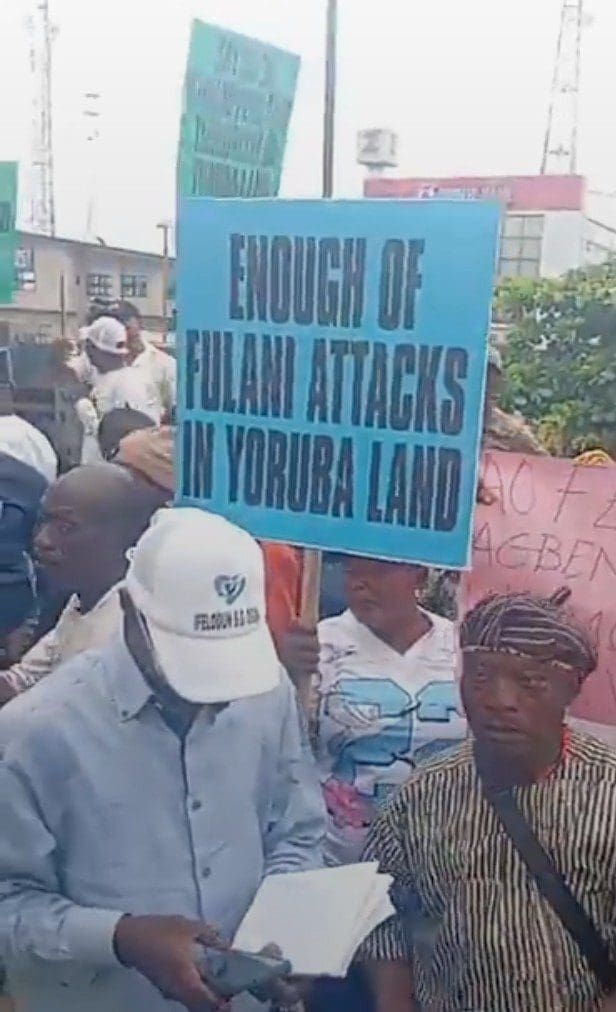
Ojota, Lagos, Nigeria—On Thursday, October 9, hundreds of Yoruba activists thronged the streets of Ojota, Lagos, Southwest Nigeria waving placards, chanting freedom songs, and demanding urgent government action against what they described as “systematic attacks” by Fulani Ethnic Militia terrorists across the Southwest.
The demonstration, organized by Afenifere Council and Ifelodun Apapo Yoruba, drew leaders from within Nigeria and the diaspora. Representing Ifelodun County and Yorubas in general, Governor’s Council delegate Mr. Takutijesu Ifelodun stood shoulder to shoulder with protesters. Also addressing the crowd were Prophet Ologunloluwa, youth leader for exiled Yoruba freedom fighter Chief Sunday Igboho, and Prince Eniola Ojajuni, Youth Leader of Afenifere. From abroad, the Coalition of Yorubas in Diaspora sent Arch George Akinola, Deputy Leader of the Yoruba Self-Determination Movement (YSDM), to lend international weight to the call.
A Protest Rooted in Fresh Bloodshed
The march was triggered by fresh attacks in Oke Odẹ (Osun State), Oke Ogun (Oyo State), Ifelodun County (Kwara State), Egbe in Yagba West County Kogi state and rural parts of Ekiti.
Just last week, TruthNigeria reported that more than 40 people were killed in coordinated night raids across four Yoruba communities. Witnesses said the Fulani Ethnic Militia terrorists targeted farmers, looted livestock, and torched homes – a pattern of violence eerily similar to attacks previously documented in Plateau and Benue States.
Victims Speak
Among the protesters was Mrs. Funmilayo Adewuyi, who traveled from Oke Ogun after her family lost their farm to the violence.
“My younger brother was kidnapped in August,” she told TruthNigeria. “We raised ₦2.5 million to pay his ransom. They collected the money, but two days later, we found his body dumped by the roadside. What else do they want from us?”
In Ifelodun County, Kwara State, survivors recounted militia raids on three villages in late September, killing at least 15 people. Local farmer Pa Joseph Ayeni described fleeing into the night with his grandchildren: “We ran with nothing but the clothes on our bodies. Our houses are gone, our harvest gone. They said Yoruba land belongs to them. Who will protect us now?”
A Dangerous Trend: Southwest Becoming the Next Hotspot
For years, the Southwest was considered relatively stable compared to Nigeria’s volatile Northwest and Northeast. But experts now warn that complacency is over.
Dr. Tunde Alabi, a Lagos-based counterterrorism analyst, said the new wave of killings signals “a creeping expansion of Fulani militia operations” into Yoruba land.
“What we’re seeing is not random banditry,” he explained. “This is a deliberate attempt to establish control, instill fear, and fracture communities. If unchecked, Oyo, Ekiti, Osun, and Kwara could descend into the same prolonged violence we’ve seen in most states in the Northeast and Northwest of Nigeria.”
According to TruthNigeria’s compiled statistics, at least 312 people have been killed in Fulani Ethnic Militia terrorists raids across Southwest states since January 2025. Hundreds more have been kidnapped, while thousands of hectares of farmland now lie abandoned.
Historical Context: A Long-Brewing Storm
The current crisis is not emerging in a vacuum. Yoruba communities have long accused Fulani Ethnic Militia terrorists of violent expansion into their communities.
In 2018–2020, escalating clashes in Oke Ogun and Ondo State led to mass protests. By January 2021, the conflict reached a breaking point when Chief Sunday Igboho issued a seven-day ultimatum for Fulanis to leave Oyo State following a spate of kidnappings and killings. That standoff sparked nationwide debate, polarizing Nigeria along ethnic lines and eventually forcing Igboho into exile after federal crackdowns.
Despite his absence, the grievances he championed have not disappeared. If anything, they have deepened.
Security experts warn that the Southwest may be following the same trajectory: majority Christian communities displacement, rural depopulation, and an eventual collapse of agricultural production – the exact spiral seen in Nigeria’s Northeast and Northwest.
A Movement Gains Momentum
At the Lagos protest, chants of “Enough is enough!” rang through the streets as demonstrators carried banners reading “Stop the Genocide in Yoruba Land” and “Farmers Deserve Protection Too.”
Prophet Ologunloluwa, speaking for Igboho’s youth movement, declared: “We will not wait until our land is overrun. Our fathers fought for freedom; now it is our turn. We demand security, or we will defend ourselves.”
From the diaspora, Arch George Akinola stressed that Yoruba voices abroad were closely watching developments at home: “What happened in Oke Ogun and Oke Odẹ is not local – it is global. The world must not wait until Yoruba communities are erased like villages in Plateau or Benue.”.
Government Response Muted
Despite the scale of the Lagos protest, no senior federal official addressed the demonstrators. The Lagos State Police Command deployed units to monitor the rally but reported no violence.
In Abuja, federal spokesmen have repeatedly downplayed reports of “ethnic-targeted killings,” insisting that attacks nationwide are “patternless” and the work of “criminal gangs.” With the National Assembly planning to send a delegation to meet with the United States government. But critics, however, accuse the Tinubu administration of ignoring evidence to avoid ethnic tensions.
The Larger Picture
The Ojota protest is not just a local response – it marks the beginning of a broader Yoruba self-determination campaign. Afenifere Council announced plans for further rallies in Ibadan, Akure, and diaspora cities such as London and Houston.
For victims like Mrs. Adewuyi, the movement represents more than protest; it is a desperate cry for survival: “We cannot farm, we cannot sleep at night, we cannot trust the government to protect us. If Yoruba people don’t rise now, tomorrow may be too late.”
Onibiyo Segun reports on terrorism and conflicts for TruthNigeria.