Moscow‑linked narratives and Niger’s military regime are jointly driving a cross‑border campaign aimed at reshaping opinion and destabilizing northern Nigeria.
By Mike Odeh James
ABUJA, Nigeria — What began as Hausa‑language broadcasts from Niger’s military ruler has evolved into a broader influence campaign reaching deep into northern Nigeria — from Russian flags in 2024 protests to grievances exploited in a foiled coup plot — raising alarms that foreign actors are shaping the political climate as the 2027 elections approach.
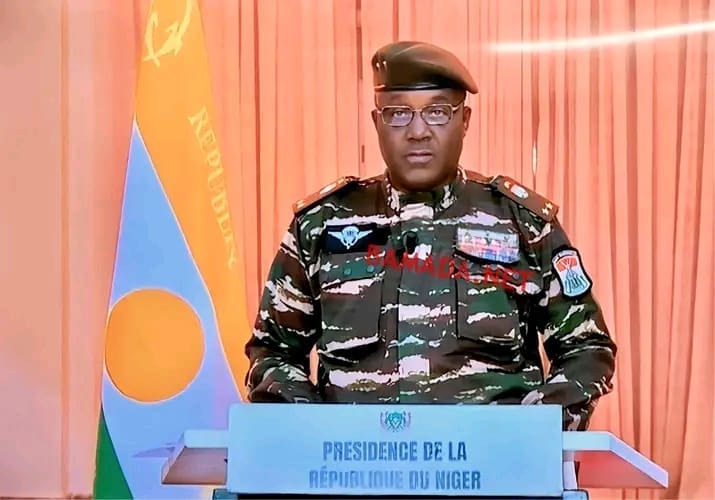
For months, Niger Republic’s military ruler, General Abdourahamane Tchiani, has used Hausa-language broadcasts to accuse Nigeria, France, and the United States of sponsoring terrorism across the Sahel.
The choice of language was strategic.
Hausa is one of the most widely spoken languages in West Africa and serves as a common language across northern Nigeria and southern Niger Republic. Spoken by tens of millions of people on both sides of the border, it allows messages originating in Niamey to reach audiences in Kano, Katsina, Kaduna, Sokoto, Jigawa, Zamfara, and other parts of northern Nigeria with ease.
According to a May 2026 investigation by HumAngle Media, Tchiani repeatedly used Hausa-language speeches and media appearances to spread allegations against President Bola Tinubu’s government and Nigeria’s Western allies.
The report suggests the messaging has found a receptive audience. A HumAngle survey conducted in Kano found that about half of respondents believed the allegations.
The findings raise troubling questions about the effectiveness of a sustained information campaign aimed at shaping public opinion inside Nigeria’s most populous northern region.
The Russian Flags Were Not Spontaneous
In August 2024, Nigerians took to the streets to protest economic hardship, soaring fuel prices, inflation, and worsening living conditions.
Across much of southern Nigeria, demonstrators carried Nigerian flags and anti-government placards. In parts of northern Nigeria, however, a different image emerged.
Young men in Kano, Kaduna, and other northern cities waved Russian flags and echoed anti‑Western rhetoric similar to that promoted by military juntas in Niger, Mali, and Burkina Faso. The scenes were captured in Reuters coverage of the August 2024 protests in Kano and Kaduna, as documented here in Reuters’ report on arrests linked to Russian‑flag protests and in Reuters’ photo coverage of demonstrators carrying Russian flags in Kaduna.
Security analysts noted that the imagery was unlikely to be accidental. Across the Sahel, Russian flags had become symbols of Russian-backed influence campaigns that followed the coups in Mali, Burkina Faso, and Niger Republic.
Washington D.C.-based security consultant Scott Morgan of Red Eagle Enterprises connected the dots bluntly. “For the second time in as many months the Russians have been caught conducting an influence operation in West Africa,” he said, noting Moscow ran the same playbook during the Papal Visit to Cameroon in April, using identical tactics to manipulate public sentiment. Ignoring a Russian campaign specifically targeting the Hausa ahead of the 2027 elections, Morgan warned, “will be an act of criminal stupidity.”
David Onyilokwu Idah of International Human Rights Commission Abuja, in an exclusive interview, noted that , Tchiani and Russia are actively using the Hausa language to appeal to Hausas in Northern Nigeria to cause loss of confidence in the US and and Tinubu administration.
“By using Hausa language, it simply causes disaffection for Tinubu and it causes distrust for the Americans by Russian operatives in Niger Republic
The HumAngle findings help explain how those narratives crossed the border. By communicating directly in Hausa, Tchiani bypassed traditional diplomatic channels and reached audiences with deep cultural, commercial, religious, and linguistic ties to Niger Republic.
Early 2025: A Coup Plot with Northern Connections
The most alarming domestic consequence surfaced in early 2025 when Nigerian security agencies disrupted an alleged coup plot, first reported in detail by the Defence Minister in an interview with Naija Punch News (link). Additional reporting by African Business outlined how the plotters allegedly sought to topple the Tinubu administration (link), while C‑Advocate Newspaper published further analysis on the suspects and the implications for Nigeria’s security and sovereignty (link).
While details remain partly classified, security reports indicated that the conspirators sought to exploit political and religious grievances already circulating in parts of northern Nigeria — grievances mirroring many of the narratives visible during the 2024 protests and in messaging emanating from neighboring Niger Republic.
Analysts of foreign influence operations note that modern destabilization campaigns often do not require direct foreign involvement in a coup. Instead, they deepen existing social, political, ethnic, and religious divisions until local actors take actions that advance external strategic interests.
“The lack of interest or comments from Abuja and the State Governors is a matter of serious concern,” Morgan warned, adding pointedly: “Wonder when some Northerners are going to realize that they are being used.”
Niger Republic as a Launch Pad
The military dimension of the challenge is unfolding along Nigeria’s northern borders.
Since Niger’s military junta seized power in July 2023 and expelled American and French forces, security gaps along the border have widened. Boko Haram and Islamic State West Africa Province (ISWAP) have exploited those gaps, using territory inside Niger Republic as a staging ground, supply route, and haven for attacks against Nigerian troops and communities.
Morgan drew a sharp parallel between jihadist groups and the Alliance of Sahel States, arguing both are racing for coastal port access — evidenced, he said, by all three AES leaders attending the recent Cotonou presidential inauguration. Nigeria, he warned, is not the only vulnerable country in the region — but it is one where the operation is already “bearing fruit.”
One Campaign, Three Fronts
Tchiani’s Hausa-language information campaign. The Russian flags of 2024. The alleged coup plot of 2025. The growing insurgent threat operating from Niger Republic in 2026.
Viewed separately, each represents a serious challenge. Viewed together, they reveal three interconnected fronts: information operations designed to erode trust in Nigeria’s government and its Western partners; exploitation of political grievances and internal divisions; and military pressure through insurgent violence that weakens state capacity.
The Clock Is Running: Nigeria’s 2027 Election Looms
The challenge is made more urgent by the approach of Nigeria’s 2027 general elections. Northern Nigeria remains one of the country’s most influential voting blocs, exposed for years to competing narratives originating across the Sahel.
The warning signs were visible in August 2024, when young men carried Russian flags through the streets of Kano.
Nigeria saw the flags.
It must now decide what to do about them.
“It is high time, the US and Nigeria fight back this campaign or face severe backlash, Idah concluded
Mike Odeh James is conflict reporter for TruthNigeria.