The raid uncovered reactor pots, chemical solvents, and meth crystals — all hidden in dense forest terrain far from surveillance.
By Onibiyo Segun
IBARAPA NORTH, OYO STATE (SOUTHWEST NIGERIA) — Nigerian drug‑enforcement officers have shut down a large methamphetamine laboratory operating inside a forest settlement in Oyo State, arresting a Mexican chemical technician and four Nigerians in an operation officials say reveals a growing shift toward industrial‑scale drug production in rural Southwest Nigeria. Nigerian anti-narcotics operatives on June 17, 2026, dismantled the methamphetamine laboratory, arrested a Mexican chemical specialist and four Nigerians inside a remote forest site.
The National Drug Law Enforcement Agency (NDLEA) says the operation exposed a transnational drug production network operating deep inside rural forest terrain, away from normal surveillance and trafficking routes, marking a shift from moving drugs to producing them in fixed industrial sites.
Officials say what was uncovered reflects a growing pattern in which drug syndicates are no longer only moving substances but are quietly building production hubs inside forest corridors across the Southwest.
Deep Inside the Forest in Ibarapa North
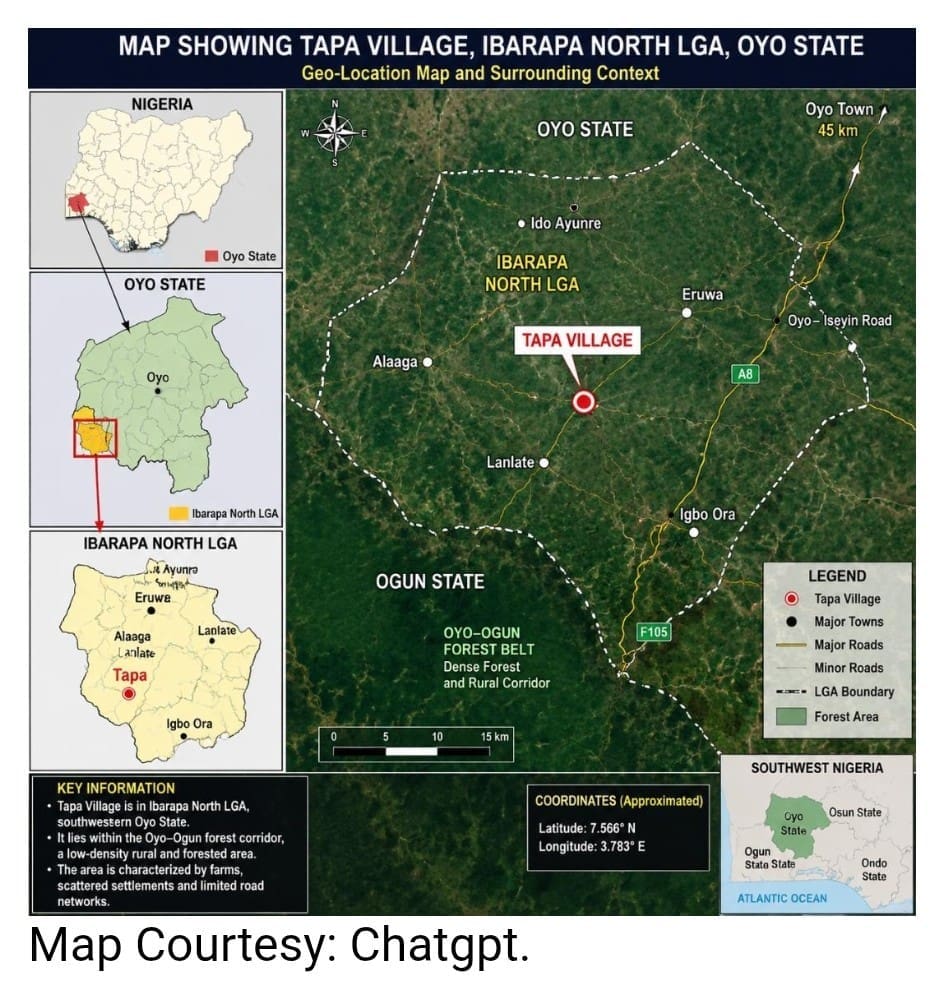
The lab was found in Tapa Village, a quiet rural community in Ibarapa North County, Oyo State, Southwest Nigeria. It sits within a forest belt linking Oyo and Ogun States, where thick vegetation, scattered farming settlements, and weak security reach make monitoring difficult.
Analysts familiar with the terrain say the area offers concealment, space, and time for long-term illegal operations.
The same forest axis has also become associated with terror-kidnapping routes, illegal mining, and synthetic drug production.
How The Raid Happened
“The raid followed actionable intelligence,” said NDLEA Chairman Brig. Gen. Buba Marwa (retd.), speaking through spokesperson Femi Babafemi in Abuja and reported in national media.
“Operatives moved into what turned out to be a fully organised industrial meth laboratory hidden deep in forest cover,” Babafemi said.
The suspects arrested include:
Jose Villa Ochoa, 56 (Mexican chemical specialist)
Maxwell Nevoh, 30
Olatunji Yusuf, 37
Bankole Owolabi, 45
Ganiu Monsiu, 43
“The presence of a foreign technician highlights how local drug networks are increasingly connecting with international expertise,” Babafemi went on to say.
What Was Found
NDLEA recovered chemicals used in meth production, including phenyl-2-propanone (P2P), phenylacetic acid, caustic soda, sulphuric acid, and industrial solvents.
Equipment included reactor pots, condensers, mixers, and drying machines, resembling a small chemical factory hidden in the forest.
Forensic experts told TruthNigeria that meth production involves controlled chemical processes that convert industrial materials into a powerful central nervous system stimulant.
NDLEA confirmed meth crystals were recovered at the site.
What This Means on the Ground
“What we are seeing is not just drug production,” said Dr. Nathaniel Nuhu, a criminologist at the Centre for Strategic Studies, Abuja.
“It is the embedding of industrial criminal capacity inside rural geography. These forest areas are becoming production zones rather than hiding spaces,” he said.
Nuhu added that the shift shows criminal groups moving from transport-based trafficking into fixed industrial operations that require technical expertise and sustained territorial control.
The Chemistry Behind It
“The recovered materials point to full-scale production,” said Dr. Folarin Yusuf, a forensic chemist at the University of Lagos Centre for Forensic Science and Toxicology.
“Once you see P2P and phenylacetic acid in large quantities, you are dealing with structured manufacturing, not small-scale experimentation,” he explained.
Yusuf added that the equipment confirms repeated batch production rather than a one-off setup.
A Network Beyond Borders
“West Africa is becoming part of a layered supply chain where roles are divided across borders,” said Mr. Jude Onuoha, an organised crime analyst with the Institute for Security and Development Policy (West Africa Desk).
“Local actors provide concealment and logistics, while foreign specialists provide technical expertise,” Onuoha noted.
Could This Connect to Terror Networks?
“There is no evidence linking the Oyo meth laboratory directly to any armed group,” Dr. Folarin Yusuf cautioned. “The concern is structural. These labs are not isolated incidents. They show how organized crime is expanding deeper into rural Nigeria,” he said.
Dr. Yusuf referenced Nigeria’s northeast as a comparative case where terror groups like Boko Haram have operated within broader illicit economies involving drug trafficking, smuggling, and informal taxation.
Security analysts also stress that this does not mean the Oyo operation is connected to terror networks, but rather that expanding drug infrastructure can, in some environments, coexist alongside other forms of violent non-state activity.
A Similar Pattern in Kwara
The Oyo operation follows another NDLEA interception in Kwara State, where synthetic drugs were seized along transport corridors linking the North and Southwest.
In that case, traffickers moved drugs through commercial transport routes.
Together, analysts say the pattern shows a split system: movement along highways and production inside forest zones.
The Bigger Regional Picture
Across West Africa, drug networks are adapting by pushing production deeper into forested and cross-border rural zones while maintaining distribution through regular commercial transport systems.
Globally, meth production is also decentralising, moving away from concentrated hubs toward smaller, dispersed laboratories closer to demand and transit routes.
Analysts say there is no confirmed link between the Oyo lab and extremist groups, but warn that expanding illicit economies increase the number of environments where different criminal systems may overlap indirectly.
What It Means for Communities
“The more it is produced, the more available it becomes,” said Dr. Tolu Martins, a psychiatrist at the University College Hospital, Ibadan.
“And the more available it becomes, the greater the danger and impact on communities,” Martins went on to explain.
Martins warns that rural proximity to production sites increases spillover into youth populations and informal markets.
Where This Is Heading
For NDLEA, the Tapa raid is a major disruption of one production site.
But analysts say the bigger concern is whether similar facilities are already emerging across the Oyo-Ogun forest belt.
For now, one lab has been dismantled. But the system that enabled it supply chains, technical networks, and forest concealment space may still be active underneath.
Onibiyo Segun reports on terrorism and conflict for TruthNigeria.