Abuja Scrambles to Fill Security Deficits before January 16
By Luka Binniyat
(Abuja ) – Five months ahead of the next presidential referendum, Abuja is sparing no expense to put its national security portfolio front and center.
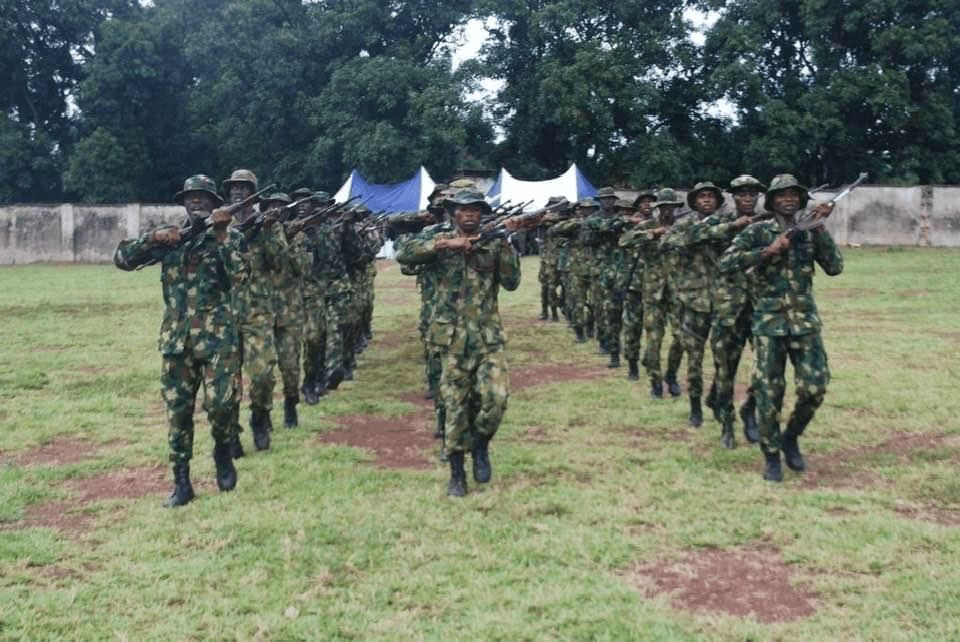
President Bola Ahmed Tinubu approved on Tuesday, Aug. 4, a major salary boost for members of the Nigerian Armed Forces. The raise has been welcomed as a long overdue for troops battling terrorism, banditry, kidnapping and separatist violence across the country, according to security experts.
According to Reuters, under the new salary structure, which takes effect on September 1, 2026, soldiers from the rank of Private to Staff Sergeant will receive an 80 percent salary increase. Personnel from Warrant Officer to Colonel will get 50 percent, while Brigadier Generals and above will receive 30 percent.
Structure Of The Increments
The Presidency said the annual military wage bill will rise from ₦660 billion ($490 dollars) to ₦924 billion ($692 million) representing an additional ₦264 billion ($197 million dollars) every year.
The increase comes at a time when the constitutional republic in Abuja is grappling with a complex array of Islamist insurgencies at the same time. Five of these insurgencies are related either to Islamic State of Iraq and Syria, or to Al-Qaeda groups, all of which seek to replace the ruling regime with a caliphate. The second-most consequential group is the loosely affiliated Fulani Ethnic Militia, who are loyal by religion to Nigeria’s government-allied Caliph, the Sultan of Sokoto, even while fighting fiercely against the Nigerian army and military across the Middle Belt. The third insurgency is the armed wing of the Indigenous People of Biafra, a separatist group.
Boko Haram (meaning: “Western Learning Forbidden”) and Islamic State of West Africa Province (ISWAP) continue to attack communities and military formations in Nigeria’s Northeast. Armed Fulani terrorist-bandits are conquering large parts of the Northwest. Kidnapping for ransom remains common across the Middle Belt and in Borno State, while separatist-related violence persists in parts of the Nigerian Southeast.
Reuters added that President Tinubu said that improving troop welfare remains one of his administration’s priorities. He also promised to continue modernising the military with better weapons and technology.
Just two weeks before announcing the salary increase, the President approved the expansion of the Nigerian Army from eight to twelve divisions and authorised the recruitment of 28,000 additional personnel.
Implementation Challenges
Security experts generally agree that the salary increase is a positive step. However, many caution that implementation will determine whether the policy succeeds.
“The problem has never been about approvals,” said Major Gambo Salisu (rtd) who retired in 2021 from the 3rd Armoured Division, Jos plateau state.
“We have always complained about delayed operational allowances and poor accommodation in and out of combat roles,” he told TruthNigeria in Kaduna, Wednesday August 5, 2026.
Gambo advised that the new salary package must reach soldiers promptly and should not be weakened by bureaucracy or delays.
Salary Increment Not Enough
A retired Director with the Nigerian Defence Intelligence Agency (DIA) who spoke to TruthNigeria and asked that his name not be mentioned, said that
inadequate medical care and slow payment of death benefits to families of personnel killed in action is a very serious matter that ought to be given serious attention.
Other analysts insist that salaries alone cannot defeat insurgency. They argue that the government must equally improve intelligence gathering, logistics, military training, air support, communications and welfare for wounded soldiers and families of fallen personnel.
Nigeria Military Still Relatively Small
Nigeria’s military is also relatively small for the country that is battling insurgency in 24 of its 36 states. Military experts told TruthNigeria in January of 2025 that Nigeria’s army had only one-quarter of the manpower it needed to tackle its challenges.
Although there is no international standard for the number of soldiers a country should maintain, experts often compare military strength with population.
According to Global Fire Power (GFP) Nigeria has an estimated population of about 242 million people and roughly 230,000 active military personnel in the Army, Navy and Air Force. That translates to about one service member for every 1,054 Nigerians.
Comparing Nigeria Military To The US Military
By comparison, the United States has about 342.7 million people and approximately 1.35 million active-duty military personnel, giving it about one service member for every 254 citizens.
In simple terms, the United States maintains more than four times as many active military personnel in relation to its population than Nigeria.
The difference is even greater when salaries are compared.
A newly enlisted American soldier earns a basic annual salary of roughly US$30,000 (N42 million Naira) to US$40,000, N56 million naira) abetted by housing allowances, healthcare, food allowances, education benefits and retirement packages. Many experienced personnel earn considerably more.
Even after Nigeria’s latest increase, most Nigerian soldiers will earn only a small fraction of what their American counterparts receive.
The difference reflects the financial strength of both countries.
While Nigeria’s entire annual military salary bill after the increase will be about US$692 million, the United States spends almost US$1 trillion annually on defence, according to the United States Department of War. See this site: War Department.
Luka Binniyat writes for TruthNigeria on Politics and Conflict from Kaduna.