

But Is Abuja’s Counter-terrorist Strategy on the Right Track?
By Mike Odeh James and Olikita Ekani
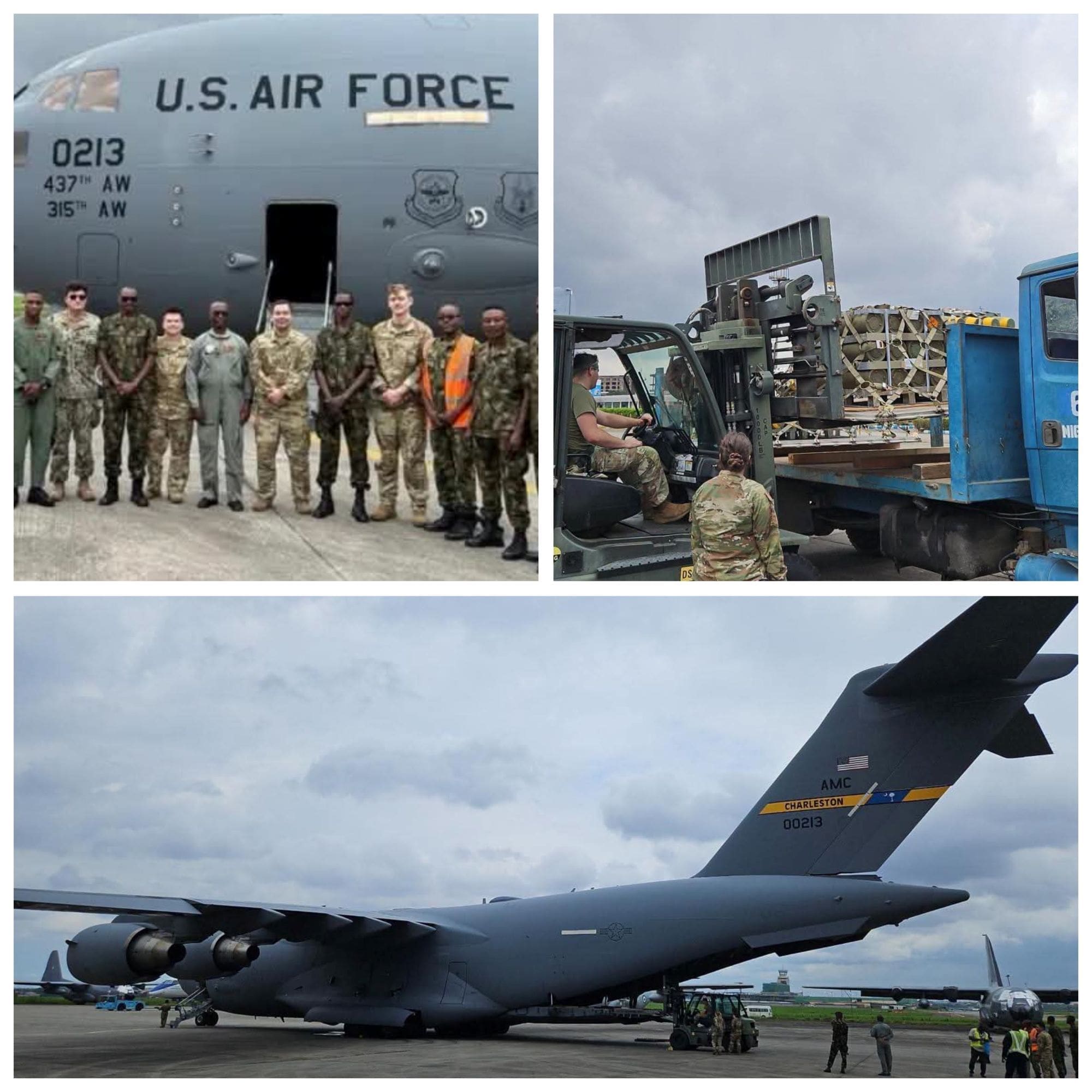
(Makurdi) A U.S. Air Force C-17 delivered undisclosed munitions to Nigeria last weekend. The paperwork behind the flight names a thousand unguided bombs.
On September 10, U.S. Africa Command published photographs of a C-17 Globemaster III offloading equipment at Nigerian Air Force facilities in Lagos and Kainji, Niger State. The command said the shipment fell under a Foreign Military Sales agreement intended to strengthen Nigeria’s counterterrorism capacity, but disclosed no contents, quantity or value.
What $346 Million Buys
The State Department’s notification to Congress of August 13, 2025, transmittal 21-47, lists what Abuja requested: 1,002 MK-82 general-purpose 500-pound bombs; 5,000 Advanced Precision Kill Weapon System II rounds and thousands of other munitions.
Stated plainly, that is a thousand unguided bombs, guidance kits to convert most of them, and five thousand precision rockets — all compatible with the A-29 Super Tucano fleet at Kainji, where the C-17 landed.
Whether those items were aboard the September flight isn’t clear, but the package has moved from Washington’s approval process into Nigerian military hands.
Washington’s New Bargain
The delivery follows the second session of the Nigeria-U.S. Joint Working Group, held in Washington in August with a delegation led by National Security Adviser Nuhu Ribadu. The agenda covered protection of Christian communities in the Middle Belt, accountability for violence and military-to-military cooperation.
It also signals a drawdown. Roughly 200 American personnel deployed this year have left Nigeria for a base in Cameroon, with smaller teams of trainers and intelligence specialists expected to remain. The footprint shrinks; the firepower grows.
Washington presses Abuja on religious freedom — Nigeria remains designated a Country of Particular Concern — while deepening the supply relationship. Abuja accepts the pressure to keep the pipeline.
The Civilian Cost of Precision
Human Rights Watch called the sale announcement conspicuously silent on the Nigerian military’s record and on what safeguards would apply. In February, it urged strict enforcement of the so-called Leahy Laws, which bar assistance to units credibly implicated in gross human rights violations.
Amnesty International’s Nigeria director, Isa Sanusi, has called for close monitoring of whether American weapons are tied to abuses. Analysts writing in “Responsible Statecraft” argue those conditions have never been effectively enforced, and that Congress has delayed arms sales to Nigeria without ever stopping one.
Assessing an earlier AFRICOM consignment in January, retired Air Commodore John Bako Ajeye told TruthNigeria the assistance “should not substitute for deeper reforms in defence governance, civilian protection, and community-level stabilization,” and that its impact would turn on “accountability in how assistance is used on the ground.”
U.S. Repositioning After Sahel Evacuation
Washington completed its withdrawal from Niger during the Biden Administration in September 2024, abandoning a $100 million drone base at Agadez and pulled forces from Chad the same year. AFRICOM has since worked from the outside in, through coastal partners, and its 2026 posture statement frames Chinese penetration of Africa’s west coast as a homeland-security concern.
Nigeria is the largest state in that calculation and the only one with an air force able to absorb substantial precision munitions. Whether it is a partner or a platform in Washington’s regional strategy is not yet clear.
The Sahel Benchmark
Jihadist insurgencies are fighting their way into Sahelian States bordering Nigeria, but so far Abuja is holding. Mali has endured a fuel blockade by Jama’at Nusrat al-Islam wal-Muslimin (JNIM), and in April a suicide car bomb in Kati, carried out by JNIM and the Azawad Liberation Front, killed Defense Minister Sadio Camara. Estimates put 40 to 60 percent of Burkina Faso outside government control. In June, JNIM attacked Niger Republic’s Niamey airport, killing 11 soldiers and two civilians.
No Nigerian capital has been besieged. Abuja is not rationing fuel. Mali’s army cannot say the same. But stability is not success.
The Targets Airpower Cannot See
Nigeria’s crisis is not territorial, because the armed Fulani Ethnic Militia (FEM) do not take over territory and raise a flag over it. True, the FEM empty Benue, Plateau and Southern Kaduna counties village by village, but they keep no fixed, fortified camps to be targeted. They occupy the farmland of the displaced in the guise of open grazing of their cattle.
In Nigeria’s Northeast, Islamic State West Africa Province (ISWAP) holds the kind of fixed positions this missile package was built to strike. In the Middle Belt, there is no publicly documented use of these weapons against the militias emptying its villages.
Ajeye, who identified himself as a Middle Belt leader, put the limit plainly. “Foreign assistance alone cannot defeat insurgency,” he said. “Real success must come from Nigerian-led efforts supported — not overshadowed — by foreign assistance.”
The cargo has arrived. The harder question is whether protection will reach the Middle Belt.
Mike Odeh James and Ekani Olikita are conflict reporters for TruthNigeria.


There is no amount of bombs or other weapons delivered to Nigeria that will be enough to defeat terrorism if the underlying security challenges are not properly addressed. The key positions within Nigeria’s security architecture are still held by members of the same Fulani ethnic group whom I believe are behind the terrorism, killings, kidnappings, and other atrocities affecting the country.
I used to think Bola Ahmed Tinubu was a very intelligent man, but I struggle to understand how a wise president could entrust such critical aspects of the nation’s security architecture to people from the same ethnic group that, according to my view, is responsible for these terrible acts.
Nigeria needs a security strategy that prioritizes competence, accountability, national interest, and the protection of all citizens, regardless of their ethnic or religious background