One Year after White House Critique, Abuja Pushes Counter-Narrative
By Mary Kiara
(Lagos) – One year after Washington spotlighted the existential threat facing Nigerian believers, U.S. lawmakers on Capitol Hill convened a high-stakes congressional inquiry on Thursday to determine whether Abuja’s pledges have translated into real protection for Christian communities.
The House Foreign Affairs Subcommittee on Africa convened the hearing on the crisis, titled “One Year Later: Assessing Nigeria’s Efforts to Protect Christians and Secure the Middle Belt,” arriving amid a fierce battle over information and accountability.
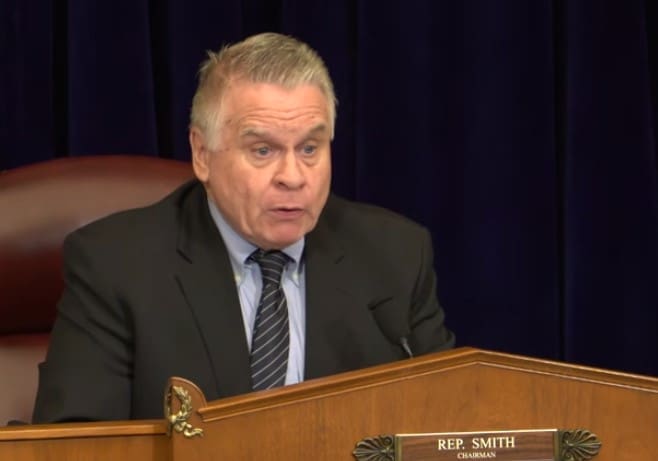
Opening the session, his fourteenth congressional hearing dedicated to religious persecution in Nigeria, Subcommittee Chairman Chris Smith (R-NJ) dismissed attempts by special interests to obscure the reality on the ground.
“For too long, the Nigerian Government and the world have looked away, a culture of denial, as radical Fulani militants, Boko Haram and ISIS/West Africa have waged a relentless campaign of terror, murder, and displacement across Nigeria,” Rep. Chris Smith said in his opening address.
The Lobbying Wall and Capitol Contentions
Even as the hearing commenced, a memo funded by the DCI Group circulated through Washington circles, pushing Abuja’s narrative of dramatic military successes, high-profile arrests, and sweeping police reforms under President Bola Tinubu.
But veteran human rights advocates and lawmakers warned that diplomatic engagement must not be mistaken for actual civilian survival.
“A year later, the atrocities continue to mount, and Nigeria maintains its ranking as the world’s deadliest place for Christians for faith-related reasons, accounting for 72 percent of such killings worldwide,” Nina Shea, Senior Fellow and Director of the Center for Religious Freedom at the Hudson Institute, testified before the committee.
“The government is tolerating the egregious ongoing violence, is not stopping it, is not taking any action to stop it, or any significant, systematic action to stop it, but is tolerating it… For that, I agree with the CPC extension or keeping it in place,” Shea said.
The hearing laid bare the intense pressure cooker surrounding U.S. policy toward Nigeria.
Chairman Smith made clear that congressional oversight will not be derailed by high-priced public relations campaigns or attempts to obfuscate the religious drivers of the conflict.
“The mood on Capitol Hill today is contentious about Nigeria as never before,” TruthNigeria Editor Douglas Burton noted following the session.
“The wall of Nigerian lobby money is crashing around us, signaling that Truthtellers are causing panic in Abuja. Big money is worried about failing information operations. And stateside we now see a movement forming.”
That friction was underscored by State Department officials testifying before the panel.
While Assistant Secretary of State for African Affairs Frank Garcia and Assistant Secretary for Democracy, Human Rights, and Labor Riley Barnes pointed to increased police recruitment, they conceded that data verifying true on-the-ground protection remains scarce.
“What we have seen the Nigerian government do is answer the mail in terms of deploying forest guards to these areas, in terms of upping prosecutions and arrests, but we have not seen that equal or turn into actual on-the-ground greater safety and security for these Christians in the Middle Belt,” Riley Barnes told the committee.
“There are still rising death tolls and kidnappings. So I think we have this posture of trust but verify.”
The Statistical Fog and Ground Realities
Reflecting what editors describe as the “mystification” of the conflict, the hearing also highlighted deep discrepancies in casualty tracking.
Open Doors US CEO Ryan Brown presented harrowing figures showing that extremist violence continues to crush Christian communities.
“Statistics from last year seem consistent with the pattern in the region and show a Christian in Plateau State is 3.2 times more likely to have been killed than their Muslim neighbor. In Benue, that likelihood is even greater, where a Christian was 7.3 times more likely to have been killed than their Muslim neighbor,” Brown testified.
Yet, as Open Doors and independent trackers document thousands killed and millions displaced across informal camps, Abuja’s defenders continue to push back against the Christian genocide framework, pointing to counterterrorism gains against Islamic State West Africa Province and Boko Haram.
For local church leaders and diaspora advocates, however, the debate in Washington often feels disconnected from the existential terror facing families in Benue, Plateau, and Kaduna states.
Bishop Wilfred Anagbe of Makurdi has repeatedly maintained that the federal government lacks the willingness to halt the massacres.
“Nigeria is capable of handling this issue of insurgency, but they are not willing to do so. The government doesn’t lack the capacity; they lack the willingness,” Bishop Anagbe told TruthNigeria.
Dr. Sylvester Okere, a security analyst and diaspora community voice, argued that true accountability requires abandoning political correctness and confronting the human elements enabling the violence from within the system.
“Accountability requires all of us,” Okere said.
“In the United States and London, public transit constantly reminds citizens, ‘If you see something, say something.’ Nigeria needs that same model of community policing where bus drivers, market traders, and everyday citizens remain observant and use their mobile phones to report unusual activity through an effective emergency line staffed by people of integrity who will not gamble with human lives,” he told TruthNigeria.
The 2027 Election Horizon
With the Trump administration maintaining its hardline stance following the October 2025 CPC designation and with Republicans retaining key oversight leverage despite recent midterm blue wave shifts, the pressure on Abuja is unlikely to ease ahead of Nigeria’s crucial general elections scheduled for January 2027.
Lawmakers like Rep. Bill Huizenga and Rep. Riley Moore vowed to keep the spotlight on the Tinubu administration.
“We need to be watching these (Nigeria) presidential elections like a hawk. And I’m going to be watching them,” Moore said.
Mary Kiara reports on Terrorism and Narrative War for TruthNigeria.