As Child Fighters Swell the Terrorist Ranks
By Suleman Ayuba
(Maiduguri Borno State) In the receding waters of Lake Chad, rival terrorists claw for the right to tax fishermen, farmers and travellers while fresh waves of youths and children are pulled into a war that refuses to end.
The battle is fundamentally about resources and taxation, according to some locals, even though a major player is Boko Haram (Western Learning Forbidden), Nigeria’s first Islamist insurgency.
“ISWAP has imposed heavy taxes on fishermen and farmers, cutting Boko Haram off from the revenue streams that sustain them,” according to Ahmed Usman, a local fish trader.
Now Boko Haram has moved in to impose its own taxes and levies on travellers and anyone trying to move goods or fish. This is why they have been clashing for days—each side is determined to bleed the other dry and own the right to extract from the living and the dead,” Usman told TruthNigeria. He described the atmosphere as one of deepening fear, with communities trapped between two predators who view the islands not as homes but as taxable territory.
In a separate exclusive interview, Engr Kabiru Abubakar, familiar with Lake Chad basin terror activities, confirmed to TruthNigeria that the islands are critical economic corridors. “These are the routes that sustain travellers, farmers, fishermen and herders. What we are witnessing is a pure battle of supremacy over who controls the economic arteries. The group that holds the islands holds the power to tax, to extort and to decide who lives or flees. It is a dark contest where civilians are the currency,” Abubakar added.
Boko Haram’s faction known as Jama’atu Ahlis Sunna Lidda’awati wal-Jihad (JAS), has launched a determined push to reclaim key island settlements from the Islamic State West Africa Province (ISWAP) in the Nigerian sector of Lake Chad, turning vital economic corridors into battlegrounds for revenue and supremacy.
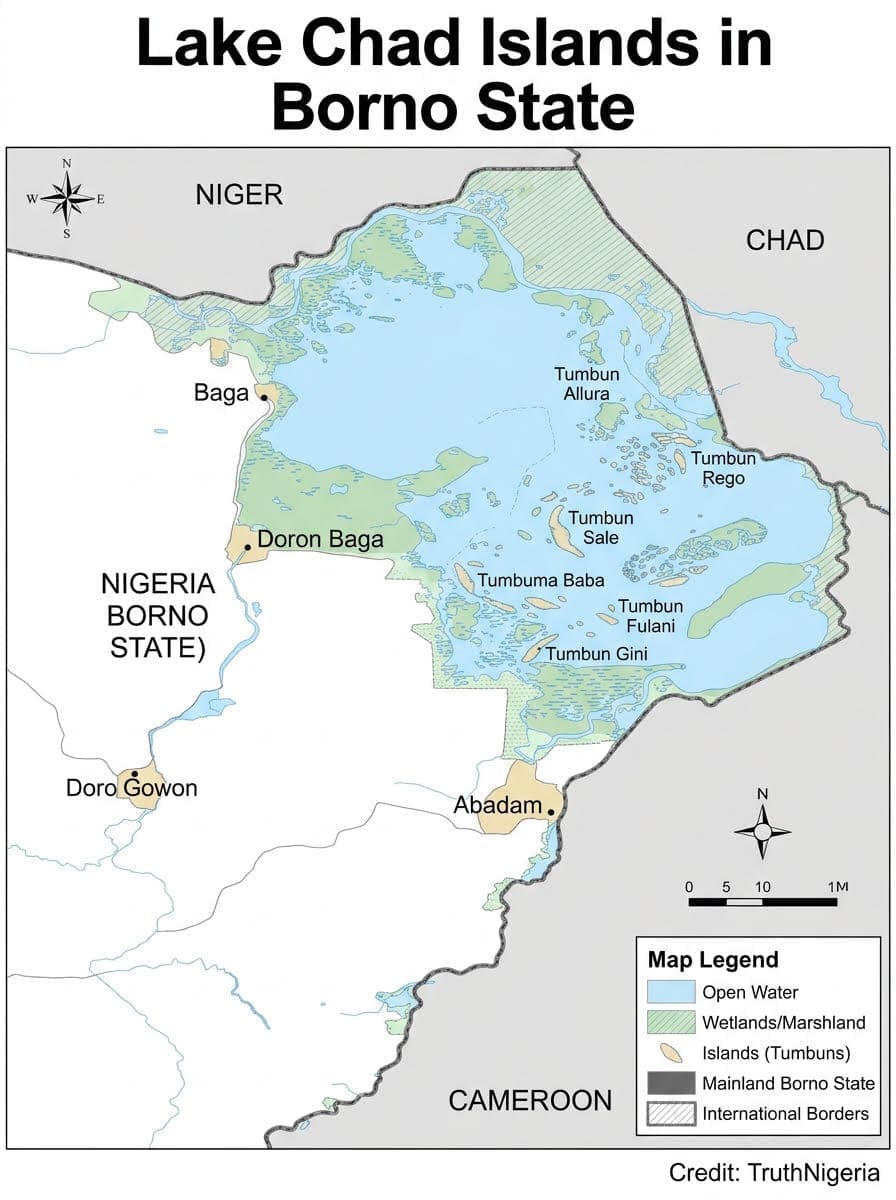
The targeted locations include Tumbun Gini, one of the most prominent island settlements in Abadam Local Government Area; Tumbun Allura and Tumbun Rego on the fringes of the lake, long used as transit and fishing points; and Tumbuma Baba and Doron Naira near the Nigerian shoreline – hubs for local fishing and cross-border movement. These sandy enclaves serve as critical routes for fishermen, farmers, herders and travellers moving between Nigeria, the Niger Republic, Chad and Cameroon.
According to counter-insurgency analyst Zagazola Makama, the latest clashes form part of a broader coordinated offensive that unfolded between November 5 and 8. JAS fighters under commanders Hassan Buduma and Mohd Hassan used multiple motorised watercraft loaded with fighters and heavy weapons in an amphibious-style assault across islands and riverine zones including Sahel 1, Dogon Chuku, Mangari, Tumbun Gini, Tumbun Dalo, Tumbun Shanu and Dumba in Abadam and Kukawa counties [Local Government Areas].
ISWAP positions were overrun, with surviving fighters forced to abandon river camps and retreat toward mainland hideouts around Ali Jillimari, Metele, Kangarwa and Gudumbali. Surveillance detected heat signatures consistent with multiple bodies, some floating in the water and others buried in shallow pits, pointing to heavy casualties on both sides.
Makama previously has documented the recurring pattern of these clashes: after the death of Boko Haram leader Abubakar Shekau in 2021, ISWAP consolidated control over many Lake Chad islands and their revenue streams.
But Boko Haram bounced back, from late 2022 onward. Under leaders such as Bakura Doro, the insurgents mounted sustained counter-offensives, seizing islands including Tumbun Gini and Allura, forcing ISWAP commanders to flee.
The cycle has been driven less by pure ideology than by the lucrative control of fishing routes, smuggling corridors and taxation of civilians, according to Makama.
His current assessment frames the November fighting as a dangerous shift from sporadic skirmishes to a full-scale territorial campaign, with JAS vowing to eliminate ISWAP from the islands and seize its supply lines. Analysts note JAS may seek to push further south toward ISWAP strongholds in Marte and Ngala, while expecting violent retaliation once ISWAP regroups on the mainland.
In a video obtained by TruthNigeria on 13th November 2026 from a security source, ISWAP fighters are seen fleeing under pressure from large Boko Haram reinforcements. The intelligence source said Boko Haram continues to recruit and expand, taking more territory even as soldiers kill many of its fighters. “The numbers keep increasing. The war is far from over. Most of the terrorists, according to what we are seeing, are children and youths pulled into the ranks,” the source warned.
Independent analysis supports the picture of a resurgent and adaptive JAS.
Since 2021, JAS has regrouped and expanded predation on civilians and rebuilt strength in the islands and beyond, according to Taiwo Adebayo of the Institute for Security Studies.
International Crisis Group and other observers have long highlighted how control of Lake Chad’s islands translates into revenue through taxation and looting, fueling both factions’ ability to sustain operations. Data trends tracked by Armed Conflict Location & Event Data (ACLED) show persistent violence involving the two rivals alongside military forces, underscoring that inter-faction fighting does not diminish the overall threat.
Military operations under Operation Hadin Kai and related efforts continue to target both groups, with periodic successes reported in neutralising fighters and disrupting logistics. Yet, the combination of difficult riverine terrain, cross-border movement, receding water levels that expose new routes, and the economic incentives of taxation means the islands remain fiercely contested.
Local voices and analysts alike warn that as long as these corridors generate revenue, the cycle of clashes, recruitment of the young, and civilian suffering will persist. The battle for Lake Chad’s islands is not merely territorial; it is a contest over who gets to extract from a population already exhausted by years of conflict Ahmed Usman told TruthNigeria.
Suleman Ayuba is a conflict reporter for TruthNigeria.