As global scrutiny over anti‑Christian massacres intensifies, a new foreign‑aid bill could empower regulators to block independent documentation of sectarian violence.
By Mary Kiara
ABUJA, Nigeria — A proposed Nigerian foreign-aid law could give officials new powers over organizations that document genocidal attacks, raising fresh questions about who controls evidence of Christian persecution.
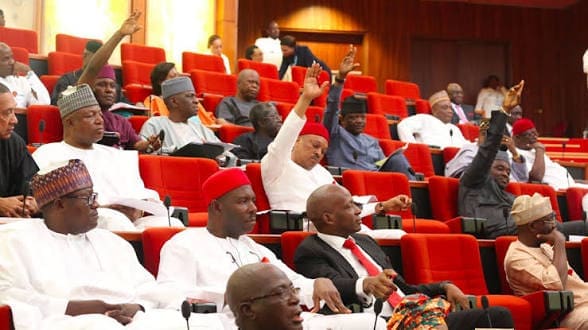
The Foreign Aid (Regulation, Transparency and Disclosure) Bill 2026, designated as SB 1034, has passed its second reading in the Nigerian Senate.
Sponsored by Senator Ibrahim Hassan Dankwambo (PDP-Gombe North), the bill seeks to establish a Foreign Aid Regulatory Commission (FARC) equipped with sweeping executive powers to register, inspect, audit, and unilaterally shut down non-governmental organizations, religious institutions, and media houses that accept foreign grants.
While Senate President Godswill Akpabio defended the measure as a vital national security initiative to cut off financial streams to insurgent networks, frontline civil society coalitions warn that its statutory provisions operate as a Trojan horse designed to stifle state accountability.
The Catholic Bishops’ Conference of Nigeria has now joined civil-society groups in warning that the proposed framework could affect organizations serving communities caught in violence.
Bishops Raise a New Warning
The bishops’ September 19 communiqué urged the National Assembly and federal government to halt the legislation, warning that its provisions could give officials excessive discretion over churches, humanitarian organizations and others receiving foreign assistance.
“National development must begin with respect for human dignity and the protection of fundamental rights, not expanding state control over charitable institutions,” the Catholic Bishops stated in their official communiqué.
For TruthNigeria, the concern extends beyond aid distribution.
Churches and humanitarian organizations often operate in communities where attacks, abductions and displacement occur. Their workers may be among the first to document casualties, abandoned villages and the needs of displaced families.
If organizations receiving foreign funding face additional registration, disclosure and compliance requirements, the question becomes whether the regulatory system could affect the independence of organizations documenting those events.
Gagging the Field Monitors
The concern predates the bishops’ objection.
“Subjecting independent media and human rights groups to an additional executive-controlled regulatory regime creates conditions conducive to self-censorship as Nigeria approaches the 2027 general elections,” Kolawole Oluwadare, Deputy Director of the Socio-Economic Rights and Accountability Project (SERAP), told TruthNigeria.
The bill’s most dangerous lever lies in Section 11, which mandates that all foreign-funded activities must strictly “align” with national development priorities set by the executive branch.
Under Section 6, organizations that fail to register foreign grants within 30 days face $14,285.71 fines and five-year prison terms for their directors.
Human rights lawyers point out that because the federal government routinely denies the targeted nature of massacres across the Middle Belt, state regulators could easily brand independent atrocity mapping as “contrary to national interest” to revoke operational licenses.
Who Controls the Evidence?
The proposed law comes as organizations tracking religious violence continue to produce data challenging competing narratives about Christian genocide in Nigeria.
Among the prime targets of this regulatory net could be the Observatory for Religious Freedom in Africa (ORFA), an independent research program that publishes detailed statistical audits tracking civilian fatalities across high-conflict zones.
In a landmark six-year report cross-referencing nearly 80,000 deaths, ORFA data revealed that armed ethnic militias killed 18,577 civilians, nearly four times the civilian fatalities inflicted by Boko Haram and ISWAP combined, with Christian farming populations slaughtered at 4.4 times the rate of Muslims in affected areas.
“The bill and the broader ongoing legislative push to muzzle NGOs is among the most dangerous pieces of legislation to enter the National Assembly since Nigeria’s return to democratic rule in 1999,” Professor Chidi Anselm Odinkalu, a prominent human rights lawyer, said in an institutional statement.
A Parallel Crisis of State Narrative Warfare
The importance of documentation such as ORFA’S extends beyond Nigeria’s borders.
President Donald Trump used his September 22 address to the United Nations General Assembly to criticize the U.N. Human Rights Council for inadequate attention to Christian persecution.
“Christians are being persecuted all over the world; it’s not even believable,” Trump said during the speech.
Trump’s address puts the protection and documentation of persecuted Christians into a broader international policy conversation.
The alignment highlights an ongoing parallel crisis between Washington and Abuja: while political elites in ruling establishments move to downplay or censor the systemic nature of anti-Christian violence, suffering communities rely on independent, foreign-funded monitors to bring field realities to light.
“The ruling elites are panicking because independent monitors are using digital mapping to bypass state censorship and expose the graphic realities of Fulani terrorists… who are moving through the Middle Belt, slaughtering citizens in their sleep and driving hundreds of thousands into internal refugee camps to the Western world,” said Judd Saul, founder of Equipping the Persecuted, said in a public statement.
Mary Kiara reports on Terrorism and Religious Freedom Policy for TruthNigeria.