17.9 million Nigerians fell into multidimensional poverty between 2021 and 2024, as economic mismanagement, insecurity, and inflation deepen hardship nationwide.
By Ebere Inyama
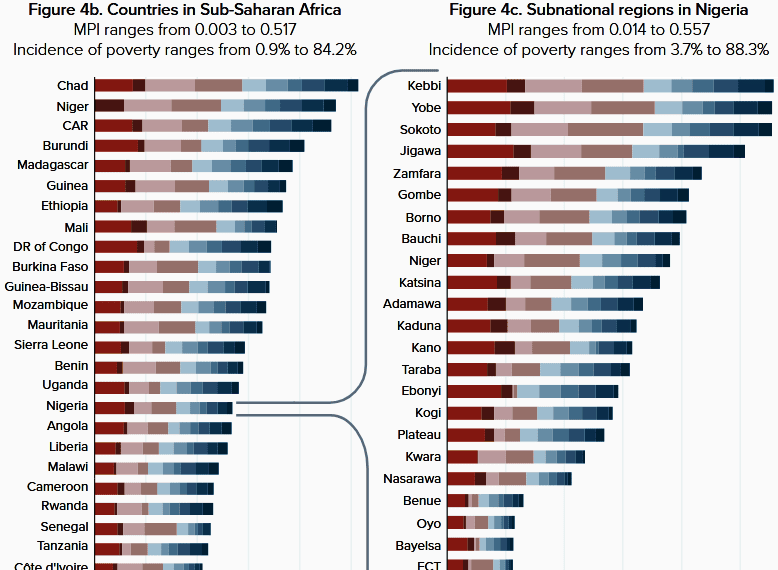
Nigeria has recorded the largest increase in the number of people living in multidimensional poverty anywhere in the world, according to the 2026 Global Multidimensional Poverty Index released by United Nations Development Programme (UNDP) and the Oxford Poverty and Human Development Initiative. The report finds that 17.9 million Nigerians fell into poverty between 2021 and 2024, placing the country ahead of Chad and Niger in poverty incidence and underscoring the scale of Nigeria’s economic and security crisis.
Findings from that report titled ‘Global Multidimensional Poverty Index, 2026’, placed the incidence of poverty in Nigeria between 3.7% to 88.3% ahead of Chad and Niger.
Out of 54 African countries studied by the World Population Review in 2026, Nigeria was recorded as the 24th poorest country in Africa with a per – capita income of $1,557.
From export economy to import dependent nation
Nigeria’s shift from an agrarian export economy to a heavily import – dependent nation represents one of the most critical challenges in its economic history, according to a report by BusinessDay. At independence in 1960, Nigeria’s revenue came from the exportation of cash crops including cocoa rubber, cashew nuts, groundnuts and palm oil among others.
A research report by Michigan State University (MSU) in the United States of America, stated that Nigeria’s Eastern Region under the administration of the Late Dr. Michael Okpara was recorded as the fastest-growing and industrializing economy in the world.
Since the discovery of crude oil in Nigeria in 1956 and subsequently, the oil boom in the 1970s, Nigeria became locked in a state of strategic economic dependence on crude oil, with the petroleum sector accounting for an overwhelming 75% to 90% of the country’s export earnings.
The journey to poverty
In a scholarly article published in May, 2025 and titled ‘The Impact Of Leadership Failure And Economic Mismanagement On Unemployment And Inequality In Nigeria (1999–2023),’ the authors, Yusufu Ahmed, Audu Bello & Audu Abu, attributed the high level of poverty in Nigeria to “corruption among Nigeria’s political elite.”
A report published by TruthNigeria in September, 2026, detailed how Nigeria’s political elites purchased U.S properties worth $271 million with funds looted from Nigeria’s public treasury.
An independent opinion poll conducted by Human Rights Writers Association of Nigeria (HURIWA) across the country, involving over 50,000 respondents in May, 2025 revealed that none had received or known anyone who had received cash transfers meant for more than 3.29 million vulnerable households in Nigeria despite the claim by the Nigerian Ministry of Humanitarian Affairs and Poverty Reduction that it transferred ₦33.75 billion ($24.7m) to poor Nigerians.
Rural farmers raise concern

Speaking in an interview with TruthNigeria, a septuagenarian and Chairman of the Elders’ Council in Oforola community, Chief Godwin Ugwuegbu, said he has been unable feed himself and his family since he survived a kidnapping experience by armed Fulani militants in February, 2024.
“ Since my abduction by the Fulani herdsmen 3 years ago, I have not visited my farms located near our boundary with Umuokanne community because I do not want to risk being kidnapped again,” said Chief Godwin Ugwuegbu.
“The proceeds I get from my farms located near our residential area is not enough to feed my family,” he continued. “Everyone is living in fear because of the Fulani herdsmen and this has discouraged the farmers from working hard like they used to in the past.”
Another respondent, Mr. Isaiah okechukwu, told TruthNigeria that kidnapping is not the only challenge facing rural farmers.
“Many families in this community are experiencing acute food shortages because beyond the issue of kidnapping, these Fulanis bring their cattle to graze on our crops”, said Okechukwu.
Experts react
“The poverty situation in Nigeria has been aggravated by the recent cost of living challenges that we had over the last two years (2023 – 2025),” said the Managing Director/ CEO, Centre for the Promotion of Private Enterprise (CPPE), Dr Muda Yusuf.
“I’m talking about things like food, transportation, education for their children and health “, Yusuf added while reacting to a report by PricewaterhouseCoopers (PwC), in October 2026.
“We are dealing with high inflation, currency depreciation and weak job creation”, said a professor of Economics and Development Studies, Olufemi Saibu.
“Nigeria’s population is expanding rapidly at a time of economic fragility and this rapid growth risks turning into a demographic burden that deepens poverty and unemployment”, Saibu added.
The way forward
Speaking at a high-level workshop hosted by the Diplomatic Correspondents’ Association of Nigeria (DICAN) in August 2026, Director of the Centre for China Studies, Abuja, Charles Onunaiju, said Nigeria’s poverty reduction strategies had largely focused on sustaining poor people at subsistence level rather than addressing the structural constraints preventing them from becoming productive wealth creators.
“Lack of individual capability is the defining parameter of poverty, so any poverty alleviation or reduction that did not enable capability could be described as just poverty maintenance,” said Onunaiju.
According to him, poverty reduction should focus on building individual and community capabilities.
Ebere Inyama reports for TruthNigeria on conflict and religious freedom.