Confidential security documents reviewed by TruthNigeria describe coordinated efforts to block harvesting, destroy livelihoods and prepare for possible attacks on churches and Christian communities.
By Mike Odeh James
Gunmen seized eight farmers from their fields in southern Kaduna on October 30. Confidential security documents say it was the opening move in a starvation campaign.
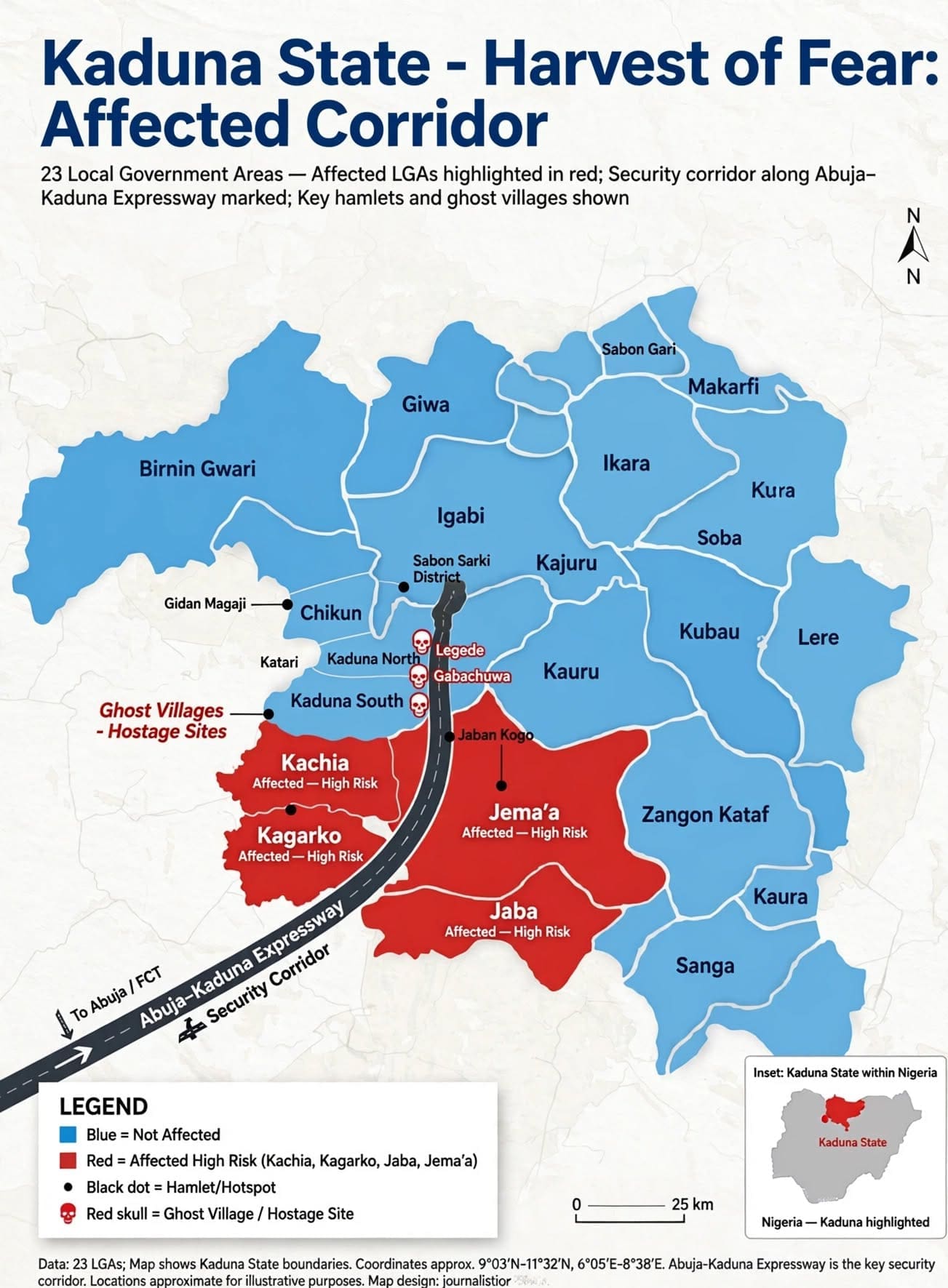
It was about 1 p.m. in Gidan Magaji, a hamlet in Kachia County too small to appear on official maps. Families were bringing in the season’s grain when heavily armed Fulani Ethnic Militia (FEM) fighters emerged from the bush.
They marched eight people away: Abu Atami, Sati Bawoi, Ayuba Makama, Haruna Saidu, Danjuma Umaru, Halima Rufai, Dauda Sale and Sale Abubakar.
Their names appear in a confidential security assessment dated October 31 and reviewed by TruthNigeria. An earlier memo dated October 28, and a threat advisory issued November 1, place the raid inside something larger: a campaign to make farming a death sentence, now escalating toward coordinated attacks on churches.
A Region Under Siege
Southern Kaduna is a largely Christian farming belt in Nigeria’s north-central region. Nearby Katari sits on the highway linking Kaduna city to Abuja, the federal capital, a road long notorious for kidnappings.
For more than a decade, militias drawn largely from Fulani herding communities have raided these villages. Thousands have been killed. Whole settlements stand empty. Ransom kidnapping has become an industry.
“The systematic abduction of farmers during peak harvest, coupled with the widespread destruction of crops by cattle herds, represents a calculated assault on regional food security,” the October 31 assessment states.
400 Fighters Move South
Between October 26 and 28, according to the earlier memo, multiple sources observed more than 400 fighters entering southern Kaduna, patrolling and possibly selecting targets.
They came, the memo says, from the camps of Dogo Gide, a Zamfara State warlord whose fighters were blamed for the 2021 abduction of students from the Federal Government College in Birnin Yauri, Kebbi State.
The memo names a Gide lieutenant, Kachalla Janbros, as coordinator of operations and supplies in the corridor. Kachalla is a Hausa title for a militia commander. TruthNigeria could not independently verify his identity.
If the account holds, the Fulani Terrorists have pushed a battalion-sized force deep into Kaduna’s Christian south, within striking distance of the road to the capital.
Hunger as a Weapon
“Militias have issued explicit threats across the Southern Kaduna corridor, warning that any attempt to harvest will result in summary execution or abduction,” the October 31 assessment reads.
The timing is precise. Maize and sorghum come in late October, and Kachia’s ginger harvest, one of Nigeria’s leading farm exports, is weeks away. A family that loses this crop faces empty granaries by spring and no seed for planting.
The fighters are feeding themselves too. The October 28 memo reports they have stormed shops and food stalls, a sign their forest camps face critical shortages. The militia starves the villages while eating what the villages grow.
Prisons in Ghost Villages
The memo documents a new tactic. Captives are no longer held in forest clearings but locked inside houses abandoned by families who fled earlier attacks, hidden from military surveillance aircraft.
“Victims are kept under lock and key until negotiations are concluded,” the memo states.
It names three emptied communities where the practice continues: Abron, Legede and Gabachuwa. Displacement has become infrastructure. Homes that once sheltered families now hold hostages, under roofs that look like nothing from the air.
The militia starves the villages while eating what the villages grow.
Churches in the Crosshairs
The November 1 advisory warns the farm raids may be a prelude. It describes an imminent, high-probability threat of coordinated attacks on Christian communities and churches, with FEM fighters mobilizing for “scorched-earth” operations.
It lists four high-risk zones: Sabon Sarki District, Jaban Kogo, the Jaba-Kagarko axis and the Abuja-Kaduna Expressway corridor. Beyond villagers and worshippers, the fighters are planning ambushes on community defense groups, military checkpoints and expressway commuters, the advisory says.
“The momentum of these activities suggests that large-scale operations are now in the final stages of execution,” the advisory states.
‘A Profound Sense of Abandonment’
Residents of the Katari area feel abandoned by government at every level, the October 31 assessment says, warning that the absence of a robust security response has emboldened the militias.
It also flags a political motive: raids timed to project state weakness, erode trust in government protection and suppress voting in southern Kaduna ahead of Nigeria’s 2027 elections.
Why Washington Should Care
The abductions come as the United States weighs how far to trust Abuja. In late 2025, Washington redesignated Nigeria a Country of Particular Concern, a State Department label for nations that commit or tolerate severe violations of religious freedom, opening the door to sanctions. U.S. lawmakers have pressed to keep it in place.
In September, a U.S. Air Force C-17 operating under U.S. Africa Command (AFRICOM) delivered American weapons to Nigeria.
If 400 fighters can cross state lines, decide who harvests and plot attacks on churches within reach of Nigeria’s capital, Western partners face a hard question: is their support protecting farmers like the eight taken from Gidan Magaji?
For now, their families wait. Across the corridor, crops stand unharvested, and congregations brace for what comes next.
Mike Odeh James is a conflict reporter for TruthNigeria.