Middle Belt leaders warn Abuja’s pilot ranching program could allocate land emptied by years of Fulani militia attacks before displaced families can return.
By Ekani Olikita
MAKURDI, Nigeria — Christian leaders in Nigeria’s Middle Belt are warning that the government’s new ranching policy could dispossess displaced farmers of ancestral land before they can return home.
The warning follows an August 11 announcement by Livestock Development Minister Idi Maiha that Benue, Plateau, Nasarawa, Kaduna and Adamawa states, along with the Federal Capital Territory, were selected for a pilot ranching program. Maiha said the initiative would begin at the Wase Grazing Reserve in Plateau State as a “proof of concept” for the government’s ranching model.
The proposal has triggered opposition from church leaders, community representatives and the Benue State Gover
nment, which says the state lacks sufficient land for large-scale ranching and fears the policy could deepen tensions in communities devastated by years of attacks, killings, kidnappings and displacement by Islamic Fulani Ethnic Militia (IFEM).
“We cannot reward our killers with our land,” said Air Commodore Titus Agbecha (retd), President-General of Tiv Union Worldwide, speaking for Benue’s tribal associations.
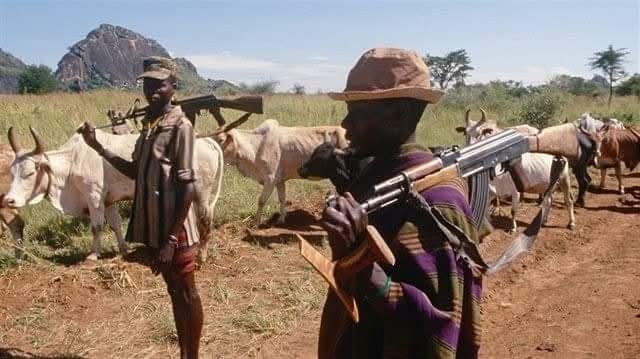
Fulani herders – some of whom double as Islamic Fulani Ethnic Militia (IFEM) –
have been linked to nearly 24,000 civilian deaths during a four-year reporting period, according to the Observatory for Religious Freedom in Africa (ORFA), making the gradual violent takeover of Benue State one of Nigeria’s deadliest ongoing security crises
Displaced Farmers First, Ranches Later

Community leaders say the government should prioritize securing communities and returning displaced Christian farmers before allocating land for ranches.
John Anthony Ikwulono, a former Deputy Chairman of Agatu County and State Assembly Candidate, said Benue does not have enough land for grazing reserves or ranches.
“Fulani militia, who are mostly from Northwest, Northeast and neighboring countries, have been attacking our communities for more than ten years, displacing more than two million of our people from their ancestral homes. Why is moving down to seize farm lands in predominantly Christian states instead of Northwest and Northeast where the Islamic Pastorialists hail from, not a land-grabbing and Islamization agenda?” Ikwulono told TruthNigeria.
“The main focus of the government should be how to return, rehabilitate and reintegrate the IDPs before talking about ranches.”
Nigeria has no authoritative national figure separating displacement caused specifically by Fulani militia violence from other causes. The Internal Displacement Monitoring Centre (IDMC), however, estimates that 5.7 million internal displacements occurred in Nigeria between 2008 and 2025, including about 354,000 in 2025 alone
Former Benue Governor Samuel Ortom estimated in 2023 that about two million Christian farmers were displaced within the state , a figure corroborated by a Senior Catholic clergyman Rev. Father Remigius Ihyula, coordinator of the Foundation for Justice, Peace, and Development Committee, Catholic Diocese of Makurdi and Catholic chaplain of Benue State University, Makurdi, in an interview with TruthNigeria in 2024 .
Counterterrorism expert Pablo Williams Agada, Benue South Zonal commander of the Civil Protection Guards, estimates that more than four million Nigerians have been driven from their homes by Fulani militia violence during the past decade, with Benue and Plateau among the hardest-hit states.
“More than four million Nigerians have been sent out of their homes by Fulani terrorists in the past one decade,” Agada told TruthNigeria.
Church Leaders Raise Alarm
Rev. Ta Targba, general secretary of the Nongov Kristu Sudan-u-Tiv (NKST), also known as the Universal Reformed Christian Church of Nigeria, said the proposed ranching policy ignores the scale of Christian losses.
“Over 5,987 of our members have been killed and 753 of our worship centres destroyed by Fulani terrorists over the past 10 years,” Targba told TruthNigeria.
“We are either Catholic, Protestant or traditional worshippers and farmers. Why should we cede our land to the same murderers who are not from our state?”
Those figures are church estimates and could not be independently verified.
Chief Bulus Nathaniel, a Gbagyi Tribal leader in Abuja, described the policy as a potential land-grabbing and Islamization exercise.
“We are farmers and 98 percent Christians in Abuja and other Middle Belt states,” Bulus said. “Why select our lands, which have been under ceaseless attacks by Muslim Fulani Pastoralists who are not from our region, for the pilot ranching scheme?. This is a pure land grabbing and Islamization move”, Bulus told TruthNigeria.
He said the government should first restore security and enable displaced residents to return to their ancestral communities.
A Broader National Displacement Crisis
The controversy comes amid a global displacement crisis. IDMC’s 2026 Global Report on Internal Displacement puts the worldwide number of internally displaced people at about 82.2 million, driven by conflict, violence and disasters
For Washington, the Nigerian debate has implications beyond land policy. Nigeria is Africa’s most populous country and a key U.S. security partner, while persistent communal violence, mass displacement and competition over agricultural land risk worsening humanitarian needs and regional instability.
The central question for displaced Middle Belt communities is whether the government will first make their ancestral homes safe enough for them to return—or allocate those lands to a new national ranching program while hundreds of thousands remain displaced.
Ekani Olikita is a conflict reporter for TruthNigeria.