2,000 Residents Flee Lakurawa-Mahmuda Clash Near Kainji Basin Area
By Onibiyo Segun and Suleman Ayuba
(Borgu, Niger State) – More than 2,000 residents have fled Borgu communities after Lakurawa-Mahmuda clashes and mosque attacks displaced families into Benin Republic and Kebbi State, exposing wider struggles around Kainji basin.
The displacement highlights a growing security challenge in Nigeria’s border communities, where Caliphate-seeking insurgents in remote areas struggle to maintain lasting control after military operations end.
Borgu Families Scatter Across Borders
“Some of our people have relations in Benin Republic, while others are currently taking refuge in Kebbi State,” Honourable Lambus Nasiru, Media Aide to the Borgu County Chairman, told TruthNigeria.
The traditional head of Dekera community, Abubakar Umar, said at least 2,000 residents fled into neighbouring Benin Republic following the attacks.
The movement followed attacks on communities around the Kainji Lake basin, where armed fighters stormed Dekera and nearby settlements on Friday, Aug. 21.
Residents told TruthNigeria that families abandoned homes, farms and businesses as fear spread. The displacement has turned a security incident into a humanitarian crisis, dividing communities between Nigeria and neighbouring Benin Republic.
Mosque Attack Leaves Worshippers Missing
The August 21 attack began when armed fighters entered communities around Dekera, Gidan-Zana, Kpenya, Giyan Gbasu, Sabon Gida and other areas around Borgu.
The Niger State Police Command confirmed the attack and said some worshippers escaped into surrounding areas while security personnel were deployed for assessment and rescue operations.
Police said tactical teams were sent to Dekera, Gidan-Zana and Kpenya communities, but the number of abducted persons remained under verification.
The attack created panic among residents already facing repeated armed raids around the Kainji basin.
Captive Video Deepens Families’ Fear
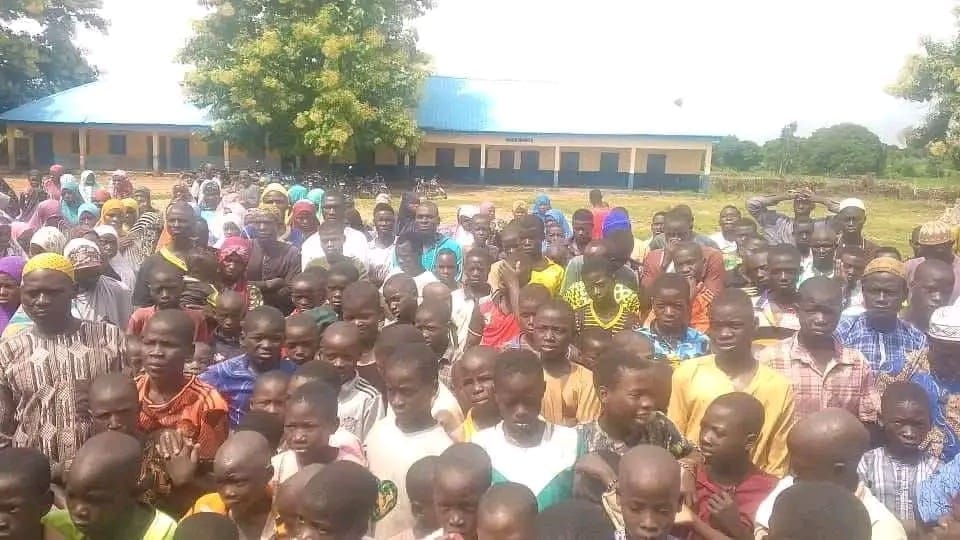
The uncertainty increased after a video circulated showing a large group of captives seated in an open area.
“The government has failed us. Our parents are still in captivity,” Tijjani Buba told TruthNigeria.
Buba questioned why affected communities had not received stronger military air support despite repeated attacks around the Kainji basin.
Kainji Basin Becomes Contest For Influence
The August attacks followed clashes around the Kainji basin between Lakurawa-Mahmuda previously reported by TruthNigeria. Analysts say the conflict reflects armed factions competing for influence over vulnerable communities, movement routes and rural territories.
Borgu’s strategic importance is defined by its pathways into Western Nigeria and by deep pockets of recoverable gold. Its remote settlements, difficult terrain and proximity to the Benin Republic challenge security monitoring. Analysts say the focus must shift from rescues to preventing armed groups from rebuilding influence.
Rescue Operation Raises Territory Question
On August 5, Nigerian authorities announced the rescue of hundreds of hostages from the Kainji Lake National Park forest area during a military operation.
Reports said the operation recovered victims abducted from communities in Kwara State and Borgu County in Niger State.
The return of armed terrorists to Borgu communities shortly after the rescue operation raised questions about whether security forces were able to hold territory after clearing operations.
“What we have in Borgu is not just a kidnapping incident. It is a territorial contest,” Prof. Hadiza Umar, a counterterrorism expert based in Keffi told TruthNigeria.
She said security success should be measured by whether residents can safely return home and farm without fear.
Border Security Challenge Extends Beyond Nigeria
Colonel Mudi Attaihiru (rtd.) said, “Border communities are vulnerable because armed groups do not recognise national boundaries. When security pressure increases in one location, they attempt to exploit remote areas and movement routes across neighbouring regions”.
“The challenge around Kainji, Borgu and the Niger-Benin corridor is not only responding to attacks, but maintaining security presence to prevent armed groups from rebuilding influence in ungoverned spaces,” Attaihiru noted.
He added: “Without that, pressure in one state simply pushes the problem across a border.”
Government Orders Rescue Effort
President Bola Ahmed Tinubu directed security agencies to launch an immediate coordinated operation to rescue the abducted worshippers.
The Niger State Government also condemned the attack and said Governor Mohammed Umaru Bago directed security agencies to work toward recovering the abducted residents.
Six days after the attack, Niger State Commissioner for Information Obed Nuhu said authorities had not received any communication or demand from the abductors.
Nuhu said, “authorities suspected involvement by Lakurawa and Boko Haram elements while investigations continued.”
Recovering abducted residents and arresting attackers remained priorities, according to Inspector General of Police, Olatunji Disu. As of August 29, there was no public confirmation that victims abducted during the August 21 attack had been rescued.
Air Commodore Darlington Abdullahi (rtd.), a counterterrorism and air operations expert said that, “there must be stronger aerial surveillance, improved border coordination and permanent security presence around vulnerable communities. Mass displacement is not just movement. It affects farming, education and community survival”.
Borgu’s Unanswered Question
For thousands of residents who fled Dekera and surrounding communities, the immediate question is when they can safely return home.
All things considered, however, the Nigerian Army took credit for pushing back the numbers of bandits and insurgents challenging the government in Abuja for control of the remote regions in Nigeria’s northern states.
The Defence Headquarters (DHQ) claimed that Nigerian troops eliminated 324 terrorists and other criminals, arrested 373 suspects and rescued 610 kidnapped victims across the country in August 2026.
The progress report came from Director of Defence Media Operations, Maj.-Gen. Michael Onoja, on Monday in Abuja during the monthly briefing on military operations.
Onibiyo Segun and Suleman Ayuba report on terrorism and conflict for TruthNigeria.