Judd Saul and Fr. Remigius Ihyula told U.S. scholars that mass killings in Nigeria’s Middle Belt are not “farmer‑herder clashes,” but targeted attacks on Christian communities, urging Washington to reassess data, policy, and security engagement.
‘Stop Calling it Farmer-Herder Clash’ – Judd Saul
By Mike Odeh James
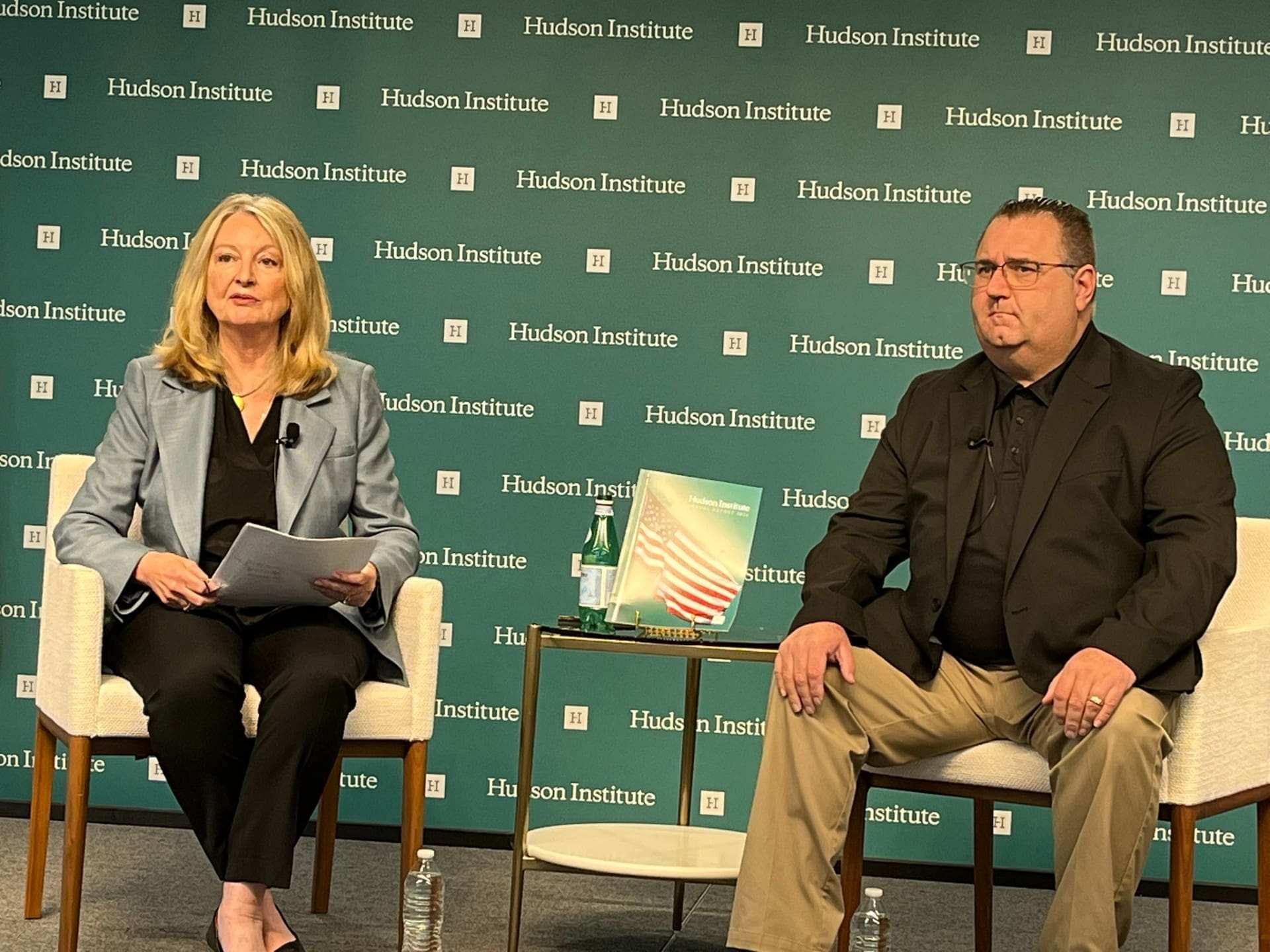
(Washington) “We have got to quit calling it the farmer-herder clash,” missionary Judd Saul told an invitation-only session at the respected Hudson Institute on Aug. 28.
Saul is executive director of Equipping the Persecuted, an American charity that aids survivors of attacks in Nigeria’s Middle Belt — the states across the country’s center where the Muslim North meets the Christian South — and travels there frequently. The subject was Nigerian mass murder from terrorism, the root causes and the way ahead. It followed Washington’s decision last year to name Nigeria a “Country of Particular Concern,” its designation for states that tolerate severe religious persecution.
Saul rejected the standard framing of farmers and herders fighting over scarce land and water. “The herders have AK-47s and they are Muslims,” he said. “They are radicalized. They are allowed to run throughout the country unimpeded. The farmers are mostly Christian, and they are unarmed.”
The Rev. Fr. Remigius Ihyula, who ran the Makurdi diocese’s justice and peace office in Benue State, joined by video link. Raids by Fulani Ethnic Militia (FEM) — armed men from a largely Muslim herding people spread across West Africa, most of whom take no part in the violence — begin between 10 p.m. and 2 a.m., he said. Gunmen ring a village and shoot whoever runs.
Even if you escape the gun, you may never escape the machete, Ihyula told the gathering of 150 scholars and Nigerian experts.
The crisis is not new: his diocese opened Benue’s first camps for the displaced in 2001, and Islamist attacks then were happening.
200 Warnings on the record
Saul said his charity has issued more than 200 terror alerts in two and a half years — tip-offs from village informants, passed to security forces, naming where gunmen are massing. He put their accuracy at 93 percent. Warnings he published last December naming three Christmas targets were called lies. All three towns were attacked.
Plateau State was warned twice before mid-August raids killed 27 people. No one came. A day later, Nigerian Army soldiers shot three Christian villagers guarding their community.
Police called January’s seizure of 177 worshippers from three churches a hoax, he said; hostages later reported that officials paid a ransom to the kidnappers.
ACLED’s Claims Challenged

Hudson senior fellow Nina Shea cited the Observatory for Religious Freedom in Africa, a European genocide tracker that accused Fulani terrorists as the perpetrators of nearly 24,000 civilian deaths in the five years to September 2025, or 47 percent of Nigeria’s civilian killings. Boko Haram and its offshoot ISWAP, the jihadist groups fighting in the Northeast, accounted for only 11 percent.
Those figures sit awkwardly beside the dataset governments use. The Armed Conflict Location and Event Data Project, or ACLED, counts violent incidents worldwide and is relied on by the United Nations. It does not record the religion of victims or attackers, saying it is usually unknown. Shea read a message she said its founder sent her calling that unknowable.
Saul called ACLED lazy and irresponsible. His reporters visit attack sites, count the dead and ask survivors which churches they attend.
Ihyula’s rebuttal rested on parish records, he said. The church is often the only institution in villages, running schools and clinics and posting lay teachers where there are no roads. Priests know the victims of terrorism by name, because the church baptized and buried them.
“We know they are Catholics and Christians because we minister to them,” he said. He keeps records of every parish and mission school closed by attacks, and offered to take doubting researchers there.
Washington’s dilemma
Former Ambassador Tibor Nagy, a former U.S. assistant secretary of state for African affairs who served in Nigeria, sketched four crises: insurgency in the northeast; kidnapping in the northwest; militia violence in the center; separatist anger in the southeast, affecting 30 of 36 states.
Nigerian-American lawyer Emmanuel Ogebe opposed pulling out the roughly 200 American troops now reported to be leaving. Airstrikes on Islamic State fighters in May worked, he said, only because U.S. drones and personnel were there.
Saul, Ogebe, Ihyula and Shea all pressed Washington to stay engaged. Nagy was the cautionary voice. He put three questions to Abuja: Does it admit the problem? Does it have the means? Will it act? “Nigerians have to solve their problem,” he said, urging incentives and sanctions.
‘Another Rwanda’ Looming,’ Saul Warns
Saul said his charity cannot arm anyone. It can pass on warnings and help villages plan where to send women and children. But that is not enough, he warned: without outside intervention, the annual Christian death toll will reach the hundreds of thousands.
“We are going to see another Rwanda genocide,” Saul said, invoking the 1994 slaughter of 800,000 people. “Let us stop the genocide now, while we can.”
Whose land, whose future?
Ihyula challenged the government’s plan to end open grazing by settling herders on government-organized ranches. The sequence is wrong, he said.
“What has happened to the millions whose land was stolen and is still occupied?” he asked. “Recover this land, resettle the displaced, then we can talk about ranching.”
He asked why ranching proposals always name as preferred locations the majority-Christian states of Benue and Plateau, never the northern states herders come from? He warned that moving farmers turns displacement into permanent loss.
More than two million Nigerians wait to learn whether they can go home but stand to lose lands their ancestors have occupied for centuries. With elections due in 2027, it may be the country’s most explosive question.
Mike Odeh James is a conflict reporter for TruthNigeria.