Across the Lake Chad Basin, insurgents now treat farming, travel, and even suspected contact with security forces as collaboration — a shift that is driving executions, mass displacement, and a deadly “checkpoint economy.”
By Suleman Ayuba
MAIDUGURI, Nigeria — Civilians in the Lake Chad Basin are being killed not only when they leave displacement camps to farm or gather firewood, but because Boko Haram and Islamic State West Africa Province (ISWAP) increasingly classify ordinary residents as collaborators, informants, or combatants. Analysts and local leaders told TruthNigeria that militants have built a parallel system of taxation, movement passes, and surveillance across Marte, Konduga, Kukawa, and Cameroon’s Far North Region — and civilians who fall afoul of that system are executed at close range, often for refusing to pay illegal levies or for being suspected of assisting security forces.
Marte’s position on Lake Chad waterways and an old agricultural corridor has allowed Islamic State West Africa Province (ISWAP) and Boko Haram fighters to impose a “checkpoint economy.” Honourable Aliyu Mai Borno, convener of the Southern Borno Progressives Union, described Marte as a former agricultural centre that has fallen outside effective government control.
“Marte is a strategic location that has been completely overrun by ISWAP and Boko Haram terrorists,” he said, adding that federal government of Nigeria equipment valued at more than N10 billion Naira had effectively been abandoned. “The people are living in makeshift shelters in IDP camps under strict security watch. Outside the camps, there is nobody. There is no economic life left inside. Those who were killed in Marte were innocent victims living in these camps who had no choice but to venture out to survive.”
Shehu Usman Dikwa, a local trader who uses routes in the area, said movement itself is taxed. “It is completely illegal to go to a farm or move through the bush without paying taxes to the terrorists. Traders and travellers like me have to pay heavy taxes just to secure a gate pass to move along these roads,” he said. Of the group attacked near Ala and Musune, he said: “The people killed were actually 18, not just 15. When you refuse or cannot pay, or when they suspect you are reporting their movement, the punishment is immediate execution.”
That account matches a pattern Lake Chad counter-insurgency analyst Zagazola Makama has documented around the basin. Writing on the separate killing of about 40 farmers at Dumba, near Baga in Kukawa, Makama reported that cultivators had negotiated access to land deep inside insurgent enclaves, paid levies, and received passes and receipts from ISWAP — an arrangement made outside the safe farming perimeters set by the military and the Multinational Joint Task Force. He estimated that more than 2,000 farmers and fishermen in the Lake Chad area operate under Boko Haram or ISWAP control, paying levies and carrying movement passes, and in some cases acting as couriers for logistics and intelligence (Zagazola).
In a follow-up on farmers who fled after a later massacre in northeastern Kukawa, he described a fixed tariff — about N10,000 per hectare, plus two bags out of every ten at harvest as zakat — and noted that the victims were shot after ISWAP found they had paid the rival Boko Haram Buduma faction rather than ISWAP (Zagazola). The vulnerability is structural. Camps offer no livelihood, so civilians buy survival from the group that controls the farms and the waterways, and that transaction can itself become a death sentence.
Sahel terrorism tracker Brant Philip draws a sharper line on who the groups consider a legitimate target. In analysis of the continuing war between Jama’atu Ahlis Sunna Lidda’awati wal-Jihad (JAS, widely known as Boko Haram) and ISWAP, he has noted that JAS treats ordinary citizens living under Nigerian government authority as apostates, while ISWAP treats Christian civilians as pagans whom they consider as soldiers, informants or otherwise affiliated with the state (Brant Philip on X).
It also explains the executions. In December 2025, Philip reported that ISWAP killed two men it accused of spying for the Nigerian Army — one seized at home in Dekwa, Yobe, another near Gubio in Borno — as part of at least nine executions in a short period, which he linked to a purge of suspected moles ahead of expected military pressure (Parallel Facts). Civilians who report movements are not, in ISWAP’s rules, neutral bystanders. They are reclassified as auxiliaries.
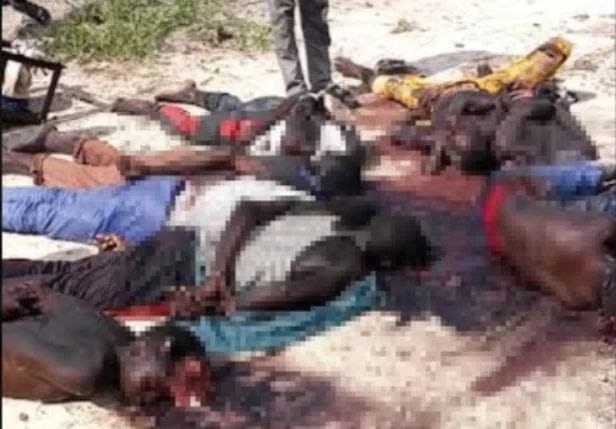
Those distinctions frame the series of killings that local sources who told TruthNigeria and officials have linked to retaliation against communities suspected of assisting troops. At least 15 farmers and firewood gatherers were killed and three others remained missing after suspected Boko Haram/ISWAP fighters ambushed civilians in Marte Local Government Area of Borno State. The victims were among 18 displaced residents who left camps to farm and collect firewood around Ala and Musune wards. Fifteen bodies were recovered. Local sources said the victims were ambushed, bound and executed at close range, and alleged that some bodies were decapitated, a detail that has not been independently verified by TruthNigeria. Borno State Police spokesperson Nahum Daso confirmed that 15 people were killed and said forces were working to locate those still missing. Reuters reported that suspected Islamist militants killed at least 18 villagers who had gone into the bush to collect firewood in Marte, with others still missing, as troops launched clearance operations (Reuters).
The Marte attack sat inside a wider wave. On September 29, 2026, 17 villagers, including a local chief, were reportedly killed in Konduga Local Government Area in an attack Shehu Usman Dikwa, a local trader, attributed to ISWAP. A day earlier, 15 people were reportedly killed at Digimsilio in Cameroon’s Far North Region near the Logone River basin, after warnings that residents said followed alerts to the Multinational Joint Task Force and Cameroonian gendarmes, Dikwa told TruthNigeria. An ISWAP letter obtained by TruthNigeria from the community warned that residents assisting government forces would be treated as enemies.

Philip’s reading of ISWAP practice fits that letter. The group’s published distinction between ordinary civilians and informants is enforced by killing the latter in public, which discourages the reporting that Nigerian forces and the MNJTF ask communities to provide. Makama’s earlier reporting on the Baga corridor points to the other side of the same trap: once civilians have bought a gate pass from one faction, they are already inside an insurgent administrative system, and a rival faction — or the same faction, if it suspects a tip-off — can treat them as collaborators. In Digimsilio, alerts before the attack did not produce protective deployments in time. Fear of retaliation isolates communities from the agencies meant to protect them. People stop reporting. People stop moving. ISWAP can then claim it is the only authority that provides access to farms and markets, even if that access is sold through brutal taxation.
Amnesty International condemned the Marte killings and called on Nigerian authorities to take immediate, transparent and human-rights-compliant measures to protect vulnerable rural communities. The organisation described the targeting of civilians as a grave violation of international humanitarian law (Amnesty International).
Across Marte, Konduga and the wider Lake Chad Basin, displaced families who cannot secure food, fuel or income inside guarded areas still cross the same gaps that armed groups tax and police. Cooperation with the state can bring retaliation; refusal to enter the bush can mean hunger. For now, survival often means walking into the space between both, Shehu Usman Dikwa told TruthNigeria.