Two troops killed and 13 wounded in a drone strike on a military position in Kukawa as analysts warn the extremists are combining satellite communications, foreign expertise, and aerial warfare tactics.
MAIDUGURI, Nigeria — A recent drone strike on a Nigerian military position has renewed concerns that Islamic State West Africa Province (ISWAP) is acquiring increasingly sophisticated technology and expertise. Security analysts told TruthNigeria that the group now combines weaponized drones, satellite communications, and foreign technical support in a strategy that mirrors tactics previously seen in Iraq and Syria.
The attack unfolded Saturday, October 31, 2026, at approximately 6:14 p.m., moments after a Borno State Government delegation that included Commissioner for Information and Internal Security Usman Tar had departed the settlement. Sources indicated the timing suggested sustained surveillance of the area ahead of the strike.
This incident aligns with a documented pattern of assaults on Kukawa positions. In early October 2026, ISWAP struck the 101 Special Forces Battalion from multiple directions. Military sources cited by Sahara Reporters and independently verified by TruthNigeria reported eight soldiers killed, while the Army confirmed more than 25 terrorists neutralized and 14 bodies recovered. TruthNigeria’s earlier reporting on that night assault detailed the role of island staging areas and the repeated cost to troops even when air support prevented the base from falling.
Death from Above: From Surveillance to Strike

For years, commercial off-the-shelf quadcopters served ISWAP primarily for intelligence, surveillance, and reconnaissance. Security sources speaking anonymously to TruthNigeria stated that fighters are now weaponizing low-altitude airspace, deploying modified drones carrying explosive payloads against military installations and critical infrastructure.
“The situation is deeply worrisome,” one security operative said. “ISWAP fighters are no longer just using drones to peer over our fences; they are executing coordinated aerial strikes designed to cripple forward bases and wipe out command nodes.”
This shift reflects broader regional developments. In January 2026, Reuters reported that drone-backed ISWAP militants raided an army base in Borno, destroying vehicles and killing soldiers and Civilian Joint Task Force members. Conflict reporter Kabiru Abubakar, who monitors the Lake Chad basin, described the escalation exclusively to TruthNigeria as part of a transnational pattern across the Sahel. He warned that without seamless, real-time coordination between the Nigerian Air Force and ground forces, these aerial systems will shift focus from remote outposts to heavily populated state capitals.
Yerwa News Express Reported on the drone attacks.
Starlink Terminals and Foreign Combatants
ISWAP’s technical backbone is being supported by high-speed satellite communications, specifically using Starlink terminals to maintain operational command and control across the Lake Chad marshes, Counter-terrorism specialist Supol Ghaida told TruthNigeria.
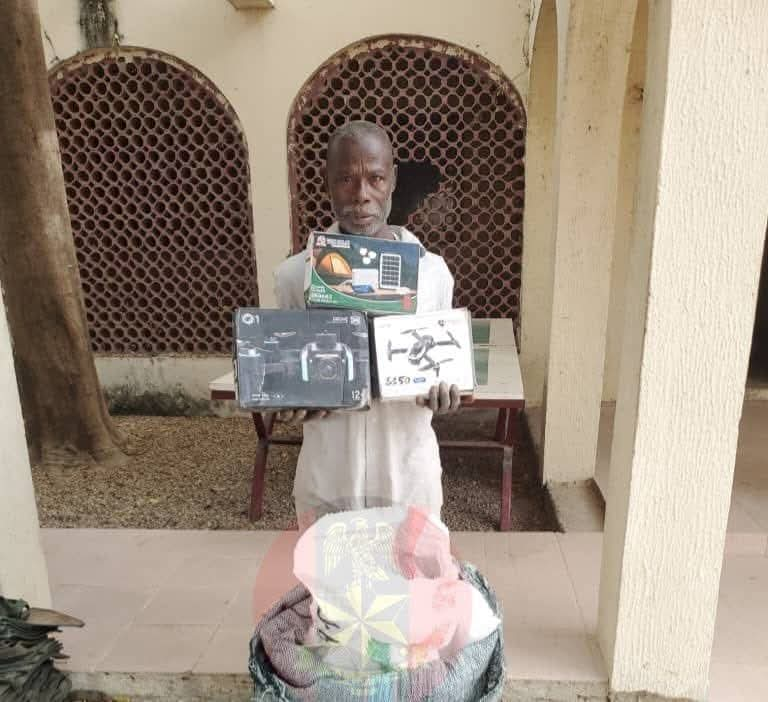
Nigerian troops have intercepted such equipment on multiple occasions. In July 2026, soldiers detained a suspect along the Maiduguri–Monguno road carrying a Starlink terminal and networking gear, as reported by TheCable and Zagazola Makama.
Reports also indicate the presence of foreign combatants. In a July 2026 failed infiltration attempt at Cross Kauwa, also in Kukawa LGA, military analysis of recovered materials identified foreign facilitators, including a Palestinian Arab assessed as an overall trainer and a Moroccan Arab serving in a medical capacity. These external elements bring specialized skills in explosive engineering, long-range communications, and uncrewed aerial vehicle modification.
Ghaida stated: “Without concrete, aggressive plans to neutralize this airborne threat immediately, we are not just looking at tactical retreats—we risk losing entire local government areas and key strategic corridors to terrorist control.”
Zagazola Makama’s Analysis
Security analyst and counter-insurgency expert Zagazola Makama has highlighted ISWAP’s adoption of weaponized drones, noting that the tactics mirror those perfected by global jihadist franchises in Syria and Iraq. Makama’s reporting indicates that ISWAP forces test defensive perimeters during high-profile civilian visits or rotational handovers, using low-radar-cross-section drones to create chaos ahead of ground waves or mortar barrages. The recovery of combat drones by troops of Operation Hadin Kai during previous clashes in the Izge and Sambisa axes confirms that insurgents are systematically acquiring, assembling, and testing uncrewed technology.
Strategic Counter-Measures
Military analyst Dr. John Mangzha identified three immediate actions: deployment of electronic warfare assets, including frequency jammers and anti-drone systems capable of severing satellite links and controller signals at forward operating bases; enhanced air-ground integration through persistent airborne early warning to detect drone launch coordinates; and supply chain interdiction through joint border surveillance along Lake Chad corridors via the Multinational Joint Task Force to intercept illegal satellite hardware and drone components.
According to public analysts tracking the Lake Chad basin, including Brant Philip who have documented the trajectory of ISWAP’s technical adaptation, the Kukawa strike represents a further step in the group’s shift toward hybrid aerial and external support capabilities.
As low-flying systems continue to operate over Borno’s skies, the distinction between front-line outposts and urban centers continues to narrow into a single operational space Ishaya Tafida an academic who is specialized in military history told TruthNigeria.
Suleman Ayuba conflict reporter for TruthNigeria.