Despite military claims of major battlefield gains, armed groups carried out deadly attacks across Kaduna and Zamfara while families in Kwara demanded action after six months of silence.
NORTHWEST NIGERIA — At least 60 people were killed across Kaduna and Zamfara states this week, even as Nigeria’s military announced a series of high‑profile victories against insurgents and armed groups. The violence unfolded as hundreds of residents marched through Kaiama in Kwara State, demanding answers about 176 villagers abducted nearly six months ago and still missing. The contrast between official battlefield claims and the grim reality on the ground has renewed concerns about the country’s worsening security crisis.
On Friday, July 24, hundreds of residents marched through Kaiama in north-central Nigeria, demanding answers about the fate of 176 villagers who have remained in captivity for nearly six months.
Terrorists stormed Woro community in Kwara State on February 3, arriving on motorcycles, moving from house to house, killing some residents and dragging others into nearby forests.
Since then, families say they have received little or no information about their loved ones. The village head, Alhaji Umar Bio-Salihu, says the community is still struggling to recover from the attack.
The situation grew even more desperate on Wednesday, April 22, when the kidnappers reportedly threatened to execute the captives unless a “substantial ransom” was paid.
Yet, even as families searched for answers, the military spent the week announcing a string of battlefield victories.
Air War Intensifies in the Northeast
The first came on Tuesday, July 21, when the military launched what officials described as a precision intelligence-led operation in Marte County (Local Government Area) of Borno State.
An Intelligence, Surveillance and Reconnaissance (ISR) platform, codenamed Guardian, tracked suspected ISWAP fighters sheltering beneath a tree near several structures.
After confirming the targets, the military carried out a drone strike that killed five militants and triggered secondary explosions, bringing the estimated death toll to about 15.
As darkness fell that same day, suspected ISWAP fighters launched a brazen assault on a military checkpoint in Gujba County, Yobe State.
Troops of the 27 Task Force Brigade repelled the attack after a fierce gun battle, but the victory came at a cost. Two soldiers were killed, a military gun truck was destroyed, and the attackers made off with a QJC machine gun and an AK-47 rifle.
The pressure continued less than 24 hours later.
On the night of Wednesday, July 22, military helicopter gunships swept over another suspected insurgent hideout along the Bama–Maiduguri highway in Borno State after detecting muzzle flashes from what intelligence identified as an ISWAP training ground.
Once the militants returned fire, the helicopters unleashed sustained strikes that military sources said killed eight insurgents, forcing the survivors to scatter into the surrounding bush.
Military Successes Shadowed by Fresh Attacks
The military also claimed major victories in the northwest, where commanders released new figures they said reflected sustained pressure on armed groups.
On Thursday, July 23, the commander of Operation FANSAN YAMMA, Major General W.B. Idris said troops had killed 805 terrorists, rescued 2,536 kidnap victims, arrested more than 1,100 suspects and informants, and recovered hundreds of assault rifles, thousands of rounds of ammunition, and hundreds of motorcycles used by armed groups during operations in July.
Around the same time, Brigadier General Mustapha Jimoh, commander of 1 Brigade, announced separate gains in Zamfara State, saying troops had killed 85 bandits and rescued 283 hostages through intelligence-led operations. He said the offensive had significantly weakened armed groups and improved security for residents, farmers, and commuters.
Yet events on the ground told a different story.
Just two days earlier, on Tuesday, July 21, armed bandits swept into farming communities in Sauna District of Talata Mafara County, Zamfara State, launching a brutal daylight attack.
Riding motorcycles, they opened fire at close range on farmers working in their fields. “They chased people, shot them, and even ran over some victims with their motorcycles. They also rustled livestock before leaving,” one survivor said.
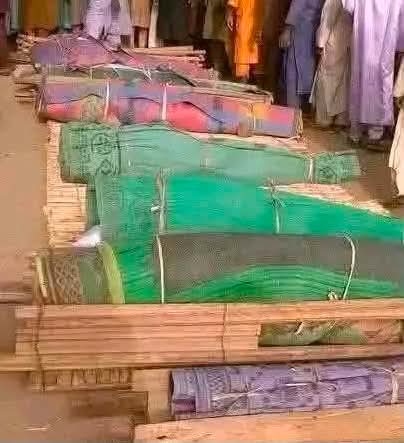
Amnesty International said 25 people were killed. Residents buried the victims in a mass grave the following day.
Before the grief from Talata Mafara could settle, Zamfara came under attack again.
Before dawn on Saturday, July 25, heavily armed bandits stormed Bungudu, less than 12 miles from the state capital, Gusau. Their target was the home of Bungudu Local Government Chairman Nura Umar Abdullahi.
His security team fought back but was hopelessly outgunned. The attackers abducted the chairman and several members of his family before fleeing toward nearby forests.
Pursuing troops rescued his wife, mother, two children, and another relative, but Abdullahi remains in captivity.
The raid left two police officers and two local vigilantes dead, while the chairman’s elder brother was wounded.
In the early hours of Sunday, July 26, troops of Operation FANSAN YAMMA rushed to Magami village in Kaura Namoda County after reports that about 40 motorcycle-riding bandits had abducted dozens of residents.
Troops intercepted the attackers and forced them into a fierce gun battle. Outgunned, the bandits abandoned all 48 captives and fled into the bush, although one civilian was killed and two others were wounded during the attack.
Troops remained in the area afterward, conducting aggressive patrols to forestall further attacks.
Beyond Zamfara
But the violence showed no sign of easing.
Between Friday, July 24, and Saturday, July 25, Fulani ethnic militia attacked the Benue communities of Elulu and Agadagba, killing at least three people and injuring two others.
Then, in the early hours of Sunday, July 26, gunmen abducted Kebbi State High Court Judge Justice Faruku Hassan Bunza from his home, adding another prominent name to Nigeria’s growing list of kidnap victims.
Hours later, another tragedy unfolded in Naridon village in Kaduna State, where heavily armed Fulani militia attacked the predominantly Christian community for nearly three hours.
Community leaders said at least 30 people, including eight children, were killed, four others were critically injured, and dozens of homes and shops were burned. Residents accused security forces of failing to intervene despite the prolonged assault.
The scars of earlier kidnappings also continued to deepen.
On Friday, July 24, community leaders revealed that seven of the 37 Christians abducted during an Easter Sunday attack on Ariko village in Southern Kaduna had died after more than three months in captivity.
There was, however, one notable win against the insurgency.
On Saturday, July 25, Musa Usman, identified by military sources as the chief finance officer of an ISWAP enclave in Jubillaram, surrendered to troops in Borno State alongside his two sons, ages 10 and 15.
Officials said Usman oversaw the group’s finances and logistics, making him one of its most senior noncombat operatives.
Ezinwanne Onwuka is a conflict reporter for TruthNigeria.