Growing Threat to Nigeria from Sahelian Jihadist Groups: Experts
By Suleman Ayuba and Onibiyo Segun
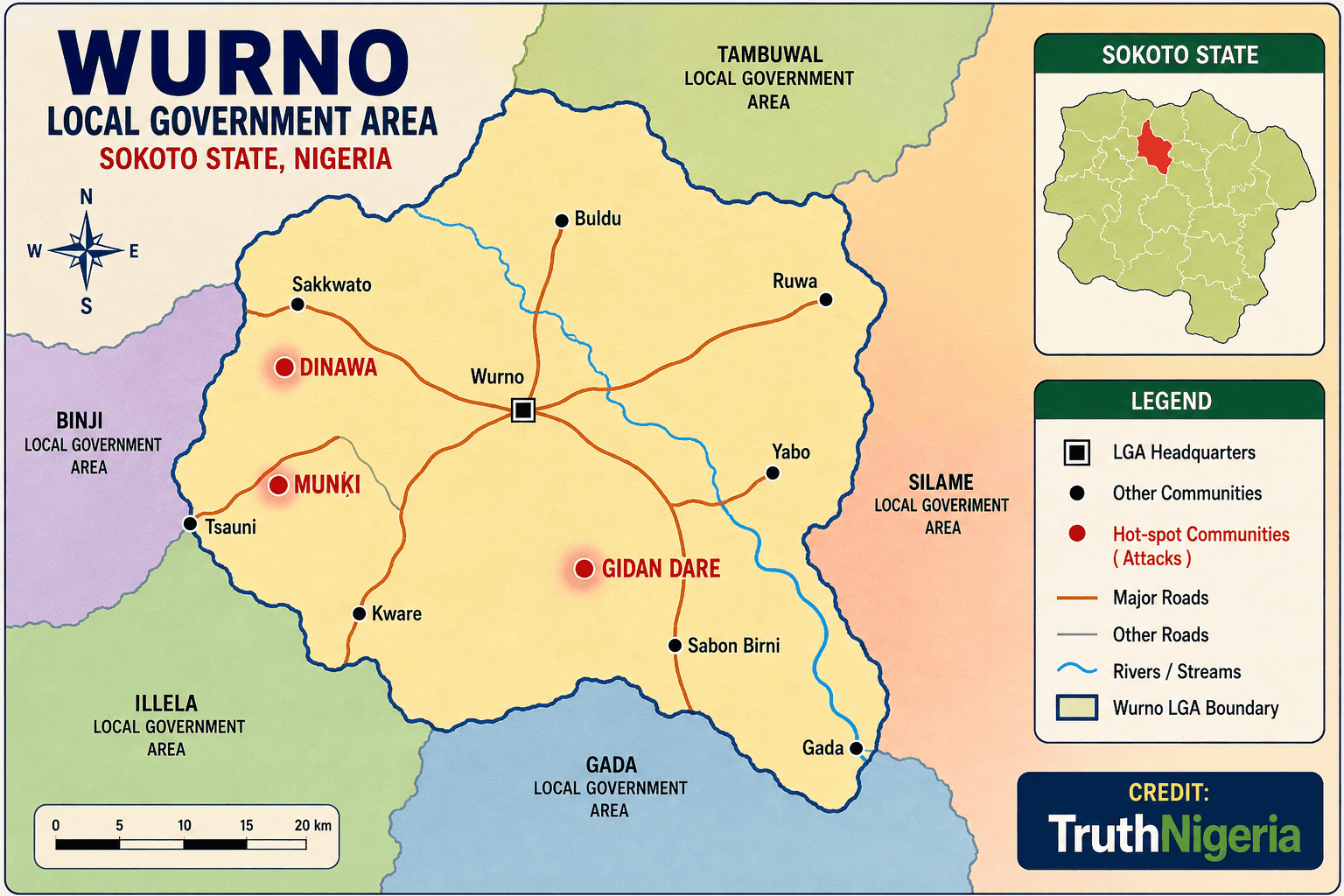
(Sokoto) – Armed Lukurawa terrorists attacked three Sokoto communities overnight, Tuesday, according to Sahara Reporters, killing five residents, abducting others and looting homes in a coordinated assault exposing the group’s growing ability to challenge law enforcement in Nigeria’s far North.The August 18 attacks targeted Dinawa, Munƙi and Gidan Dare communities in Wurno County, Sokoto State, as residents said the attackers exploited heavy rainfall to move while many families remained indoors.
Community sources said the attackers moved from house to house during the night, leaving residents unable to mount an effective response, according to interviews conducted by TruthNigeria reporter.
“The assault on Dinawa began around 10:30 p.m., with Lukurawa terrorists stealing valuables, destroying property and killing five residents”, a university academic from Usman Danfodiyo University, Sokoto, told TruthNigeria reporter.
“Several others were abducted during the attack, while families continued searching for missing relatives and trying to determine who had been taken,” the academic said.
“The attackers arrived in large numbers and overwhelmed the community,” the academic noted. Simultaneous assaults on Dinawa, Munƙi and Gidan Dare showed a level of coordination that residents feared could signal a wider expansion of terrorists seeking to topple Nigeria’s Sokoto’s 200-hundred year-old caliphate based in Sokoto itself.
“In Munƙi and Gidan Dare, the attackers reportedly rustled cattle and stole valuables,” the academic told TruthNigeria reporter, seeking to speak on background only.
“Residents were still counting their losses and searching for missing persons after the attacks,” a local farmer Aminu Adam told a TruthNigeria reporter.
The assault left families fearful of further attacks, with residents questioning whether their communities could withstand repeated strikes by armed groups operating in the area, according to interviews conducted by TruthNigeria reporter.
“The attackers were believed to be members of the Lukurawa terrorist group based on their appearance, methods of operation and information from residents familiar with armed groups operating in the area,” eyewitness Dauda Ismaila told a TruthNigeria reporter.
Ismaila said, “the fighters carried what appeared to be newly acquired weapons, raising questions about possible changes in the group’s supply networks”. TruthNigeria could not independently verify the origin of the arms.
Security analysts said the attack suggests Lukurawa may be evolving from a local armed network into a more organised terrorist force capable of planning simultaneous operations.
Dr. Iro Aghedo, Professor of Political Science at the University of Benin and a Sahel security researcher, said the assault showed that Lukurawa was moving beyond testing community reactions.
“The coordinated attack on Dinawa, Munƙi and Gidan Dare shows Lukurawa is no longer testing the waters. They are expanding,” Aghedo told TruthNigeria in a chat.
He said the attackers’ ability to use weather conditions as cover and strike multiple communities in one night indicated improved intelligence and logistics.
“The use of rainfall as cover and the ability to hit three communities in one night proves they have intelligence and logistics,” Aghedo mentioned.
Col. Hassan Stan-Labo (rtd.), former Army intelligence officer and counterterrorism consultant, said the assault exposed gaps in Nigeria’s security response.
“Hitting three communities at 10:30 p.m. requires planning. That is an intelligence and deployment gap,” Stan-Labo told TruthNigeria.
He said terrorist groups were adapting their tactics to environmental conditions faster than security agencies can track them: “Our forces are still configured for daytime, dry-season operations, while the enemy adapts to the rains,” Stan-Labo said.
“We need forward bases, drones, and real-time community intelligence along the Niger Republic border,” he added.
Lakurawa emerged as a major security concern in northwestern Nigeria in early 2025 after reports of armed fighters operating around border communities in Sokoto and Kebbi states. Experts say it appears to be an arm of Islamic State in Sahel Province (ISSP).
TruthNigeria previously reported that the group expanded its influence through recruitment networks, religious enforcement and violent attacks, raising concerns over its links to wider Sahel extremist movements.
Security experts have warned that the group’s ability to exploit remote terrain and porous borders could allow it to establish deeper roots if authorities fail to disrupt its networks.
Nigeria’s Defence Headquarters has identified Lukurawa as a terrorist organisation operating in parts of Sokoto and Kebbi states.
Previous TruthNigeria reporting highlighted concerns from residents that official claims of containing the group did not always reflect realities in affected communities.
The group’s emergence has also produced diplomatic tensions between Nigeria and Niger Republic.
Niger’s military leader, General Abdourahmane Tchiani, alleged that foreign actors supported Lukurawa’s activities. Nigerian authorities rejected the claim, describing allegations of state involvement as false.
Nigeria’s Minister of Information and National Orientation, Mohammed Idris, said claims that Abuja collaborated with France to support terrorist activities were baseless.
French officials also dismissed the allegations.
The latest attacks raise urgent questions about Lukurawa’s next phase.
Security analysts Stan-Labo told TruthNigeria that, “authorities must determine how the group recruits fighters, acquires weapons, gathers intelligence and moves across border communities without detection.”
“The challenge for Nigeria is whether its counterterrorism strategy can adapt as quickly as Lukurawa’s operations. And again if the government of president Tinubu is ready to secure the country,” Stan-Labo went on to say.
The question now facing security officials is not only where Lukurawa will strike next, but whether Nigeria can disrupt its recruitment networks, weapons supply routes and territorial ambitions before the group becomes another entrenched Sahel militant organisation.
Suleman Ayuba and Onibiyo Segun report on conflict for TruthNigeria.