A midnight security warning emptied a school, hospital, orphanage, and rehabilitation center — and families say they still have no safe path home as Middle Belt displacement deepens.
By Onibiyo Segun
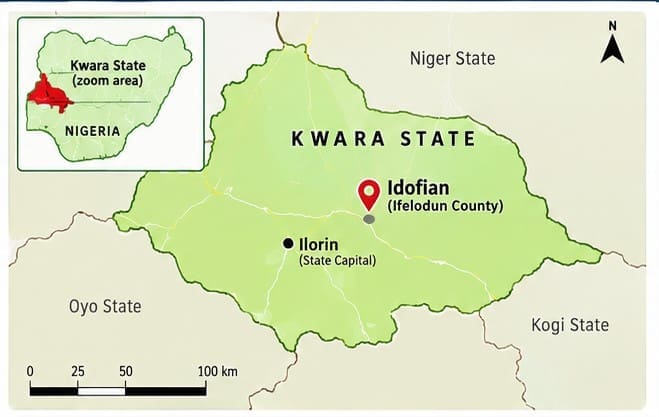
IDOFIAN, Nigeria — More than 100 vulnerable residents remain scattered across Kwara four months after a midnight security warning forced them from a church-run community, leaving a school, hospital, orphanage and rehabilitation centre abandoned.
The residents have not returned to the Word Assembly Ministries camp in Idofian, north of Ilorin, after police warned on May 31 that kidnappers were preparing to attack.
The Guardian reported that armed attackers arrived shortly after the evacuation but found the facility empty. The property was later looted.
The camp housed orphaned children and staff and operated schools, a hospital, an old people’s home and a rehabilitation centre for women rescued from the streets with their children.
A Community Left Behind
Analysts said Idofian should not be treated as an isolated church evacuation.
“What happened in Idofian should not be viewed as an isolated evacuation of a church facility. It is an illustration of a much wider displacement crisis affecting Christian communities across the Middle Belt,” Dr. Olusesan Omoago, an evangelist and public affairs analyst based in Ilorin told TruthNigeria.
Omoago added: “The real tragedy is that displacement can become permanent. Four months after these people were evacuated, they are still scattered, the facility remains closed and essential services have stopped.”
Three-Part Pattern
Omoago told TruthNigeria that Idofian fits a broader pattern involving three linked consequences of violence: killing and abduction, economic destruction through ransom demands, and displacement without an effective route home.
“The first component is the killing or abduction of people. The second is the economic destruction that follows when families are subjected to ransom demands, lose their livelihoods or sell their property to secure the release of relatives. The third is displacement, because once communities become too dangerous to inhabit, people flee and often have no realistic pathway back home.” Omoago explained to TruthNigeria.
Kwara’s Ifelodun County provides recent examples.
On March 22, eight worshippers were abducted during a Sunday service at an ECWA church in Omugo. Three later escaped, while TruthNigeria reported in June that five others died in captivity.
The kidnappers initially demanded ₦1 billion, about $756,748. The following day, March 23, two community-appointed guards were killed near Oro-Ago.
Those incidents do not establish that the same armed group carried out every attack. But they show the security environment surrounding rural communities in Ifelodun.
From Attack To Displacement
“Since we left Idofian, I have slept in my brother’s shop. My children stopped school. I cannot farm or feed them. We need security to return,” Elder Francis Obabiolorun, a displaced Idofian resident, told TruthNigeria in a telephone chat.
“You are looking at a pattern in which violence removes people from their homes, kidnapping drains the resources of surviving families and insecurity prevents displaced people from returning,” Omoago told TruthNigeria.
Omoago said some Christian leaders and observers describe the pattern as part of a wider campaign of Christian persecution or genocide, but stressed that genocide has a specific legal meaning.
“I would describe it as part of what many Christian leaders and observers increasingly characterize as a genocidal pattern against indigenous Christian communities by Fulani Ethnic Militia, particularly where the violence combines killing, forced displacement and the destruction of the economic and social conditions necessary for communities to survive,” Omoago explained.
Government’s Return Test
For Omolehin and the displaced residents, the question is no longer why they fled on May 31. It is when, and under what conditions, they can return.
Omolehin said he contacted the police, the Department of State Services and the Kwara State Ministry of Social Welfare but received no official clearance indicating when the facility will be safe enough to reopen.
The Guardian reported that the camp has remained deserted since the evacuation and that Omolehin has appealed to the Federal and Kwara State governments to provide security for the residents’ return.
“Once government authorities issue a credible security warning that causes people to abandon a community, the government has a responsibility that goes beyond the warning,” Omoago said to TruthNigeria.
A Safe Return
“The people need more than assurances. They need to know who is responsible for their security, what has changed since May 31 and what mechanism exists to respond if another threat emerges.” Colonel Mudi Attaihiru retired, security analyst based in Birnin Kebbi told TruthNigeria.
Attaihiru added that authorities should conduct a credible security assessment, provide sustained protection and establish a formal return plan with displaced families and church authorities.
Bishop Sunday Adewole, chairman of the Christian Association of Nigeria in Kwara State in a telephone chat with TruthNigeria reporter called for stronger government action, including security, resettlement, housing and livelihood support for displaced Christians.
For the Idofian residents, rebuilding cannot begin until there is somewhere safe to return.
Four months after a midnight warning emptied their community, more than 100 people remain scattered while a school, hospital, orphanage and rehabilitation centre stand unused.
Idofian offers a local window into a larger national Middle Belt problem: when violence drives communities from their homes, the consequences can continue long after the immediate threat has passed, leaving displacement itself as an unresolved part of the security crisis.
Onibiyo Segun reports on terrorism and conflict(s) for TruthNigeria.