Terrorists overrun military outposts, kill soldiers, abduct civilians, and force hundreds of Christian villagers into a night‑time flight toward Gombe as insurgents push out from the Kopre–Sambisa corridor.
By Suleman Ayuba
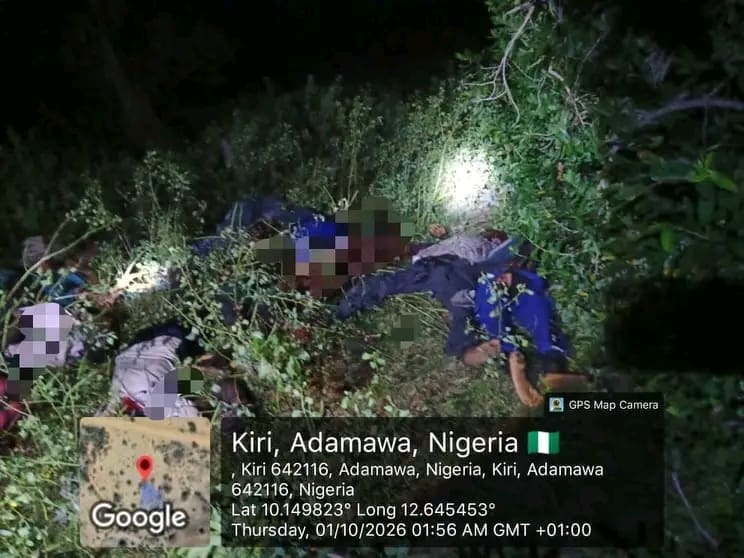
MAIDUGURI, Nigeria — Nigeria’s 66th Independence Day was plunged into chaos as Boko Haram terrorists launched coordinated overnight assaults on military outposts across Adamawa State, killing soldiers and a forest guard, abducting women and children, and forcing hundreds of terrified villagers to flee toward Gombe. The attacks, striking Hong and Gombi counties between September 30 and October 1, underscore the insurgents’ renewed momentum from the Kopre–Sambisa axis and the widening vulnerability of Christian communities trapped along the forest corridor.
The human tumult unfolded in the dark on the eve of Independence Day. In Hong County, terror struck the 232 Battalion military outpost in Garaha-Mojili around midnight on September 30. Gunmen breached the area with speed and overwhelming force. Dr. Aliyu Yerima Sa’ad Hong, Chairman of Hong County, confirmed that three soldiers and a forest guard were killed during the fierce confrontation, while ten heavily wounded soldiers were rushed to the Federal Medical Centre in Hong.
Before retreating into the bush, the assailants abducted two women. Concurrently, nearby Dakna in Dugwaba District—located just kilometers from the Sambisa Forest boundary—was raided, where terrorists seized two more women and an eight-year-old child.
By October 1, in Zangula, a Christian village in Guyaku Ward, Gombi Local Government Area, Boko Haram terrorists advanced directly from the Kopre mountain forest corridor, causing complete panic. Exhausted mothers, frightened children, and the elderly were forced into a grueling 25-to-35-kilometer trek on foot from the Guyaku Ward cluster—encompassing Guyaku, Balhona, Dongo, and Kwalamba—seeking refuge in Gombi town.
Markus Ishaya, a trader from the Boima general area who witnessed the intense fighting, described the sheer terror: “We thought we were finally getting peace, but the night was shattered by continuous heavy gunfire and explosions. The terrorists arrived using backtracks, striking with speed and surprise before disappearing into the bush. Even though the soldiers fought bravely, three of our fine young officers paid the ultimate price. We are living in constant fear; these insurgents are changing their patterns, sneaking past major roads, and striking when everyone expects quiet.”
See video from the attacked region.
The onslaught represents a calculated, asymmetric campaign designed to probe defense lines, inflict maximum psychological fatigue, and exploit isolated outposts. Sector 4 has turned into a lethal proving ground. Official military statements confirmed that while troops at the 226 Battalion in Garkida and 232 Battalion in Garaha responded with heavy firepower, the casualty count among security personnel paints a sobering picture of Boko Haram’s residual operational elasticity.
Zagazola Makama, a security analyst and counter-insurgency expert on the Lake Chad region, assessed the Independence Day clashes as clear evidence that insurgents are actively testing military lines despite ongoing joint degradation operations. Commenting on the September 30–October 1 engagements, Makama noted that troops of Operation HADIN KAI (OPHK) neutralised multiple terrorists and repelled coordinated attacks across Adamawa State. At approximately 5:30 a.m. on October 1, after soldiers spotted about 16 terrorists and 15 motorcycles concealed under a dense tree canopy in the Boima area, an air interdiction was launched. The precision strike recorded a direct hit, scattering the surviving insurgents.
Speaking on behalf of the military, Captain Mohammed Goni, Acting Military Information Officer for Headquarters Joint Task Force (North East) Operation HADIN KAI, confirmed the sequence of events in a statement shared on Facebook. Goni stated that ground troops conducted a well-coordinated ambush in Boima, neutralising 16 terrorists and recovering three AK-47 rifles, two pump-action rifles, one Dane gun, six AK-47 magazines, and belts of ammunition, as also reported by Stone Reporters News and Rismadar Voice. However, Goni acknowledged the heavy price paid during the defense of Garkida and Garaha: “Regrettably, three brave soldiers paid the supreme sacrifice during the fierce battle, while wounded personnel were swiftly evacuated and are currently in stable condition.” Goni added that Headquarters Theatre Command is currently undergoing structural reorganization to improve joint air-and-ground integration and deny terrorists freedom of action, according to Spye TV.
Despite official assurances, academics and security experts from the Nigerian Army University Biu warn that a purely defensive posture leaves frontline units as static targets for sudden ambushes. Experts urge military leadership to move away from locked positions and aggressively flush out terrorist enclaves deep within the hinterlands.
The strategic geography explains the persistent threat. The Kopre Mountain Forest links directly into the expansive Sambisa Forest, which spans across Borno, Adamawa, Yobe, Gombe, and Bauchi along the Darazo corridor. This vast network serves as a permanent staging ground for raids on surrounding communities. Though the Army raided a Boko Haram/ISWAP camp in Kopre in August, killing 21 insurgents, the terror cells continually regenerate. Just weeks prior, on September 13, twelve villagers were murdered and a schoolgirl was abducted during a night raid on Nzangola village, where an EYN Church was burned to the ground.
Compounding the crisis, Hong and Gombi counties now face a devastating triple siege. On September 24, Fulani ethnic militias struck Lar Garha ward in Hong, burning an LCCN church and destroying local homes. Trapped between armed ethnic militias, Boko Haram, and ISWAP, indigenous Christian villagers face systematic displacement and loss of ancestral lands. As Inspector Supol Ghaida G Emthe told TruthNigeria, defeating this evolving campaign requires converting defensive resilience into an uninterrupted, sustained offensive before the region falls entirely under insurgent dominance.
Suleman Ayuba is a conflict reporter for TruthNigeria.